
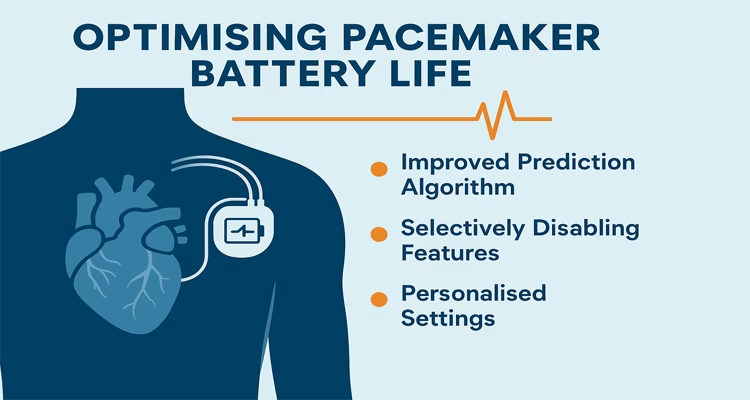
News Desk: A European research team has developed an advanced algorithm that can dramatically extend the lifespan of pacemaker batteries by identifying and switching off unnecessary device functions based on a patient’s individual medical needs.
Researchers from the University of Leeds, Université Grenoble Alpes, and the University Hospital of Grenoble-Alpes have created a modelling tool that analyses different pacemaker features to determine which ones drain the most power. Because pacemakers typically last only seven to 14 years depending on feature usage, selectively disabling non-essential functions could add several more years of operation—reducing the need for replacement surgeries and easing the financial burden on healthcare systems such as the NHS.
“This represents an initial step toward enabling clinicians to select the most appropriate pacemaker and optimise its settings to deliver the required performance and battery longevity for each patient,”
said Dr. Klaus Witte from the University of Leeds School of Medicine.
The findings have been published in PLOS One in a paper titled “Cardiac implantable electronic devices’ longevity: A novel modelling tool for estimation and comparison.” The tool is freely available through open access, allowing cardiologists worldwide to use it for clinical decision-making.
Dr. Witte, who also serves as a Consultant Cardiologist at Leeds Teaching Hospitals NHS Trust, added:
“This is an important first step in determining which device and settings best suit each patient’s needs. Ideally, it will delay—or potentially eliminate—the need for battery replacements, benefiting patients, the NHS and society more broadly.”
Professor Pascal Defaye of Université Grenoble Alpes highlighted the real-world relevance of the project:
“This approach is unique because it draws on real-world data and enables direct comparisons across devices, features and manufacturers.”
How pacemakers work
A pacemaker is a small implanted electronic device that helps regulate heart rhythm. Containing a battery and microcomputer within a small metal casing, it is positioned under the skin near the collarbone. Wired leads then connect to the heart through blood vessels, allowing the device to monitor heartbeats and deliver electrical impulses when necessary—such as when the heart slows or skips a beat.
Modern pacemakers offer a wide range of advanced features, including:
-
correcting slow heart rates
-
coordinating heart chamber timing
-
adjusting heart rate during exercise
-
recording activity and rhythm patterns
-
enabling remote monitoring
However, most patients do not require the full suite of available functions.
What the researchers did
The research team examined technical specifications and battery consumption data from manufacturer manuals. They then used computer simulations to model energy use across different pacemaker settings and clinical scenarios. The simulations were later confirmed with real patient data.
The analysis revealed:
-
which functions consume the most energy
-
how various settings influence total battery life
-
how many additional years can be gained by disabling specific features
Toward personalised cardiac care
Cardiologists currently rely heavily on manufacturer-provided guidance when selecting pacemakers. However, the sheer diversity of models and options often makes prediction difficult.
As Dr. Witte explained:
“We often don’t know exactly how different options affect battery life. By discussing which features are essential and which are simply ‘nice to have,’ doctors and patients can weigh the battery cost of each function. Selecting the right device and settings is similar to choosing a car—deciding which features are necessary and which can be skipped.”
The research team also included French collaborators: Pascal Defaye (University Hospital of Grenoble-Alpes), Serge Boveda (Clinique Pasteur), and Jean-Renaud Billuart from industry partner Microport.
This innovation marks a major move toward personalised pacemaker configuration—improving patient outcomes, lowering costs, and contributing to a more efficient and sustainable cardiac care system.