
Maguni Charan Behera
Chief Editor, Sampratyaya (www.sampratyaya.com)
Email: sampratyaya.ijr@gmail.com
History often moves like Fortuna’s wheel—turning unpredictably, lifting some powers while revealing the vulnerabilities of others. Yet within this cycle of shifting fortunes, few international relationships have displayed the steadiness and mutual confidence that define India–Russia ties. As President Vladimir Putin arrives in India once again, his visit is not a mere diplomatic formality; it symbolizes a partnership built through decisive moments, strategic instinct, and an unusual emotional warmth that has endured ideological shifts and global realignments.
At the heart of this understanding stand Prime Minister Narendra Modi and President Vladimir Putin—leaders who, despite navigating altered geopolitical landscapes, retain a personal rapport marked by candour, clarity, and strategic maturity. Their equation reflects a deeper truth: India’s connection with Russia is not an episodic transactional arrangement but a civilisational continuity expressed through modern strategic engagement.
In contrast, India’s relationship with the United States—despite its dynamism in technology, trade, and people-to-people ties—has been clouded by hesitation, inconsistency, and moments when Washington’s actions sharply contradicted India’s core security interests. From Cold War realpolitik to post-9/11 shifts and more recent sanction-driven pressures, American behaviour has repeatedly reminded New Delhi of the limits of U.S. reliability.
Against this backdrop, the Modi–Putin meeting stands as a reminder that in international relations, trust—cultivated over time, tested through crises, and sustained across changing global circumstances—remains the most valuable currency.
A Visit that Reaffirms Continuity
Putin’s visit once again directs global attention to a partnership that has outlasted decades of turbulence and emerged as one of the world’s most stable bilateral relationships. In a domain where alliances often shift with the unpredictable turns of Fortuna’s wheel, India and Russia have carved out a space of exceptional steadiness.
The personal equation between Modi and Putin has become a symbol of this continuity. Despite dramatic transformations—from the brief American unipolar moment to today’s fractured multipolarity—their relationship reflects long-term trust, mutual respect, and a shared belief that each nation’s strategic interests are strengthened by the other’s stability.
Putin’s current visit is thus not ceremonial. It reaffirms a strategic compass that has guided both nations through the Cold War, the unipolar 1990s, the post-Crimea sanctions era, and the emerging contestations of the Indo-Pacific. It provides an appropriate moment to revisit the foundations of India–Russia ties—civilisational warmth, overlapping geopolitical instincts, defence and energy cooperation, and cultural affinities—while contrasting them with the inconsistent record of the United States, particularly the erratic behaviour displayed during the Trump presidency.
Modi–Putin Chemistry: A Rare Trust in World Politics
The Modi–Putin equation is one of the most stable and dependable leader-level relationships in contemporary global politics. They have met more frequently than with most other foreign leaders, and their discussions are marked by ease, candour, and strategic clarity.
What stands out is:
- Absence of public disagreements
- Continuity of long-term projects
- No coercive tactics or transactional conditionalities
This stability rests on a seven-decade foundation of industrial cooperation, strategic alignment, cultural familiarity, and public goodwill—elements that cannot be manufactured overnight.
Russia’s Reliability in India’s Toughest Moments
India’s confidence in Russia is rooted in experience, not sentiment. Time and again, Russia has stood with India during moments of existential challenge, while other major powers—especially the United States—adopted ambiguous or adversarial positions. These episodes shaped India’s strategic memory, reinforcing Russia’s image as a dependable partner whose support helped preserve India’s autonomy.
A Partnership Rooted in Autonomy and Mutual Respect
During the Cold War, when the world was divided into rigid blocs, the Soviet Union respected India’s non-alignment and allowed it sovereign decision-making space. Moscow never demanded ideological conformity. This early respect for autonomy laid the psychological foundation of the modern India–Russia relationship.
1971: The Moment That Sealed the Friendship
The Bangladesh Liberation War remains the decisive turning point in India–Russia relations. At a moment when the United States and China tilted toward Pakistan and overlooked the humanitarian catastrophe unfolding in East Pakistan, India turned to the Soviet Union for diplomatic and strategic support.
The Indo–Soviet Treaty of 1971 provided the security umbrella India needed, while the Soviet naval presence in the Indian Ocean acted as a deterrent when the USS Enterprise sailed into the Bay of Bengal. This episode entered India’s collective memory as irrefutable proof that Russia stands by India when it matters most.
Russia and India’s Industrial Rise: Foundations of Modern Power
The Soviet Union played an extraordinary role in building India’s industrial base. It helped establish major steel plants such as Bhilai, Bokaro, and Visakhapatnam; supported the growth of heavy engineering and machine tools industries; and strengthened institutions like Bharat Heavy Electricals (BHEL).
Soviet scientists and engineers collaborated closely in the early stages of India’s space and nuclear programmes, while academic and technical institutions benefited immensely from knowledge transfer. These were long-term partnerships that shaped modern India’s industrial and technological foundations far beyond transactional exchanges.
Friendship Beyond the Soviet Collapse
Even during Russia’s difficult years in the 1990s, India did not distance itself. Instead, it deepened the partnership — culminating in the 2000 Declaration on Strategic Partnership, and later its elevation to a “Special and Privileged Strategic Partnership.”
This continuity reflects the depth and resilience of the relationship, which has consistently weathered global realignments.
Cultural Warmth That Outshines Geopolitics
Unlike many of India’s relationships with Western nations, the India–Russia relationship carries an emotional and cultural warmth rooted in literature, cinema, philosophy, and intellectual exchange — a bond that extends well beyond statecraft.
Literature, Philosophy, and Shared Moral Imagination
Russian literature profoundly influenced Indian readers. The works of Tolstoy, Dostoevsky, Gorky, Pushkin, and Turgenev resonated deeply with Indian philosophical traditions exploring morality, human suffering, justice, and the search for meaning.
Gandhi’s correspondence with Tolstoy shaped significant aspects of his moral and political ideas.
Russian scholars of Indology produced pioneering work on Sanskrit, Vedic texts, Indian philosophy, and Pali literature — scholarship still globally respected.
These intellectual connections fostered a shared moral imagination that few countries have achieved with India.
Cinema, Emotions, and People-to-People Affinity
Indian cinema enjoyed extraordinary popularity in the Soviet Union. Raj Kapoor, Nargis, and later Mithun Chakraborty became cultural icons, and Bollywood films created emotional closeness that transcended politics.
Even today, yoga, Ayurveda, Indian devotional music, and Bollywood dance attract large audiences in Russia. These ties create a cultural intimacy rare in international relations.
Civilisational Parallels Without Myth-Making
Despite occasional claims of ancient racial or linguistic links, the real strength of India–Russia civilisational parallels lies in shared values, not invented myths.
Both societies place high value on spirituality, introspection, cultural resilience, and respect for poets and philosophers. Both are sceptical of hegemonic power and favour a balanced, multipolar world.
These tendencies foster civilisational comfort without exaggeration.
Defence: The Steel Spine of the Partnership
If cultural ties offer emotional depth, defence cooperation forms the strongest structural pillar of India–Russia relations.
For over sixty years, Russia has been India’s most reliable defence partner.
- The backbone of the Indian Air Force — MiG and Sukhoi aircraft — is Russian in origin.
- The jointly developed Su-30MKI exemplifies trust and deep cooperation.
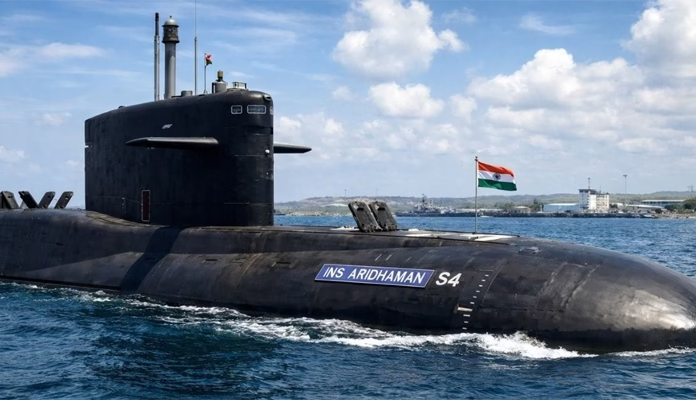
- Russia supported India’s nuclear submarine programme and provided INS Vikramaditya.
- The BrahMos missile system is a standout symbol of high-end defence collaboration.
- Nuclear cooperation — including the Kudankulam project — further strengthens the partnership.
Unlike the United States, Russia has never tied defence cooperation to political conditions, sanctions, or intrusive monitoring. India sees Russia as a predictable, long-term partner in national defence.
Energy, Economy, and the Evolution of Strategic Cooperation
While economic ties long lagged behind defence, they accelerated significantly after 2022.
Russia became one of India’s largest crude oil suppliers, offering stable contracts and competitive prices, reducing India’s dependence on the Middle East. Trade expanded in pharmaceuticals, diamonds, fertilisers, and civil aviation.
Both nations are exploring new frontiers:
- Cooperation in the Arctic
- The International North–South Transport Corridor
- The Chennai–Vladivostok maritime route
- Increasing use of national currencies to reduce exposure to geopolitical financial pressures
India–U.S. Relations: Necessary but Inconsistent
India values its partnership with the United States — especially in technology, education, and global governance. Yet the relationship has often been marked by fluctuations, unpredictability, and frequent contradictions with India’s core interests.
These inconsistencies stand in sharp contrast to the steadiness of Russia’s engagement.
U.S. Betrayals: A History India Cannot Ignore
India’s experience with the United States includes multiple episodes of distrust:
- American arms supplied to Pakistan were used against India in 1965, 1971, and during Kargil.
- The U.S. imposed an arms embargo in 1965, which harmed India more.
- During the 1971 crisis, the U.S. sent the USS Enterprise toward India — an openly hostile act.
- After India’s peaceful 1974 nuclear test, the U.S. led global efforts to deny India nuclear and high-technology access.
- Sweeping sanctions followed the 1998 tests.
These actions reinforced the perception that U.S. support is transactional and reversible.
America’s Policy Volatility Across Decades
U.S. policy toward India has repeatedly oscillated:
- From countering the Soviet Union
- To fighting terrorism
- To managing China
- This constant recalibration has made long-term strategic consistency difficult.
Afghan Jihad and Its Long Shadow on India
U.S. support for Pakistan during the 1980s Afghan jihad empowered extremist networks that later targeted India, particularly in Jammu and Kashmir. The consequences of this policy still affect India’s security landscape.
Nuclear Denials, Sanctions, and Strategic Hypocrisy
Despite India’s responsible nuclear posture, the United States pursued punitive actions. Selective non-proliferation policies revealed deep hypocrisy and disregard for India’s sovereign choices.
Domestic Interference and Technology Barriers
U.S. commentary on issues such as CAA, farmers’ protests, and Jammu and Kashmir is perceived as intrusive. Technology transfer barriers persisted for decades despite claims of strategic partnership.
Trump-Era Unpredictability and Tariff Diplomacy
Sudden visa restrictions, tariff hikes, public criticisms of India, and pressure tactics on medical exports created further uncertainty. These episodes reinforced the belief that U.S. policy is often driven by impulsive, short-term considerations.
Why Russia Is Trusted in a Way the U.S. Is Not
Russia has never:
- threatened sanctions
- interfered in India’s domestic affairs
- used economic coercion
- withheld critical technology for political reasons
- It has consistently respected India’s sovereignty, supported India in crises, and treated India as an equal.
This combination of strategic steadiness and emotional warmth has built a level of trust the U.S. has not matched.
Modernising an Old but Enduring Partnership
The India–Russia partnership must evolve to reflect contemporary realities, with new areas of cooperation that meet 21st-century challenges.
High-Tech, Connectivity, and Eurasian Strategy
The future trajectory lies in collaboration across:
- Artificial intelligence
- Quantum computing
- Cybersecurity
- Space exploration
- Hypersonic systems
- Advanced materials
- Connectivity initiatives such as the North–South Corridor, the Chennai–Vladivostok route, and Arctic shipping lanes will shape Eurasian integration. Cultural diplomacy, university partnerships, language centres, and research institutions will deepen societal links.
Russia remains indispensable to India’s continental strategy — from Central Asia to the Arctic, Afghanistan, and West Asia.
A Relationship That Outlasts Storms and Power Shifts
Across seven decades, India and Russia have sustained a partnership that has survived ideological conflicts, geopolitical realignments, the Soviet collapse, the rise of China, the U.S. unipolar moment, and contemporary global turbulence.
India will continue multi-alignment with the U.S., Europe, Japan, ASEAN, and the Gulf. But its relationship with Russia occupies a unique space — historically tested, strategically vital, emotionally warm, and essential for a multipolar world.
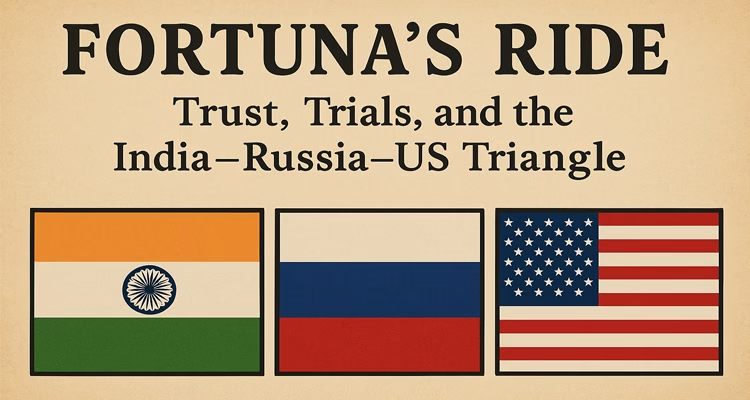
The Strategic Triangle: India–Russia–U.S.
In this evolving triangle, the United States enters as the restless, unpredictable arm — powerful yet lacking the civilizational rootedness that grounds India and Russia. In contrast, ties between India and Russia draw strength from deep historical memory, cultural comfort, and strategic steadiness.