News Desk: A fresh trade flare-up between India and the United States may be on the horizon after U.S. President Donald Trump hinted at imposing new tariffs on agricultural imports — particularly rice from India and fertiliser from Canada — during a White House meeting on Monday.
The remarks came as Trump unveiled a $12-billion farm relief package aimed at shielding American farmers from falling commodity prices. The President sharpened his criticism of low-priced imports from India and other Asian suppliers, suggesting that “dumped” agricultural goods were hurting U.S. producers.
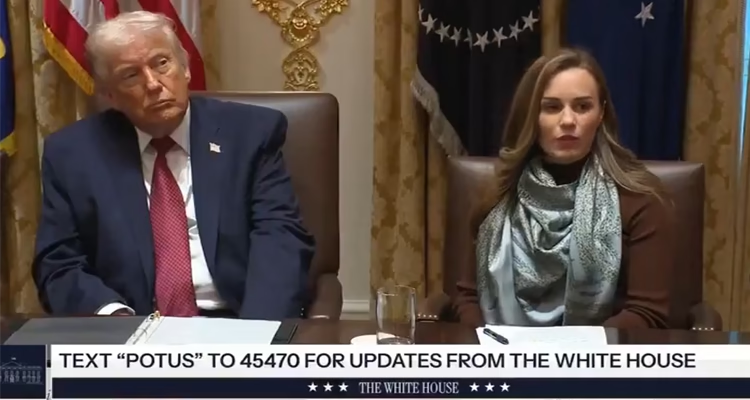
President Trump Participates in a Roundtable https://t.co/L64lyrYlZ1
— The White House (@WhiteHouse) December 8, 2025
Farmers Push Trump to Act Against ‘Dumped’ Rice
During the meeting, attended by Agriculture Secretary Brooke Rollins and lawmakers from key farm states, several farmers urged Trump to take a tougher stance on foreign rice.
Meryl Kennedy, CEO of Louisiana-based Kennedy Rice Mill, alleged that countries such as India, Thailand and China had been “dumping rice” into the U.S. and its territories at below-market prices.
“India, Thailand, even China into Puerto Rico… We haven’t shipped rice there for years,” Kennedy told Trump, urging him to “double down” on tariffs.
Responding to her concerns, Trump questioned why India was “allowed to do that”, turning to Treasury Secretary Scott Bessent and asking whether New Delhi enjoyed any tariff exemptions. Bessent replied that no such exemption existed and that the U.S. was still negotiating a trade package with India.
Trump then shot back:
“They should not be dumping… They cannot do that.”
Why This Matters: India Dominates Global Rice Trade
India is the world’s largest rice producer, accounting for nearly 28% of global output, according to the Indian Rice Exporters Federation (IREF). It is also the top exporter, holding more than 30% of the global export market in 2024–25.
The United States, meanwhile, is a net importer of several specialty rice varieties, including basmati.
#WATCH | Delhi | On US President Donald Trump’s statement on Indian Rice export, Vice President of the Indian Rice Exporters Federation, Dev Garg says, “… All the exports of the US market are demand-driven… We have seen that there has been an increasing trend in Indian rice… pic.twitter.com/MdbNN1XI2Z
— ANI (@ANI) December 9, 2025
Prem Garg, National President of the Indian Rice Exporters Federation, had described the 25% retaliatory tariff as only a temporary “hurdle” for rice shipments, noting that India continues to enjoy a strong pricing edge over competitors such as Vietnam and Pakistan.
Washington-based trade analysts note that U.S. farm lobbies have repeatedly accused India of distorting the global market through subsidies under its Minimum Support Price (MSP) system. A 2023 U.S. International Trade Commission report argued that India’s support prices and export volumes had contributed to global oversupply and price depression.
Understanding the Dumping Charge
Rice dumping refers to foreign exporters selling rice at artificially low prices in another market, harming local producers. U.S. farm groups claim Indian exporters — supported by MSP and stockpiling policies — have been able to sell rice abroad at rates American farmers cannot match.
Kennedy told Trump that rice dumping had been happening “for years”, but that the scale had “grown significantly in recent years.”
A New Trade Flashpoint
Trump’s latest remarks add to the long list of bilateral trade friction points between India and the U.S. — from digital taxes and steel tariffs to dairy and agricultural market access.
If Washington proceeds with fresh duties on Indian rice, it could trigger retaliatory steps from New Delhi, setting the stage for another U.S.–India mini trade war.
Indian officials have not yet issued a formal response, but trade experts warn that higher U.S. tariffs may disrupt rice shipments and complicate ongoing negotiations for a broader trade settlement.