

Ajay Kumar, Senior Journalist
Lucknow (U.P.)
Until barely two days ago, the global community spoke in one voice against Islamic terrorism. World leaders delivered speeches from prominent platforms, invoking humanity, peace, and civilization. Yet today, that same world stands conspicuously silent as Hindus bleed in Bangladesh. Institutions that proclaim themselves guardians of human rights appear unmoved, as though nothing of consequence has occurred.
What is unfolding in Bangladesh is not merely internal turbulence in a neighbouring country. It exposes a deeper malaise: selective outrage and ideological hypocrisy that the world prefers not to confront.
From Protests to Mob Violence
The situation spiralled after the death of radical leader Sharif Usman Hadi. What began as street protests soon degenerated into violent mob action. In Dhaka and other cities, arson and vandalism spread rapidly. Media houses were attacked, government property was torched, and anti-India slogans echoed openly. This was not a sudden eruption; it was the release of a long-fostered extremist mindset.
⚡🇧🇩 Yesterday in #Bangladesh, radical #Islamists brutally murdered a Hindu youth named Dipu Chandra in Mymensingh on allegations of religious blasphemy.
Yet these incidents will not catch the attention of human rights bcz he was a Hindu. @meeganguly @pavanbadhe pic.twitter.com/qbkmU7F6zl
— Bangladeshi Hindus Community🚨🇧🇩 (@Hindubd49346) December 19, 2025
A Lynching That Shook Conscience
The most horrifying episode emerged from Mymensingh district. A young Hindu man, Dipu Chandra Das, was encircled by a mob, brutally assaulted, and killed. The savagery did not end there. His body was tied to a tree, dragged onto the road, and set ablaze. This was not merely a murder—it was a declaration by an extremist mob that it stood above law, constitution, and basic humanity.
Silence on Human Life, Statements on Buildings
One would expect such barbarity to provoke swift international condemnation. Instead, there was near-total silence. Western governments and global rights bodies offered no stern warnings, no urgent statements. The message seemed unmistakable: the killing of a Hindu did not merit outrage.
Ironically, when media offices in Dhaka were attacked, concern for press freedom poured in promptly. Offices of Prothom Alo and The Daily Star were vandalised and set on fire, prompting reactions from Western media organisations. Such concern is legitimate—but it raises a disturbing question. Are buildings and institutions more valuable than human life? Why did voices fall silent when a Hindu was burned alive just kilometres away?
Fear Among Minorities
Bangladesh’s interim government did condemn the killing and promised action, with a few arrests reported. Yet fear persists on the ground. The Hindu community feels increasingly unsafe. Attacks on Hindus, destruction of temples, and episodes of forced migration are not new in Bangladesh. What sets this moment apart is the extreme cruelty on display.
When Sport Turns Political
Amid this unrest, another development triggered outrage in India. The Bangladesh Cricket Board paid tribute to Sharif Usman Hadi—a figure associated with anti-India politics and linked to the controversial “Greater Bangladesh” map that includes India’s northeastern states. When national institutions honour such figures, it compels India to ask whether engagement can continue with eyes closed.
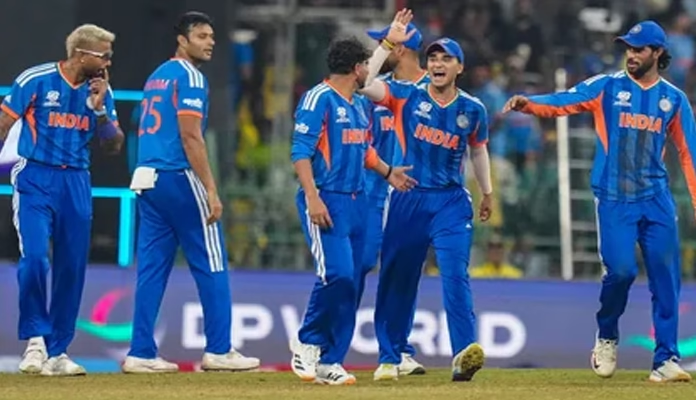
The debate soon spilled into cricket and the IPL. It intensified after Kolkata Knight Riders signed Bangladeshi pacer Mustafizur Rahman for a substantial sum. Defenders argue that sport should remain above politics. But that argument weakens when sporting bodies themselves send political signals. Past controversies over the player’s social media activity critical of India add to the unease. The question is unavoidable: should India reward individuals and institutions that harbour or amplify anti-India sentiment?
A Question of Consistency
Social media today reflects public anger. People ask why anti-India slogans on Bangladeshi streets, the killing of Hindus, and the glorification of hostile narratives have not elicited a firm response from the Board of Control for Cricket in India or the Indian Premier League. Will India’s resolve remain confined to speeches, or will it translate into action?
India severed sporting ties with Pakistan to send a clear message. If a similar ideological hostility is taking root in Bangladesh, should New Delhi apply a different standard?
A Warning for the Region
What is happening on Bangladesh’s streets is a warning for South Asia. Extremism does not discriminate in the long run—it devours humanity wherever it gains ground. Today Hindus are the target; tomorrow it could be someone else. That is why an honest, unbiased fight against ideological terror is imperative.
The world must recognise that Islamic extremism is not a threat only to Jews or Western societies. It endangers Hindus and Asian nations just as gravely. The murder of one Hindu is an assault on humanity itself. Until this truth is accepted, sermons on human rights will ring hollow.
India now stands at a crossroads. The response must be firm, strategic, and rooted in policy—not emotion. Friendship is meaningful only when it is reciprocal. Those who nurture hostility towards India must be told unambiguously: India will no longer remain silent. The moment demands it—and India’s national interest requires it.