
 Prof. (Dr.) Manmohan Prakash
Environmentalist and Independent Journalist
Pollution today is no longer merely an environmental issue; it has emerged as a decisive fault line affecting human health, social equilibrium, and even the survival of civilization itself. According to the World Health Organization’s 2023 data, air pollution caused nearly 6.8 million premature deaths worldwide, with India accounting for over 20 percent of this toll. This crisis is not limited to a few cities or regions—it has assumed the proportions of a national disaster.
The irony is striking. Environmental pollution is taught in textbooks, debated in academic seminars, discussed in Parliament, and addressed through periodic pledges. Yet genuine and sustained improvement in public behavior remains largely absent. Data released by the Central Pollution Control Board (CPCB) in 2024 reveal that 31 out of 39 major Indian cities recorded an Air Quality Index (AQI) exceeding 300, placing them in the “severe” category. It is an undeniable truth that pollution of air, water, land, and even sound is largely the direct or indirect outcome of human activity. Despite this reality, citizens, leadership, and institutions often appear indifferent to the warning signs, long-term consequences, and future risks posed by unchecked pollution.
Over the past few decades, the social influence of politicians, film stars, sportspersons, social media influencers, YouTubers, religious leaders, media anchors, entrepreneurs, academicians, and scientists in India has increased substantially. Numerous social studies indicate that public awareness campaigns supported by such influential personalities have a 30 to 50 percent—or even higher—chance of success, as they possess the power to shape public thinking and behavior. Ideally, such engagement should be viewed as a social responsibility rather than an avenue for economic or promotional gain. While some individuals have stepped forward in this direction, their numbers remain negligible in a country with a population as vast as India’s.
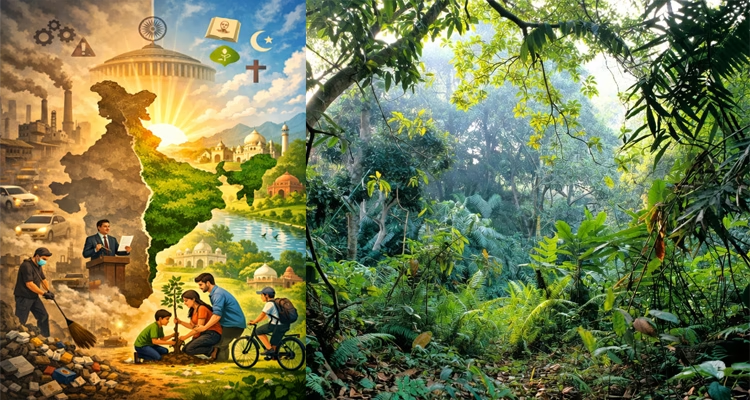
The success of the Swachh Bharat Abhiyan has demonstrated that meaningful behavioral change is possible when political will, administrative commitment, and public participation converge. On similar lines, if a “Pollution-Free India Mission” is implemented in practice—with robust policy frameworks, strong legislation, and committed leadership—and if environmental protection norms move beyond rulebooks to streets, neighborhoods, and households, a profound transformation in public behavior can certainly be achieved.
In Indian tradition, religion is not merely a system of worship; it is a way of life. The Rig Vedic mantra “Mātā bhūmiḥ putro’ham pṛthivyāḥ” declares humans to be responsible children of the Earth. The Prithvi Sukta of the Atharvaveda emphasizes balance among the five great elements (pañchamahābhūtas) as the foundation of life. Rivers are revered as mothers, trees are worshipped as divine, and mountains are held sacred. The Jain principle of ahimsa extends compassion and protection to all living beings. Buddhism’s Middle Path promotes restraint from blind consumption and excessive exploitation of natural resources. In Sikhism, Guru Nanak Dev’s words—“Pavan Guru, Pani Pita, Mata Dharat Mahat”—teach responsible and familial conduct toward nature. In Islam, the Earth is described in the Qur’an as a trust from Allah, while Christian teachings regard the protection of creation as a form of service to God.
It is evident that all major religions carry clear and powerful messages advocating environment-friendly conduct. Yet a deep gap persists between religious belief and everyday practice. There is an urgent need for religious leaders across faiths to integrate themes of environmental protection, cleanliness, water conservation, and tree plantation into their sermons, festivals, and public engagements. If it is clearly communicated from platforms of faith that human-induced pollution is not only against nature but also contrary to religious values, the impact can be wide-ranging and enduring.
The warning issued by the Intergovernmental Panel on Climate Change (IPCC) in 2023 must also be taken seriously. The report cautions that if pollution and the climate crisis are not brought under control, India’s GDP could decline by nearly 2.8 percent by 2050. Millions may suffer from pollution-related diseases, premature deaths, and a significant deterioration in quality of life. The damage inflicted on flora, fauna, and entire ecosystems may prove irreversible.
This, therefore, is not merely a moment for expressing concern—it is a call for decisive and collective action. If clear direction from policymakers, sincere initiative from leadership, strict administrative enforcement, the moral force of faith, and cooperation from public conscience all become active simultaneously, the vision of a pollution-free India can move beyond rhetoric and become a living reality.