 by Dr. Vinod Chandrashekhar Dixit
Ahmedabad
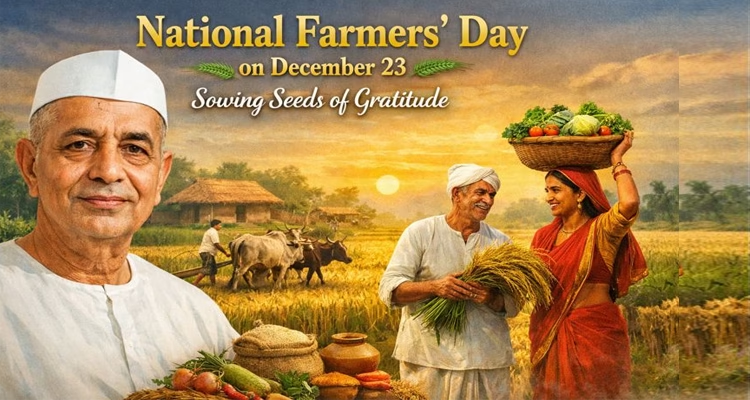
National Farmers’ Day, observed every year on December 23, is a moment of collective gratitude for the millions of farmers whose labour sustains India’s economy and food security. The day marks the birth anniversary of Chaudhary Charan Singh, a leader revered as Kisanon ke Neta—the farmers’ leader—whose life and politics were rooted in the soil of rural India.
Born into a peasant family, Charan Singh understood farming not as an abstraction but as lived reality. This close connection shaped his politics and policy choices. A son of the soil, he devoted his public life to improving the condition of Indian farmers, articulating their concerns with rare clarity and conviction. His contributions to agrarian reform remain unparalleled in India’s political history.
India is fundamentally an agrarian nation. Nearly half of its population resides in villages, and agriculture continues to be the backbone of the economy, sustaining the livelihoods of over 50 per cent of Indians. While today’s share reflects economic diversification, there was a time when nearly 75 per cent of the population depended directly on agriculture for income—underscoring the sector’s enduring centrality.
Charan Singh’s legacy is inseparable from this reality. By grasping the real problems faced by cultivators—exploitative moneylenders, inequitable land ownership, and insecure markets—he worked tirelessly to uplift them. His passionate appeal and magnetic persona united farmers against entrenched interests. A prolific and persuasive writer, he also articulated farmers’ problems and practical solutions through his books and essays.
He served as Prime Minister of India from 28 July 1979 to 14 January 1980. Though his tenure was brief and he never faced the Lok Sabha as Prime Minister, his influence on agrarian policy was deep and lasting. Among the landmark reforms associated with his vision were the Zamindari Abolition Act (1952), the Consolidation of Holdings Act (1953), and the Imposition of Ceilings on Land Holdings Act (1960)—laws that transformed rural power structures and strengthened small and marginal farmers. He also introduced an Agricultural Produce Market Bill aimed at ensuring fairer prices and market access.
Today, the challenges confronting farmers are complex and urgent. Sustainability in agriculture has become critical as financial distress, climate uncertainty, and market volatility intensify. Data from the Ministry of Agriculture indicate that farmer suicides for agrarian reasons in recent years run into the thousands—a grim reminder that rural distress is both real and widespread. Many cases go unreported, masking the depth of the crisis.
Farmers who feed the nation toil through scorching summers and relentless monsoons, yet often reap minimal rewards. Social respect seldom matches their contribution. Without sustainable practices, farmers risk falling into a vicious cycle of debt—marked by excessive fertiliser use, water mismanagement, declining productivity, and recurring losses. Agriculture in India has always been a high-risk occupation, with crop failure frequently driven by factors beyond human control.
Access to agricultural credit and mechanisation remains especially difficult for small and marginal farmers. Solutions lie in pooling resources, promoting shared access to technology, and strengthening cooperative models. Encouragingly, banks are increasingly willing to lend to village consortia—an approach that can boost productivity, reduce overdependence on chemical inputs, and promote sustainable farming.
What India needs is safe yet remunerative agriculture. Greater emphasis on organic farming, reduction of post-harvest wastage, expansion of surface irrigation, revival of traditional tank systems, and assured remunerative prices are essential steps. Together, these measures can restore resilience and dignity to farming livelihoods.
On National Farmers’ Day, the nation salutes the endless hard work of its farmers—the true backbone of India. In remembering Chaudhary Charan Singh, we are reminded that genuine leadership grows from empathy with the land and those who till it. His life remains a beacon for policies that honour farmers not just with words, but with justice, security, and respect.