 by Dr. Vinod Chandrashekhar Dixit
Ahmedabad
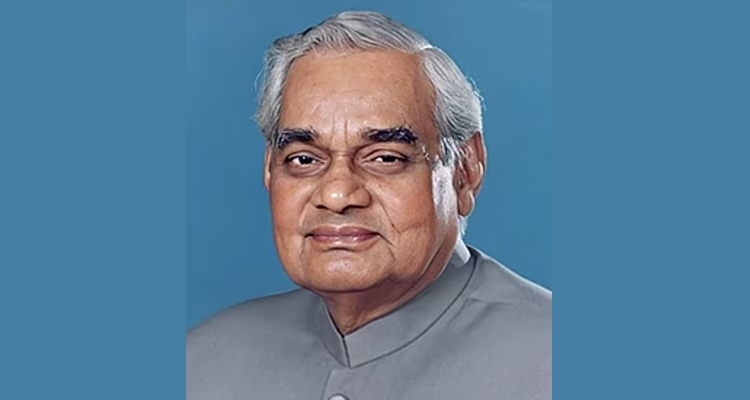
I still remember the first words spoken by Atal Bihari Vajpayee when he was sworn in as the 16th Prime Minister of India—words that were solemn rather than celebratory: “I have a pledge to redeem, and a promise to fulfil.” Those words captured the essence of a leader who viewed power not as privilege, but as responsibility.
Born on December 25, 1925, in Gwalior into a Brahmin family, Vajpayee’s intellectual journey began early. As a teenager, he was exposed to diverse ideological streams before being introduced to the Rashtriya Swayamsevak Sangh (RSS), which would later shape much of his political worldview. From there, he entered public life and rose steadily, step by step, to become one of the most respected and meticulously upright statesmen in Indian politics.
Vajpayee created history on October 4, 1977, when he became the first Indian leader to address the United Nations General Assembly in Hindi—an assertion of India’s linguistic and cultural confidence on the global stage. Over the years, his contributions were recognised with several honours, including the Padma Vibhushan in 1992, followed by the Govind Vallabh Pant Award in 1994 for being the Best Parliamentarian.
What truly set Vajpayee apart was his non-controversial stature in a deeply polarised political environment. He was admired not only by his own party colleagues but also by opponents across the political spectrum. A master orator, Vajpayee was known for his refined choice of words, measured pauses, subtle humour, gentle sarcasm, and—above all—his uncanny ability to read the mood of his audience. His popularity often extended beyond the ideological boundaries of the movement he represented, making him a rare mass leader with cross-party appeal.
His political life was marked by resilience. Vajpayee faced challenges and setbacks with courage, composure, and sincerity, never harbouring personal malice. He was among the few leaders who genuinely respected dissent and opposing viewpoints. As Prime Minister, the poet-turned-politician presided over several defining moments in India’s history: the successful Pokhran-II nuclear tests, India’s victory in the Kargil conflict, the launch of the Golden Quadrilateral national highway project, and sustained economic growth averaging five percent or more.
At the same time, his tenure was not without difficulties. The hijacking of an Indian Airlines aircraft, the terrorist attack on Parliament, and the Gujarat riots tested his leadership and moral resolve. Yet even critics acknowledged his dignity, restraint, and commitment to democratic institutions, especially his conduct in Parliament.
Many observers consider his ability to successfully manage what was often called an “unwieldy coalition” as one of his greatest achievements. Others praise his forward-looking foreign policy or the stability and momentum the Indian economy gained under his leadership. Vajpayee was also among the earliest and strongest voices opposing the unequal Nuclear Non-Proliferation Treaty (NPT), making it clear that India would sign it only when nuclear powers showed genuine commitment to global disarmament. As he famously said, India’s nuclear capability was meant for deterrence, never aggression.
Vajpayee shared a deep and enduring bond with Lucknow, which he represented five times in the Lok Sabha. Despite being a devout Hindu and an embodiment of cultural tradition, he commanded immense trust among minority communities. He consistently sought to reassure India’s Muslims that they were equal stakeholders in the nation’s future. While he described the RSS as his alma mater—once writing that “the Sangh is my soul”—he retained the independence to make decisions guided by constitutional morality rather than organisational diktats.
Jawaharlal Nehru had once introduced Vajpayee to Winston Churchill as a future Prime Minister of India—a prediction that history vindicated. Over decades, Vajpayee emerged as a towering national leader, respected by allies, rivals, and admirers alike, both in India and abroad. He was cherished for his intellect, poetry, integrity, courage, patriotism, and his rare ability to forgive and build consensus.
A parliamentarian of exceptional calibre, Vajpayee served nine terms in the Lok Sabha and two in the Rajya Sabha. During his tenure, inflation witnessed one of its sharpest declines, infrastructure expanded dramatically, and India asserted itself as a nuclear power. His vision of nationwide highway connectivity transformed mobility and economic integration, while initiatives such as river interlinking reflected his long-term thinking on water security.
Remaining active in politics for over six decades—both in power and in opposition—Vajpayee retired without a single allegation tarnishing his character, a rare distinction in public life. From leading delegations at the United Nations to launching the Lahore bus service and articulating India’s position on Kashmir, he consistently demonstrated statesmanship.
Atal Bihari Vajpayee was more than a politician. He was an eminent poet, a thoughtful journalist, a compelling orator, and a humane leader who stood for the poor and the marginalised. His life conveyed a timeless message: even in the most trying circumstances, a nation must never abandon its values. His name will forever be etched in golden letters in the history of India.