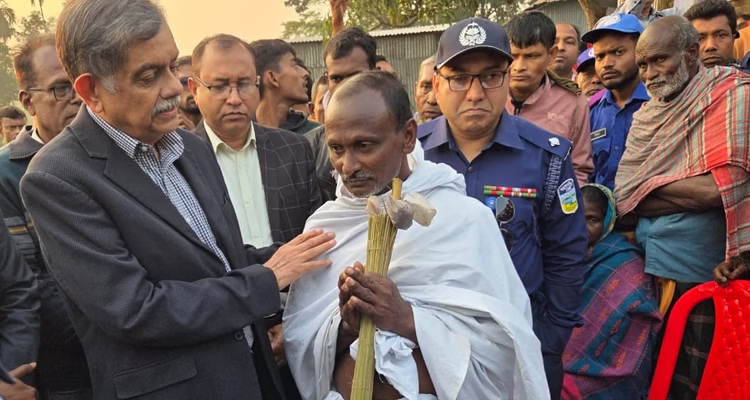
Amid rising anti-India rhetoric, Bangladesh has recently emerged from a phase of intense political turmoil following the death of young radical leader Sharif Osman Bin Hadi. As the situation gradually stabilises, the South Asian nation is now preparing for its next general election, scheduled for 12 February 2026. The forthcoming polls—considered among the most consequential in Bangladesh’s recent history—will notably exclude the Awami League, which ruled the Muslim-majority country of around 170 million people for several years. The absence follows the dramatic ouster of former Prime Minister Sheikh Hasina after a student-led mass uprising during July–August 2024. Hasina, along with thousands of her party colleagues, continues to stay in neighbouring India. This is despite a Bangladeshi court sentencing her to death for crimes against humanity related to last year’s unrest, which reportedly claimed over 1,400 lives, including minors. The interim government in Dhaka, led by Nobel laureate Muhammad Yunus, has repeatedly sought her repatriation. However, New Delhi has remained non-committal, causing visible strain in India–Bangladesh relations and contributing to a steady deterioration of bilateral ties. Suspicion and resentment deepened after the killing of Sharif Osman Bin Hadi. Anti-Hasina campaigners alleged that Hadi’s attackers crossed into Indian territory after the shooting in Dhaka on 12 December, before Hadi was airlifted to Singapore for advanced treatment, where he later succumbed to his injuries on 18 December. The prime accused, Faisal Karim Masud, allegedly linked to Chhatra League, remains untraceable. A significant section of Bangladeshi public opinion—without concrete evidence—believes that he received shelter and support in India. This perception triggered widespread anger against India and emboldened extremist elements to target Hindu families across various parts of Bangladesh. The outrage intensified further following two brutal mob lynchings. Deepu Chandra Das (27), a garment worker from Bhaluka in Mymensingh, was beaten to death and his body set on fire on 18 December over unverified allegations of blasphemy. Earlier, Uttam Kumar Barman (45), a grocery shop owner from Rangpur, was similarly killed on 13 December. These incidents sparked protests across India, with demonstrators gathering outside Bangladeshi diplomatic missions demanding justice and safety for religious minorities. The interim government in Dhaka described the Mymensingh killing as a heinous criminal act with no religious or moral justification. Education adviser Prof. C. R. Abrar later visited Deepu’s family to express official condolences and assure state support. Authorities confirmed that more than ten people had been arrested in connection with the crime. A recent report by the Brussels-based International Crisis Group (ICG) observed that Hasina’s continued presence in India has become a central factor in escalating tensions between the two neighbours. The report noted that the interim government moved swiftly to invoke the 2013 extradition treaty, but Indian authorities were unlikely to comply. According to ICG, New Delhi may be reluctant to appear as an “unreliable ally” to other regional governments and thus continues to stand by Hasina. The report further revealed that Dr Yunus personally urged Prime Minister Narendra Modi to restrain Hasina from issuing political statements from Indian soil, warning that such interventions were perceived in Dhaka as hostile acts. These concerns were reportedly not well received in New Delhi. Bangladesh also expressed resentment over allowing thousands of Awami League activists to conduct political activities from cities like Kolkata and New Delhi. In recent statements, Hasina sharply criticised the Yunus-led interim administration, branding it ineffective and accusing it of presiding over lawlessness. She claimed that extremist elements had been placed in key positions, convicted terrorists released, and international extremists allowed space in public life—developments she blamed for worsening ties with India. Hasina rejected calls to return to Bangladesh, stating that she would not risk “political assassination” unless a legitimate, elected government with an independent judiciary is established in Dhaka. She also expressed gratitude to India for providing her refuge since her departure from Bangladesh in 2024. India, for its part, has maintained that its position is guided by humanitarian principles and its long-standing civilisational ethos of offering shelter to individuals facing grave threats. New Delhi has also conveyed strong concern over attacks on minorities in Bangladesh, particularly following the killing of Deepu Chandra Das. Yet a pressing question lingers: why has Sheikh Hasina not offered an apology to the Sanatani Hindu community, given that significant failures to protect Hindus and other minorities occurred even during her long tenure as prime minister? Though reports once suggested she might seek asylum in a third country, no nation has so far extended such an offer. Nor has she publicly acknowledged India’s role in rescuing her from a potentially fatal situation at Ganabhaban on 5 August 2024. More than a year later, Hasina remains in a Hindu-majority country, with no visible international support forthcoming. In such circumstances, should her first act not be to seek forgiveness from the very community that has, indirectly, ensured her safety? by Nava Thakuria