Govt. Imposes Blanket Ban on Fresh Leases
New Delhi: In a decisive move to protect one of India’s most fragile ecological zones, the Centre on Wednesday imposed a blanket ban on granting new mining leases across the entire Aravalli range, days after the Supreme Court halted fresh mining approvals in the region.
The Union Ministry of Environment, Forest and Climate Change (MoEF&CC) said it has directed all Aravalli states to immediately stop issuing new mining leases, calling the decision a major step towards conserving one of the world’s oldest mountain systems.
MoEFCC has directed States to impose a complete ban on granting any new mining leases across the entire Aravalli Range, stretching from Delhi to Gujarat.#AravalliIsSafe pic.twitter.com/JKiKbc6cf8
— MoEF&CC (@moefcc) December 25, 2025
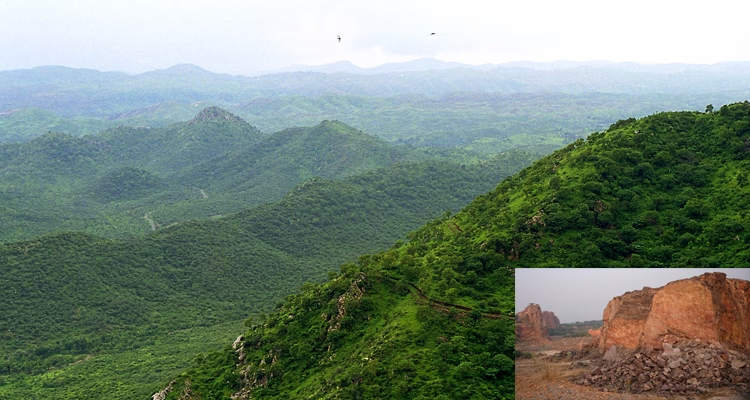
The ban covers the full Aravalli landscape—from Delhi and the National Capital Region (NCR) through Haryana and Rajasthan to Gujarat—and is aimed at preserving the range’s geological continuity and ecological role as a natural shield against desertification.
Supreme Court push, scientific roadmap ahead
The Centre’s order follows a November 20 directive of the Supreme Court of India in the long-running TN Godavarman Thirumulpad vs Union of India case. The court had ruled that no new mining leases should be granted until a Management Plan for Sustainable Mining (MPSM) is finalised.
The MoEF&CC said the plan will be prepared through the Indian Council of Forestry Research and Education (ICFRE), using a science-based approach that balances conservation with regulated economic activity.
Centre Orders Complete Ban on New Mining Leases in Aravallis
The Aravallis act as our natural guardian, protecting us from bad air and weather…: A local speaks, as @_kritika_tiwari reports from the Aravallis, Gurugram.
The first directive is to halt all new mining leases.… pic.twitter.com/rHRE02xDtl
— TIMES NOW (@TimesNow) December 25, 2025
More no-mining zones to be identified
Beyond the immediate ban, the Centre has tasked ICFRE with identifying additional ecologically sensitive zones within the Aravallis where mining must be permanently prohibited, even beyond areas already under restriction. The assessment will factor in ecological sensitivity, geological features, and landscape-level connectivity.
For existing mines, the ministry clarified that operations may continue but only under strict environmental safeguards and full compliance with Supreme Court directions. States have been instructed to tighten monitoring to prevent illegal or unsustainable extraction.
Amid public concern and political debate
The decision comes amid growing public unease and social media campaigns questioning the scientific definition of the Aravalli hills recently upheld by the court—based on elevation and clustering criteria. Environmental groups and Opposition parties argue that the definition may exclude smaller hillocks, weakening ecological corridors and affecting groundwater recharge.
The Supreme Court, while acknowledging the Aravallis as a critical “green barrier” against the eastward spread of the Thar desert, had earlier rejected a total mining ban, cautioning that it could inadvertently fuel illegal mining. Instead, it called for a regulated, science-led conservation model, similar to approaches used in other fragile ecosystems such as Jharkhand’s Saranda forests.
Stretching across Delhi, Haryana, Rajasthan and Gujarat, the Aravalli range is vital for biodiversity, groundwater replenishment and climate resilience in northwestern India—making the Centre’s latest move a significant intervention in the long-running battle between conservation and mining pressure.