 by Dr. Vinod Chandrashekhar Dixit
Ahmedabad
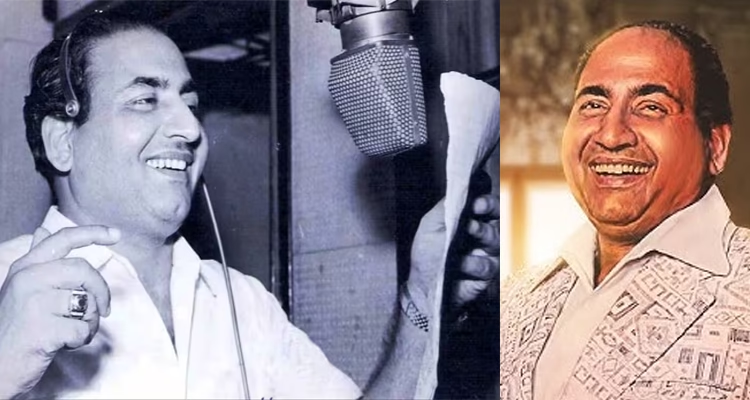
As the nation marks the 101st birth anniversary of Mohammed Rafi, India remembers not just a singer, but a voice that became the soul of its cinema and collective memory. Rafi’s singing continues to stir emotions across generations, transcending time, language, and geography. Few artistes in the history of world music have achieved such universality and reverence.
Born on December 24, 1924, in a small village in Punjab, Rafi’s love for music emerged early in life. As a child, he was deeply moved by the hymns sung by wandering fakirs—an influence that quietly shaped the spiritual depth of his later music. Academics never interested him as much as melody, and destiny soon guided him toward classical training under Ustad Chhote Ghulam Ali Khan, followed by mentorship from Firoze Nizam.
A defining moment came when Firoze Nizam was appointed music director at Lahore Radio, giving young Rafi his first opportunity to sing on air. That broadcast proved to be the turning point of his life—and of Indian film music.
Over the next four decades, Mohammed Rafi would go on to sing more than 26,000 songs in Hindi, Urdu, Punjabi, Bengali, Marathi, Telugu, Tamil, Kannada, Gujarati, and several other languages. His voice possessed unmatched clarity, emotional precision, and melodic intelligence—often described as “divinely graceful and exquisitely pleasant.”
Rafi’s versatility was unparalleled. He could render a romantic ballad with tenderness, a patriotic song with fire, a qawwali with fervour, a bhajan with devotion, and a classical composition with scholarly finesse. From playful numbers to heartbreaking laments, his voice adapted effortlessly to every emotional shade. Iconic songs such as “Chaudhvin Ka Chand Ho,” “Baharon Phool Barsao,” “Aaj Mausam Bada Beimaan Hai,” “Kya Hua Tera Vaada,” and “O Duniya Ke Rakhwale” remain timeless masterpieces.
He became the favourite voice of legendary composers like O.P. Nayyar, Shankar–Jaikishan, and Sachin Dev Burman, and famously embodied the on-screen persona of Dev Anand through unforgettable melodies. Rafi’s singing defined what is now remembered as the golden era of Hindi cinema, lending it artistic grandeur, originality, and emotional depth.
Beyond his musical genius, Mohammed Rafi was admired for his humility and humanity. Soft-spoken, disciplined, and deeply spiritual, he lived a simple life, free from arrogance. He actively supported struggling artistes—financially and emotionally. It was Rafi who once suggested that Kishore Kumar take up stage performances during a difficult phase, helping him regain stability.
Legendary singer Lata Mangeshkar once said of him:
“He was a man of God. There were no airs about him… There has neither been a voice like his nor will there be one in a hundred years.”
Rafi was also remarkably professional—always punctual, welcoming newcomers, and fully devoted to his craft. He performed in nearly 38 international concerts, taking Indian film music to global audiences. His achievements were equally extraordinary:
-
Featured in the Guinness Book of World Records for the highest number of songs sung
-
21 Filmfare nominations, with 6 wins
-
National Film Award for “Kya Hua Tera Vaada” (Hum Kisise Kum Naheen)
In 1948, India’s first Prime Minister Jawaharlal Nehru honoured him on Independence Day for his soul-stirring tribute to Mahatma Gandhi, “Suno Suno Ae Duniya Waalon, Bapu Ki Amar Kahani.”
Though Mohammed Rafi is no longer with us, his voice continues to rule the world of music. His songs remain as relevant, powerful, and beloved today as they were during his lifetime. In every note, every emotion, and every silence between melodies, Rafi lives on—an eternal angel of Indian music, whose name will forever be written in golden letters.