
 Ajay Kumar
Senior Journalist
Lucknow (U.P.)
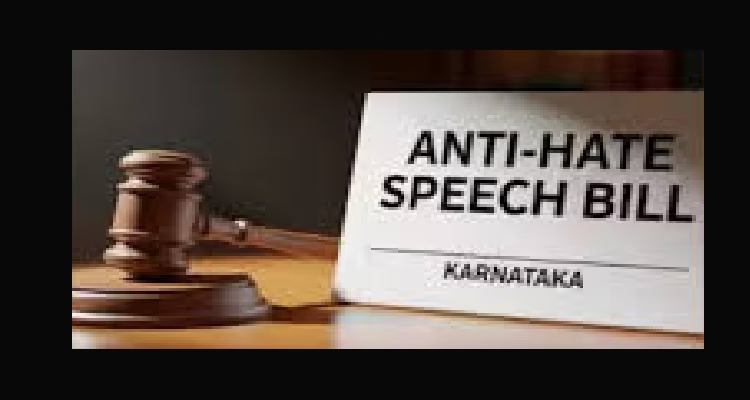
The Karnataka Hate Speech and Hate Crimes (Prevention) Bill, 2025, passed by the Karnataka Legislative Assembly on December 18, has emerged as one of the most contentious pieces of legislation in recent years. Far more than a routine law, it sits at the heart of a larger national debate—how should a democracy balance freedom of expression, state authority, and social harmony?
The ruling Indian National Congress ”, has projected the Bill as a much-needed response to rising hate speech and hate crimes, arguing that existing laws have failed to curb the problem. The opposition Bharatiya Janata Party (BJP), along with several civil liberties groups, has sharply criticised it as a “black law” that could erode democratic freedoms. As the first Indian state to explicitly define hate speech and enact a comprehensive law on it, Karnataka’s move is being closely watched across the country.
Why the government says the law is necessary
According to the Congress government, the current legal framework is inadequate. Provisions under the Indian Penal Code—such as Sections 153A and 295A—and the Information Technology Act are primarily designed to maintain public order, not to tackle the deeper social roots of hate-driven speech and violence.
Official data is often cited to support this argument. Statistics from the National Crime Records Bureau show that while arrests under hate-related provisions are relatively high, conviction rates remain low. In 2020, for instance, the conviction rate under Section 153A stood at just about 20 percent. The government contends that such outcomes allow those who spread hatred to escape punishment, perpetuating a cycle of intolerance.
To plug this gap, the new law prescribes stringent penalties—imprisonment ranging from one to seven years, extending up to ten years for repeat offenders. Offences are made non-bailable, and provisions for victim compensation have been introduced, signalling a tougher stance against hate crimes.
Opposition fears: vagueness and misuse
The sharpest criticism has come from the BJP. Leader of the Opposition R. Ashok warned in the Assembly that the Bill’s broad and ambiguous definition of hate speech could criminalise ordinary political criticism, satire, or cultural expression. He went so far as to claim that it would turn the police into instruments of political control.
Former minister C. T. Ravi invoked past judgments of the Supreme Court of India, stressing that freedom of speech is part of the Constitution’s basic structure and cannot be diluted lightly.
A major concern is the scope for misuse. Since offences are non-bailable, police can arrest without warrants. In a charged electoral atmosphere, critics fear that opposition speeches or social media posts could be branded as hate speech, leading to FIRs and arrests. Past cases—some involving slogans or political statements later quashed by courts—are often cited as cautionary examples.
Impact on media and digital space
Journalism and social media are at the centre of this controversy. The Bill empowers the state government to block or remove electronic content without a judicial order. Critics argue that this could have a chilling effect on investigative journalism, reporting on sensitive social issues, and criticism of those in power.
They also draw parallels with Section 66A of the IT Act, which was struck down by the Supreme Court in 2015 for being vague and overbroad. According to detractors, the Karnataka law risks restoring similar powers through a different legal route.
Supporters’ case: prevention before violence
Supporters of the law, however, argue that these fears overlook ground realities. Minority groups, including several Christian organisations, have welcomed the legislation against the backdrop of attacks on churches and religious institutions. Their argument is that hate speech often acts as a precursor to physical violence, and early, strict intervention can prevent larger communal clashes.
Judicial trends are also cited in support. In 2022, the Supreme Court directed police across states to take suo motu action in hate speech cases and warned that failure to do so could amount to contempt of court. While the court later acknowledged the practical difficulty of monitoring every instance, it underscored the need for proactive enforcement.
The Bill also reflects recommendations made in the Law Commission of India’s 267th Report and echoes provisions of a 2022 private member’s bill. It expands protected categories to include sexual orientation and gender identity and introduces the controversial idea of “collective liability,” holding organisational leaders accountable for hate crimes linked to their groups.
A test of intent and implementation
At its core, the debate returns to a familiar Indian question: does the problem lie in the law itself or in how it is enforced? Supporters see the Bill as a long-overdue instrument to protect vulnerable communities and promote social harmony. Critics fear it could become a political weapon to silence dissent.
Karnataka has undoubtedly set a precedent. Whether the Anti-Hate Bill strengthens democratic values or deepens anxieties about free expression will depend less on its text and more on its fair, transparent, and non-partisan implementation. The country is watching closely.