
Maguni Charan Behera
Chief Editor, Sampratyaya
Email: sampratyaya.ijr@gmail.com
Introduction
Whether tribes in India are Hindus or not remains a contested question among academics, activists, politicians, and public intellectuals. This debate, however, is largely a colonial and post-colonial construct rather than an indigenous concern. During the colonial period, census officials struggled to assign singular religious identities to tribal communities. As a result, tribes were placed in ambiguous and shifting categories that reflected both overlap and difference—between tribes and Hindus, as well as among tribes themselves. This classificatory uncertainty produced constructs such as “tribal religion,” a term that remains conceptually unclear and analytically problematic.
In colonial Africa, Europeans used the term tribe to mark indigenous populations as cultural “others.” Indigenous belief systems were viewed as fundamentally different from European religions, which were organised around doctrinal coherence or individual-centred ideologies. In India, however, colonial administrators encountered a far more complex religious landscape, extending across territories, ethnicities, and cultural communities. This religious space shared certain features with African indigenous beliefs and personality-centred cults, yet it differed significantly in structure and philosophy.
Traditions centred on figures such as Sri Rama, Sri Gautama, or Sri Krishna did not establish ideological supremacy of individuals. Rather, they functioned to reaffirm universality in ethics, belief, faith, and social morality—domains that had historically experienced deviations and internal contradictions.
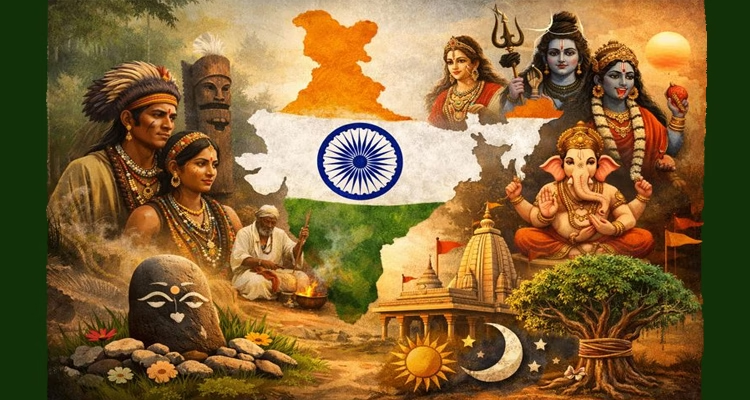
Among tribal communities, shamans and priests play a central role in regulating social conduct by guiding members on moral, ritual, and social obligations. Tribal belief systems are not perceived as doctrinal or anthropogenic constructions; instead, they are embedded in lived relationships with nature and the environment. Like many communities with whom they have coexisted since antiquity, tribes believe in natural forces, resulting in polytheistic cosmologies. Polytheism, often associated with tribal belief systems, is also a defining feature of what is contemporarily understood as Hinduism.
India posed a particular challenge to colonial understanding due to its extraordinary religious plurality—Buddhists, Muslims, Hindus, Sikhs, Jains, Parsis, and Christians coexisted across regions such as Kerala. Significantly, Hindu communities themselves did not possess a formally articulated religious name prior to colonial rule. The term Hindu gained prominence during the colonial period, possibly through reformist figures such as Raja Rammohan Roy.
Before colonial intervention, tribal religious identity was not a matter of concern. The issue gained prominence with the arrival of Christian missionaries, who separated religion from culture and promoted religion as an individualised doctrine through organised preaching and propaganda. This intervention fundamentally altered indigenous understandings of religion.
Core Issues in the Debate
Idol Worship
It is often argued that tribes are not Hindus because they do not worship idols. This raises the basic question: what constitutes an idol? An idol is a symbolic representation of supernaturality, a practice that exists across religious traditions. Christians and Buddhists worship statues or images of Jesus Christ and Gautama Buddha. Tribal communities express faith through symbols such as stones, wood, hills, trees, and visual forms including Warli and Saura paintings.
Moreover, Mahima Dharma followers and Arya Samajists reject idol worship altogether, yet they are recognised as Hindus. Idols, therefore, function as concrete mediators through which abstract metaphysical realities are perceived.
Nature Worship
Tribes are often categorised as nature worshippers and therefore placed outside Hinduism. However, Muslim and Christian tribal communities also exist; they believe in one God and are not polytheists. Does this make them nature worshippers as well? Furthermore, nature worship forms a significant component of Hindu religious practice. Hence, nature worship cannot serve as a distinguishing criterion.
Hindu Identity and Religious Choice
Some scholars question how a tribal individual or community can be Hindu. If individuals can convert to Christianity, Islam, or Buddhism, there is no conceptual basis for excluding Hinduism as a legitimate affiliation. Historically, apart from Buddhism, Jainism, and Sikhism, there was no rigid “-ism” categorising communities now identified as Hindu or tribal.
Neither tribes nor Hindus followed a single unified faith. Shared features included nature worship, belief in multiple supernatural powers, reverence for religious leaders (with shamans functioning as authorities), belief in a supreme power, and diverse ritual practices. In contemporary debates, however, Hinduism is often reduced to Brahmanism. This reduction ignores the plural and inclusive nature of Hindu traditions, of which Brahmanical practices represent only one strand.
Animism and Ancestor Worship
Tribes are frequently labelled animists, but distinctions between animism and animatism are often overstated. Ancestor worship, central to many tribal belief systems, is not exclusive to tribes and is not a defining element of animism. Hindu traditions also emphasise ancestor worship and belief in the soul, indicating philosophical continuity rather than rupture.
What Is Hindu Identity?
Is Hindu identity primarily religious, ethnic, or territorial? It cannot be ethnic, as multiple and diverse ethnic groups are designated as Hindu. While it is increasingly perceived as religious, Hindu identity encompasses immense diversity. A worshipper of Kali and a person who worships no deity are both identified as Hindu. Vaishnavites, Tantrics, and followers of individual gurus are all Hindus.
Practices such as wearing the sacred thread, shaving the head, wearing a dhoti, or worshipping trees and stones are not prerequisites. Hindu identity is therefore best understood as territorial and cultural, within which religion is one component. This territorial dimension encompasses all those who do not adhere to an exclusive personality cult.
Varna System
It is often argued that tribes are not Hindus because they fall outside the varna system. This assumes that Hinduism is synonymous with varna, an assumption that is empirically untenable. Many tribes possess occupational specialisations such as hunting, gathering, cultivation, or artisanal work.
Tribes such as the Halbi, Bhatara, and Saharia have long identified as Hindu while remaining outside the varna framework, without any erosion of identity. Empirical evidence therefore weakens the claim that varna is a defining criterion of Hinduism.
Untouchability and Exploitation
Untouchability, purity–pollution norms, and exploitation are often cited as grounds for exclusion. However, these practices exist within varna-based Hindu society itself. Purity–pollution concepts also exist in several tribal communities in different cultural contexts. Exploitation is a universal phenomenon arising from inequality.
Emphasising differences while ignoring shared features—such as clan organisation, shared territories, coexistence, and non-doctrinal religion—is analytically selective. Historically, kingdoms were territorial entities (Magadha, Kalinga, Sena, Jaintia), not “tribal” or “Hindu.”
Fear of Loss of Tribal Identity
Concerns that tribes will lose identity if identified as Hindu raise the question: which identity—religious, linguistic, cultural, occupational, or ethnic? Tribe functions as both a generic and a community category. Members of the same tribe may follow Hinduism, Christianity, Islam, or traditional beliefs.
Changes in occupation, dress, food habits, or political participation do not erase ethnic identity. Language loss among the Duara or Gadba has not resulted in loss of tribal identity, just as Africans in the USA retain African identity despite language loss. Hinduism does not cause linguistic erosion; market forces do. If tribes follow multiple religions, the very concept of “tribal religion” requires scrutiny.
Food Habits
Food habits are also used to distinguish tribes from Hindus. However, Hindu communities include both vegetarians and non-vegetarians. Vegetarianism is a voluntary spiritual discipline rather than a religious mandate. Its practice by non-Hindu figures such as Albert Einstein or Benjamin Franklin further undermines its use as a defining criterion. Equating vegetarianism with Hinduism reflects a partial and misleading understanding.
Hindu as a Territorial Identity
Historically, the term Hindu denoted people living east of the River Sindhu, signifying a territorial and cultural identity. Texts such as the Vishnu Purana and Shiva Purana describe Bharatavarsha as a geographic and cultural entity. Within this framework, no distinction existed between tribes and others.
Identifying people as Hindu on a territorial basis does not prevent them from following different faiths. Punjab or Assam represents territorial identities within which multiple religions coexist. Just as all citizens identify as Indian or Bharatiya, they may also be Hindu in a territorial sense. A term can designate both a whole and its parts.
Tribe, Scheduled Tribe, and Default Hindu Identity
Some argue that tribes are Hindus by default, though Hindus are not necessarily tribes. This raises deeper questions: who is a tribe, and how does it differ from Scheduled Tribe (ST)? Historically, the concept of tribe has never been rigid or universal. During colonial rule, communities were classified as tribes based on administrative convenience.
The present ST category includes anthropological tribes, caste-based communities, and communities clearly identified as Hindu. Thus, the claim that tribes are Hindus by default rests on historically unstable definitions of both tribe and Hindu.
Tribal and Hindu Deities
It is often claimed that tribal gods are fundamentally different from Hindu gods. This difference is largely one of nomenclature and cultural expression, not theological substance. Across communities, there exists a shared notion of a supreme power expressed through different symbolic forms within polytheistic systems.
Shiva, Kali, Donyi-Polo, Mahapru, Dharmesh, Sing Bonga, Perumal, Murugan, and Pillaiyar all represent supreme powers worshipped under different names. The presence of multiple deities does not negate the idea of a supreme power; it demonstrates that the concept of supremacy exists within polytheism itself.
Tree Worship and Polytheism
Tree worship is widespread across communities and closely connected to ecological contexts. Trees such as Beela, Shami, Peepal, Karma, and Sal vary by region, but their symbolic meaning remains consistent: the embodiment of spiritual power. Territorial polytheism represents a macrocosm of local belief systems. Distinguishing tribes from Hindus on religious grounds thus involves selective reasoning.
The Problem of “Tribal Religion”
Given the diversity of beliefs among tribes, the concept of “tribal religion” mirrors the same logic used to describe Hinduism—a plural system with multiple deities and practices. If supreme powers such as Donyi-Polo, Mahapru, or Buddha can be accommodated within tribal religion, there is no rational basis for excluding Hindu deities. In practice, these belief systems are already interwoven.
Why the Debate?
The separation of tribal religion from Hindu religion is driven primarily by political interests, misinformation, and ideological propaganda. A historically grounded, philosophically coherent, and empirically informed approach shows that the issue cannot be resolved through rigid categories. The question therefore demands sustained, nuanced, and rigorous scholarly engagement.