India Takes Big Leap in Critical Minerals as CSIR-NML, NALCO Sign Red Mud Pact
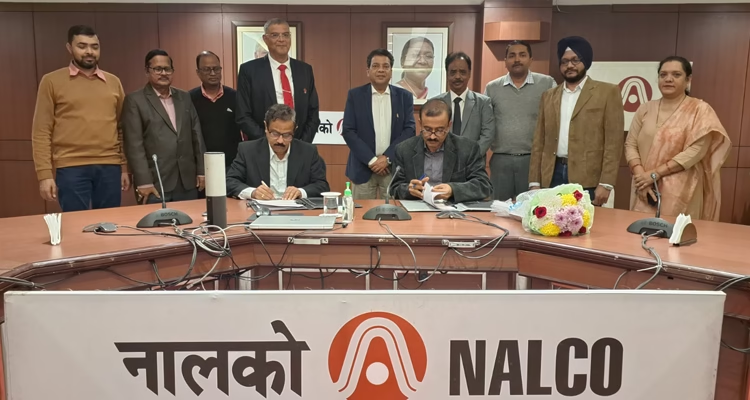
Jamshedpur: In a major step towards sustainable mining and critical mineral recovery, CSIR–National Metallurgical Laboratory (CSIR-NML) has signed an agreement with National Aluminium Company Limited (NALCO) to establish a 10 TPD red mud recycling pilot plant.
Under the collaboration, CSIR-NML’s indigenously developed process will be scaled up to recover iron, alumina, titania and scandium oxide, along with other valuable and critical metals from red mud (bauxite residue). The initiative addresses both the long-standing environmental challenge of red mud disposal and the growing global demand for scandium, a high-value rare earth element.
The technology was earlier validated at a 200-kg scale at CSIR-NML with support from NITI Aayog, which had identified red mud as a potential domestic source of scandium. Globally, only about 3% of the 140 million tonnes of bauxite residue generated annually is currently utilised, mainly in cement and iron making.
India alone produces over 5 million tonnes of red mud each year, containing 45–70 ppm scandium. The CSIR-NML process enables recovery of alumina and iron while generating a rare earth concentrate, envisioned as feedstock for scandium extraction. Scandium finds applications in aerospace, fuel cells, lasers, MIG aircraft, 3D printing and advanced alloys.
This marks the first such development in India, positioning NALCO to significantly mitigate red mud hazards while strengthening India’s role in the global rare earth and critical minerals supply chain.
The agreement was signed on January 6, 2026, at NALCO’s Bhubaneswar office in the presence of B. P. Singh, CMD, NALCO; Jagdish Arora; S. P. Mohapatra; and senior scientists and officials from both NALCO and CSIR-NML.