
 Dr. Vinod Chandrashekhar Dixit
Doctors’ handwriting has long been a subject of jokes and casual ridicule—but for all the wrong reasons. What appears humorous on the surface masks a serious and often dangerous problem. It is a common belief that only an experienced pharmacist can decipher a doctor’s prescription, identifying the intended medicine based on diagnosis and symptoms. Patients, meanwhile, are left confused, anxious, and dependent.
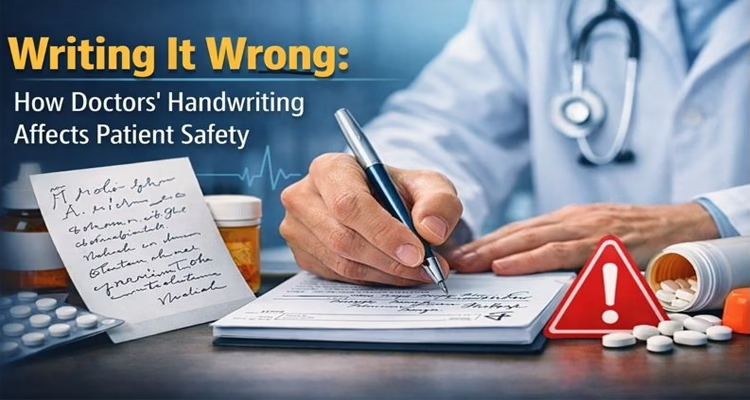
While jokes about illegible handwriting abound, the consequences are far from amusing. Every year, poor handwriting by doctors is reportedly responsible for thousands of preventable medical errors, resulting in serious harm and even death. Estimates suggest that more than 5,000 lives are lost annually due to prescription-related mistakes linked to illegible writing.
From a patient’s perspective, unclear prescriptions can delay treatment, lead to unnecessary investigations, or result in incorrect medications and dosages. In the worst cases, patients may receive the wrong drug altogether—causing deterioration of health or death. Despite its severity, this issue remains vastly underreported in India.
Almost every patient has stared at a prescription wondering what exactly has been prescribed. In most cases, the writing resembles an indecipherable script rather than a set of medical instructions. Hardly a word—sometimes not even a single letter—is recognisable.
Although handwriting itself is gradually becoming obsolete in the digital age, handwritten prescriptions continue to dominate medical practice. This is particularly concerning because drug names are required to be written clearly, preferably in capital letters, to avoid confusion. Many medicines have similar spellings but entirely different therapeutic purposes. Even a minor misreading by a chemist can have serious or fatal consequences.
At times, pharmacists are forced to contact doctors to clarify prescriptions. Spelling mistakes are also common—sometimes because doctors are unsure of the correct spelling, sometimes due to haste. While doctors may be extremely busy, poor handwriting cannot be justified when it puts patient safety at risk.
Some doctors habitually write illegibly. Recognising the danger, doctors have now been instructed to prescribe medicines using generic names, written clearly and in capital letters. The Central Government has approved amendments to the Indian Medical Council Regulations, 2002, mandating that every physician prescribe drugs in a legible manner using generic names and ensure rational drug use.
Unfortunately, compliance remains inconsistent. In some cases, prescriptions are written in a manner that only a particular pharmacist—often associated with the same hospital—can understand. This practice is deeply problematic and unethical.
There is no excuse for poor handwriting. Prescriptions should be written only in capital letters. Thankfully, computers have begun to replace handwritten prescriptions in some hospitals, improving clarity and safety. However, computer-generated prescriptions remain difficult to implement universally, especially in rural areas.
That said, the need of the hour is standardisation. Clear, enforceable rules for prescription writing must be adopted and followed. Patient safety must take precedence over convenience or habit.
It is time to bid farewell to the infamous doctor’s scrawl. Healthcare must be legible, accountable, and safe. Let us put patients first—because clarity in medicine can be the difference between life and death.