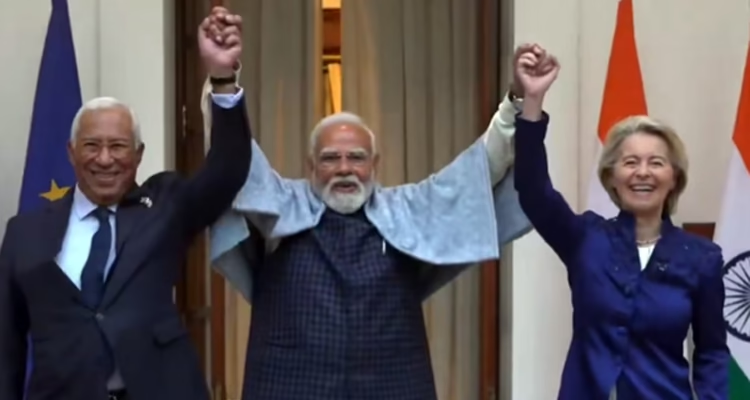
RNS: In a major breakthrough for global trade, India and the European Union have sealed a long-awaited free trade agreement that leaders on both sides are calling the “Mother of All Deals.” The agreement, confirmed by Prime Minister Narendra Modi, has also drawn sharp international attention, as it links two of the world’s largest markets in a single, comprehensive economic framework.
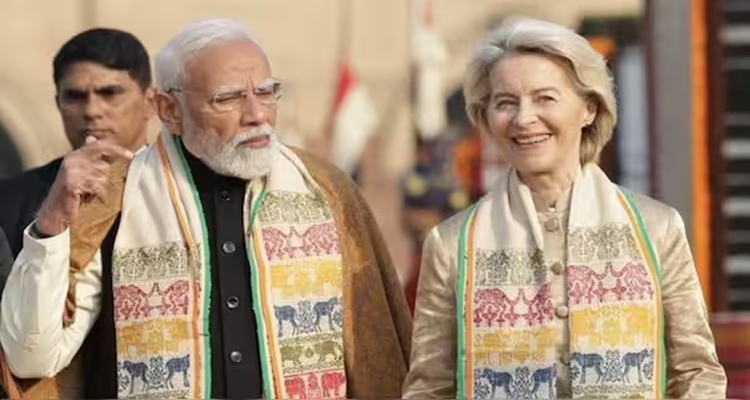
European Commission President Ursula von der Leyen described the pact as a “historic step for Europe and India, and a powerful signal that open, fair and rules-based trade can still deliver in a fractured world.” EU leaders said the deal would anchor a new era of strategic, economic and technological cooperation between the two partners.
The Mother Of All Deals
THANK YOU FOR YOUR ATTENTION TO THIS MATTER pic.twitter.com/4tmydymPRC
— 🅺🅳🆁 🚩 (@KDRposts) January 27, 2026
A Landmark Trade Reset
The India–EU Free Trade Agreement covers trade in goods, services, investment, digital commerce, intellectual property, climate cooperation and regulatory standards. Together, India and the EU represent nearly two billion consumers, making this one of the largest bilateral trade arrangements ever signed.
Prime Minister Modi said the agreement “opens new doors for Indian industry, farmers, youth and innovators,” while also strengthening India’s role in global value chains. He called the pact a “win–win framework that balances growth, fairness and national interest.”
EU leaders echoed the sentiment, saying the deal would deepen economic integration, reduce trade barriers and strengthen Europe’s presence in the fast-growing Indian market.
The India–EU Free Trade Agreement marks a decisive shift in India’s global economic engagement. From manufacturing and agriculture to MSMEs, services, and high-tech sectors, this landmark pact unlocks unprecedented access to European markets and strengthens India’s position in… pic.twitter.com/MKsuapI8nF
— MyGovIndia (@mygovindia) January 27, 2026
Key Highlights of the Deal
1. Massive tariff liberalisation
India will gradually reduce high customs duties on a wide range of European goods, including machinery, medical devices, chemicals, automobiles, wines and premium consumer products. In return, the EU will slash or remove tariffs on most Indian exports.
2. Big boost for Indian manufacturing
Labour-intensive sectors such as textiles, garments, leather, footwear, gems and jewellery, handicrafts and engineering goods are expected to gain significantly from easier access to European markets.
3. Auto sector opened — with safeguards
India has agreed to cut import duties on a limited number of European cars in a phased manner. The reductions will apply mainly to premium models and will be rolled out gradually. Electric vehicles remain protected in the early years, giving domestic manufacturers time to compete.
4. New opportunities in services and IT
Indian IT, software, finance, consulting and professional services firms will benefit from improved access to Europe. EU companies, in turn, gain greater entry into India’s growing services market. Provisions on skilled mobility will make cross-border business easier.
5. Digital trade and data rules
The agreement includes modern rules for digital trade, e-commerce, cross-border data flows and cybersecurity, providing certainty for tech-driven businesses.
6. Investment protection and IPR
Stronger safeguards for investors and intellectual property are included, while ensuring public interest protections, especially in healthcare and technology.
7. Sustainability and climate transition
The EU has committed technical and financial support to help India meet green and climate goals, linking trade growth with environmental responsibility.
Economic and Strategic Impact
Officials expect the pact to significantly expand two-way trade over the next decade and generate billions of euros in annual tariff savings. More importantly, it is seen as a strategic counterweight in an era of shifting global alliances and supply-chain realignments.
EU leaders said the agreement strengthens Europe’s strategic partnership with India and reduces dependence on narrow trade corridors. “This is not just a trade deal, it is a geopolitical partnership,” an EU official said.
The Road Ahead
The pact will now undergo legal vetting and ratification in India and across EU member states. Its implementation will be phased over several years, with sensitive sectors receiving transition periods.
Why It Matters
The “Mother of All Deals” is more than a commercial agreement — it is a signal that India and the EU are aligning their economic futures. As Prime Minister Modi confirmed, the pact is designed to deliver growth, jobs and innovation, while EU leaders say it places both partners at the heart of a more balanced and resilient global trading system.