
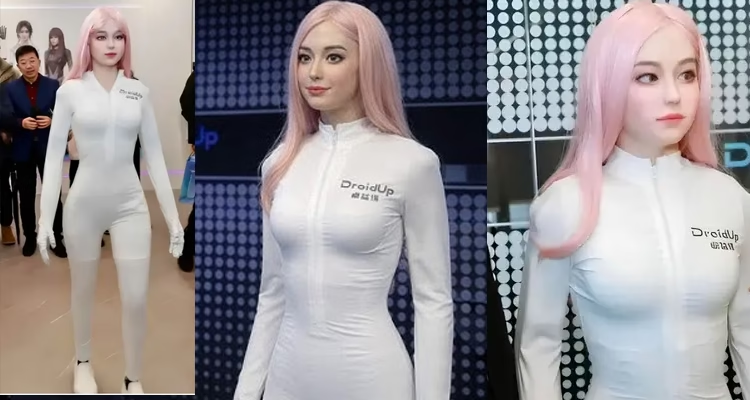
Humanoid Breakthrough: ‘Moya’ Robot Mimics Human Walking with 92% Precision
News Desk: Marking a striking advance in humanoid robotics, China has unveiled what developers describe as the world’s first fully biomimetic embodied artificial-intelligence robot — Moya — capable of imitating human walking with up to 92% accuracy and reproducing subtle facial expressions.
Presented in Shanghai by robotics firm DroidUp, the humanoid is designed as an “embodied intelligence” system that can perceive, reason and act in the physical world, rather than operating solely in digital environments.
Standing roughly 1.65 metres tall and weighing about 32 kilograms, Moya closely mirrors adult human proportions and maintains a surface body temperature between 32°C and 36°C to enhance lifelike interaction. Its locomotion system focuses on balance and natural movement, while integrated perception tools allow it to maintain eye contact and display micro-expressions such as nodding or smiling.
Pushing the Human–Machine Boundary
Built on an upgraded Walker-3 skeletal platform, the robot uses lightweight lattice-style synthetic “muscle” materials and modular components that allow outward customization without altering its mechanical core. Its AI-driven sensory and interaction architecture enables the imitation of nuanced behavioural cues, signalling a shift toward more socially responsive machines and closer human-robot engagement.
Developers see potential uses in healthcare assistance, education, and public-facing service roles — including museums, retail centres and financial institutions — though details of large-scale commercial deployment remain unclear.
Mixed Reactions to Hyper-Realism
The unveiling has drawn both admiration and unease, reviving debate over the “uncanny valley” — the discomfort people sometimes experience when machines appear almost human. Online responses have ranged from excitement about the technological breakthrough to concerns about ethical implications and future human-machine relationships.
Specialists note that despite rapid progress, humanoid robots remain largely experimental and expensive, placing widespread household adoption beyond the near horizon.
Part of a Larger Robotics Surge
Moya’s debut reflects the accelerating push into embodied-intelligence development in China, where humanoid robotics is emerging as a fast-growing sector backed by AI expertise and manufacturing strength. As engineers continue narrowing the gap between human and machine capability, the robot represents both technological momentum and the broader social and ethical questions accompanying the next generation of intelligent machines.