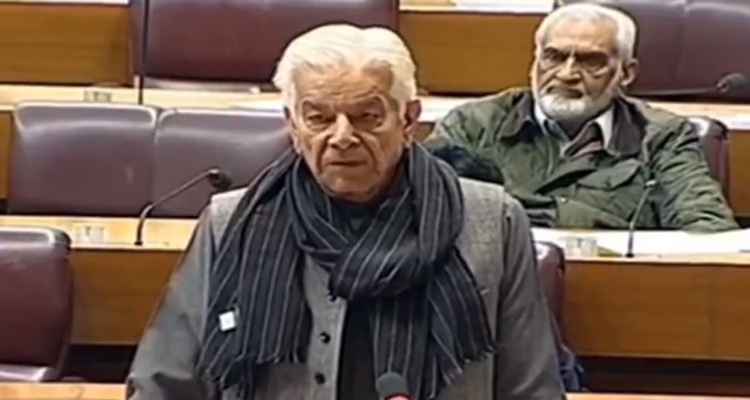
Islamabad: Pakistan’s Defence Minister Khawaja Asif has triggered a political storm with one of the bluntest acknowledgements yet of Islamabad’s past alignment with the United States, telling Parliament that the partnership proved costly and strategically misguided.
Addressing the National Assembly, Asif accused Washington of exploiting Pakistan’s cooperation for its own interests before abandoning the country, saying Islamabad had been “used for a purpose and then thrown away like a piece of toilet paper.” His remarks have set off intense reactions and revived debate over Pakistan’s foreign policy choices across decades.
Big statement –
“Pak was used like toilet paper”Khawaja Asif admitted that Pakistan has historically fought wars for superpowers & waged a “Made in USA” jihad. Asif also claimed that Pakistan was treated “worse than toilet paper” by USA, used for a purpose and then discarded. pic.twitter.com/DpNFAWfG9I
— War & Gore (@Goreunit) February 11, 2026
Rare candour in Parliament
In his address, Asif acknowledged that Pakistan has long struggled to confront its own history, particularly its role in supporting militant networks in earlier years. He described denial of the country’s terror-linked past as a persistent issue rooted in policies shaped under military regimes.
The minister admitted that involvement in successive Afghan conflicts had backfired, arguing that terrorism and instability within Pakistan today were consequences of those strategic decisions. He characterised the ongoing violence as “blowback” from past state policies rather than isolated developments.
Costs of post-9/11 alignment
Asif specifically highlighted Pakistan’s realignment with Washington after 1999 and its cooperation with the US-led campaign in Afghanistan following the September 11 attacks. He said Islamabad’s shift against the Taliban came at enormous human, economic and security costs.
According to him, while Pakistan supported US objectives during the conflict, the eventual American withdrawal left the country dealing with prolonged insurgency, radicalisation and economic strain. The losses, he told lawmakers, were “irreversible” and could never be fully compensated.
Questioning past narratives
Breaking with earlier official rhetoric, the defence minister also challenged the long-standing narrative that Pakistan’s involvement in Afghan wars was driven by religious duty. He argued that mobilisation under the banner of jihad masked geopolitical motivations.
Asif directly referenced former military rulers Zia-ul-Haq and Pervez Musharraf, saying their decisions to align with global powers were political choices rather than actions taken “for the sake of Islam.” He warned that failure to acknowledge such realities had deepened internal challenges, including the rise of extremism.
Lasting societal impact
Beyond security fallout, Asif pointed to broader social consequences, claiming the education system was reshaped during those eras to justify military engagement in Afghanistan. He said ideological narratives embedded at the time continue to influence Pakistan’s political and social fabric.
Renewed introspection
The remarks represent one of the most forthright admissions by a senior Pakistani leader on the legacy of strategic alliances forged during the Cold War and post-9/11 period. Asif’s speech has reopened scrutiny of Pakistan’s role in regional conflicts and the long-term costs of decisions shaped under military rule.
His candid assessment signals growing introspection within parts of Pakistan’s political establishment about how past alignments continue to shape the country’s security environment today.