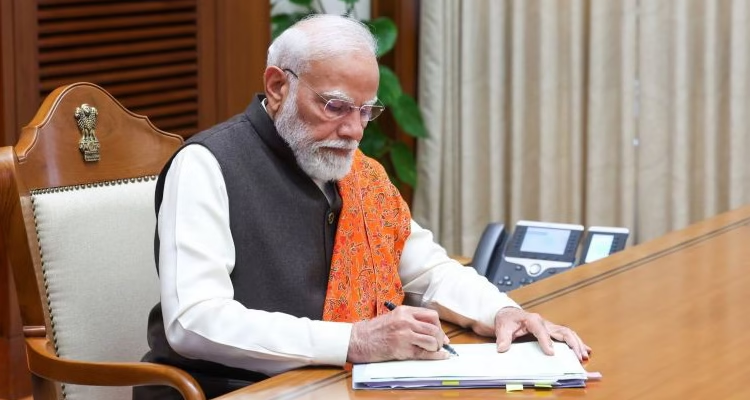
New Delhi: PM Modi approves four major schemes covering Women, Agriculture, Accident Care and Startups at his new office at Seva Teerth, marking the first set of policy decisions after inaugurating the newly built complex in the capital.
Prime Minister Narendra Modi formally opened the Seva Teerth facility — now housing his office — and cleared a cluster of initiatives aimed at farmers, women, youth and vulnerable citizens, signalling a governance push centred on welfare delivery and economic capacity building.
At Seva Teerth earlier today, signed files that are connected with the empowerment of the poor, downtrodden, our hardworking farmers, Yuva Shakti and Nari Shakti. The key decisions include:
Approval for the launch of PM RAHAT scheme, as per which victims of accidents will get… pic.twitter.com/dVn5LyrVNX
— Narendra Modi (@narendramodi) February 13, 2026
Among the key approvals is the PM RAHAT scheme, which provides cashless medical treatment up to ₹1.5 lakh for accident victims, designed to ensure immediate care without financial barriers during emergencies.
The Prime Minister also scaled up the government’s flagship self-help group initiative, announcing that the target of “Lakhpati Didis” will be doubled to six crore by March 2029, after the programme crossed the three-crore mark ahead of schedule — underscoring an expanded focus on women-led economic empowerment.
In the agriculture sector, the Agriculture Infrastructure Fund has been doubled to ₹2 lakh crore, intended to strengthen storage, supply chains, and value-addition capacity across the farm ecosystem.
Additionally, Mr Modi cleared the Startup India Fund of Funds 2.0, with a ₹10,000-crore corpus, aimed at energising the next phase of innovation by supporting deep-tech ventures, early-stage startups, advanced manufacturing and frontier technologies.
Officials described the decisions signed at Seva Teerth as setting the tone for policy priorities from the new office — combining welfare protection, rural investment, women’s empowerment and innovation support in a single policy package.