
Watch full interview will Tom Cooper pic.twitter.com/XgT6EkUKTv
— Sanatan Prabhat (@SanatanPrabhat) February 18, 2026
New Delhi: A fresh strategic debate has resurfaced after aviation historian and military analyst Tom Cooper claimed that the Indian Air Force (IAF) struck Pakistan’s sensitive Kirana Hills complex during Operation Sindoor — an assertion New Delhi has consistently rejected.
Analyst Calls Evidence “Unmistakable”
In an interview with NDTV, Cooper asserted that the evidence pointing to an Indian strike on Kirana Hills is “unmistakable.” The Austrian analyst said he possesses multiple indicators suggesting the target — widely believed by defence observers to be linked to Pakistan’s nuclear infrastructure — was hit during the brief but intense confrontation.
According to NDTV, Cooper argued the alleged strike appeared calibrated to send a strategic warning rather than cause large-scale destruction. He was quoted as saying the location is one that would be targeted “when you want to send a clear message without causing too much damage.”
What Cooper Cited
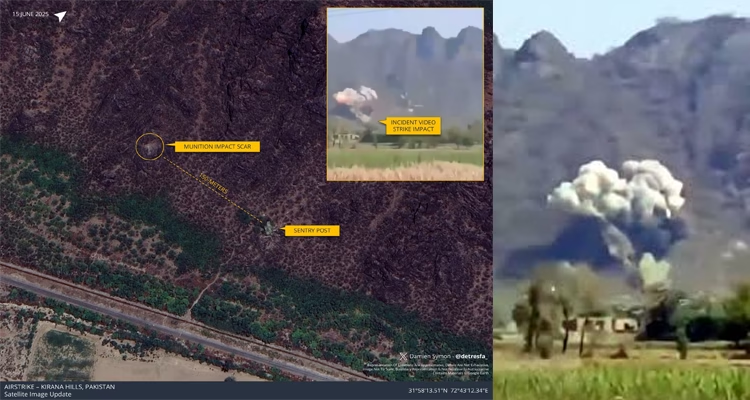
Cooper pointed to open-source material, including civilian-shot videos that allegedly show missile contrails descending toward the Kirana Hills area and smoke rising near what he identified as a Pakistani Air Force radar installation of the 4091st Squadron.
As reported by NDTV, he claimed Indian forces first neutralised radar capability before striking at least two entrances to underground storage facilities. He described Kirana Hills as a “centrepiece” of Pakistan’s nuclear programme and said the area is believed to have hosted 20–24 non-critical nuclear tests.
In earlier social media remarks referenced by NDTV, Cooper also criticised the IAF’s public communications, taking issue with Vice Chief Air Marshal Nagesh Kapoor’s dismissal of reports about strikes on the underground complex.
Diplomatic Timeline Seen as “Telling”
The analyst further argued that the sequence of diplomatic developments strengthened his assessment. He noted that Pakistan’s outreach to Washington and New Delhi and its push for a ceasefire during the conflict window appeared significant.
While stopping short of calling it a plea, Cooper told NDTV the developments that followed the alleged strike “cannot be clearer anymore.”
He also claimed Pakistan’s retaliatory campaign, Operation Bunyan-un-Marsoos, did not achieve its objectives, attributing the outcome largely to India’s air defence systems. Cooper described the alleged Kirana Hills strike as one of the decisive moments of the confrontation.
India’s Military Pushback
Despite the renewed claims, the Indian Air Force has repeatedly denied targeting any nuclear-linked site in Pakistan.
The Economic Times earlier reported that Air Marshal A.K. Bharti clarified India did not hit Kirana Hills. The publication also noted that IAF Vice Chief Air Marshal Nagesh Kapoor reiterated Operation Sindoor was focused on terror infrastructure and selected military assets, not nuclear facilities.
Watch full interview will Tom Cooper pic.twitter.com/XgT6EkUKTv
— Sanatan Prabhat (@SanatanPrabhat) February 18, 2026
IAEA Finds No Radiation Leak
Amid speculation at the time, the International Atomic Energy Agency (IAEA) confirmed there was no radiation leak from any Pakistani nuclear facility, according to The Times of India — a finding that undercut fears of nuclear damage.
Narrative Still Contested
The episode remains shrouded in competing claims. While some open-source analysts and satellite interpretations have fuelled speculation about activity near Kirana Hills, there is no publicly verified independent confirmation of a strike on the sensitive complex.
For now, the question of whether Operation Sindoor crossed Pakistan’s nuclear threshold remains part of the information fog surrounding the 2025 India-Pakistan flare-up.