 Dr. Vinod Chandrashekhar Dixit
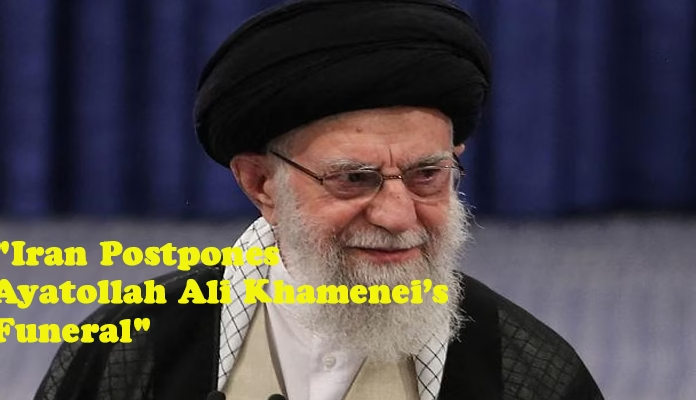
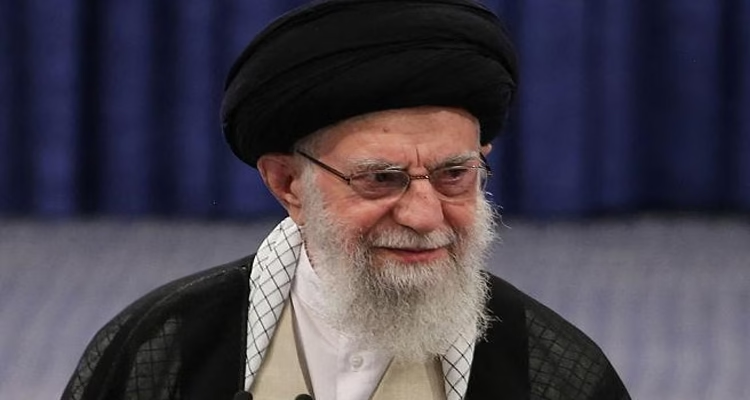
The death of Iran’s Supreme Leader, Ayatollah Ali Khamenei, would likely trigger a complex succession process, given his pivotal role in the country’s political and religious leadership since 1989. Khamenei became Supreme Leader after the death of Ayatollah Ruhollah Khomeini, the founder of the Islamic Republic who led Iran’s 1979 revolution and shaped the post-Shah political order.
His passing could usher in a period of political uncertainty as different factions within Iran’s power structure compete to shape the country’s future. Domestically, this may lead to shifts in policy direction and possible unrest. Internationally, it could affect Iran’s relations with major global and regional players, including the United States, Israel, and Saudi Arabia. The implications for nuclear negotiations and regional conflicts in countries such as Syria and Yemen could also be significant.
Economically, uncertainty surrounding the leadership transition may aggravate Iran’s existing challenges, particularly those linked to international sanctions. Under Iran’s Constitution, the Assembly of Experts is responsible for overseeing the succession process and appointing a new Supreme Leader. However, the final outcome remains uncertain.
Khamenei’s death has also evoked a wide range of reactions among Iranians, reflecting the country’s deep social and political divisions. In cities such as Tehran and Mashhad, thousands have gathered to mourn, chanting religious slogans and holding photographs of Khamenei. Many mourners, largely supporters of the ruling establishment and the Shia clergy, view him as a symbol of Iran’s sovereignty and Islamic identity.
At the same time, reports from other cities such as Karaj and Rasht indicate that some people have celebrated the news, dancing in the streets, honking car horns, and expressing hopes for political change and a more liberal future. These reactions highlight the opposition to Khamenei’s strict policies and his government’s human rights record.
Meanwhile, many Iranians remain anxious about what lies ahead. Concerns are growing over possible internal power struggles and the risk of escalating tensions with countries such as the United States and Israel. Although Iran’s interim leadership has promised continuity, uncertainty continues to dominate the political atmosphere.
Overall, Khamenei’s death has exposed deep fault lines within Iranian society and may set the stage for a volatile period in the country’s modern history.
Implications for India
Khamenei’s death could also have significant implications for India, particularly in terms of economic and strategic interests. One major concern is India’s investment in Iran’s Chabahar Port, a critical gateway for India’s access to Central Asia and Afghanistan while bypassing Pakistan. The stability of the 10-year operational agreement signed in 2024 may now face uncertainty.
The International North-South Transport Corridor (INSTC), designed to reduce transportation time and costs between India, Iran, Russia, and Central Asia, could also encounter delays if political instability in Iran intensifies.
Trade relations between the two countries may be affected as well. India exports goods such as rice, tea, and pharmaceuticals to Iran, while importing items including dry fruits and chemicals. Any disruption in these trade flows could impact businesses on both sides.
Another major concern is the Strait of Hormuz, a vital maritime route through which a significant portion of India’s crude oil imports passes. Instability in the region could disrupt shipping and push up global oil prices, potentially triggering inflationary pressures in India.
India’s broader strategic autonomy and its diplomatic balancing between Iran and the United States may also be tested. With Washington maintaining sanctions on Tehran, India must carefully navigate diplomatic and economic pressures while safeguarding its long-term interests.
Chabahar Port and Strategic Concerns
The Chabahar Port project remains central to India’s regional connectivity strategy. The port allows India to expand trade with Central Asia and Afghanistan while reducing reliance on routes through Pakistan. However, US sanctions on Iran continue to complicate India’s operations at the port.
India has already invested around $120 million in Chabahar’s development and is engaged in discussions with the United States regarding sanctions waivers. Currently, a waiver permitting limited operations is valid until April 2026. Any disruption at Chabahar could undermine India’s trade connectivity plans and weaken its strategic efforts to counter China’s growing influence in the region.
A Turning Point for Iran
Ayatollah Ali Khamenei’s death marks a pivotal moment in Iran’s political history, creating uncertainty over leadership succession, regional dynamics, and international relations. For India, the transition carries economic and strategic risks, particularly in relation to energy security and the future of the Chabahar Port project.
As Iran navigates this sensitive phase, careful diplomacy will be essential for India to protect its strategic interests. Ultimately, the passing of Khamenei exposes deep divisions within Iranian society and may usher in a volatile period with far-reaching implications for the region and the world.