
Guwahati: Prime Minister (PM) Narendra Modi has congratulated the people of Nepal and the interim government in Kathmandu for the successful conduct of the country’s 2026 general elections held on 5 March.
In a message posted on his verified social media account, Modi praised the enthusiastic participation of Nepali voters in the democratic process.
“It is heartening to see my Nepali sisters and brothers exercise their democratic rights so vibrantly,” the Prime Minister said.
Highlighting India–Nepal ties, Modi added that India remains committed to strengthening cooperation with the new government in Kathmandu.
“As a close friend and neighbour, India remains steadfast in its commitment to working closely with the people of Nepal and their new government to scale new heights of shared peace, progress and prosperity,” he stated.
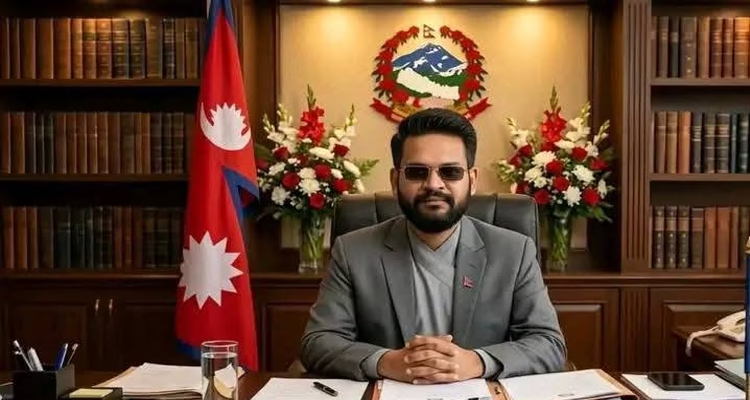
Later, Modi held telephone conversations with Rabi Lamichhane, chairman of the winning Rashtriya Swatantra Party (RSP), and Balendra Shah, the party’s prime ministerial candidate. During the conversations, the Indian Prime Minister congratulated them on their electoral victories and reaffirmed New Delhi’s commitment to work with the incoming government for the prosperity and well-being of both nations.
Had warm telephone conversations with Mr. Rabi Lamichhane, Chairman of the Rastriya Swatantra Party (RSP) and Mr. Balendra Shah, Senior Leader of the RSP.
Congratulated both leaders on their electoral victories and RSP’s resounding success in the Nepal elections. Conveyed my…
— Narendra Modi (@narendramodi) March 9, 2026
RSP Registers Major Electoral Victory
The Rashtriya Swatantra Party secured a decisive victory in the elections — the first national polls held after the violent youth uprising of September 2025 that shook the Himalayan nation.
The party won 125 of the 165 constituencies where direct voting took place for the 275-member House of Representatives.
Balendra Shah — a young engineer-turned-rapper-turned-politician and former mayor of Kathmandu — scored a major political upset by defeating veteran Marxist leader KP Sharma Oli in Jhapa-5 constituency in eastern Nepal.
Shah defeated the four-time prime minister by a margin of around 50,000 votes, positioning himself to become Nepal’s next prime minister.
Oli, who heads the Communist Party of Nepal (Unified Marxist-Leninist), was removed from power last year during the anti-corruption protests that triggered widespread unrest across the country.
The UML managed to win only nine seats, while Nepal’s oldest political party, the Nepali Congress, finished a distant second with 18 constituencies.
According to the Nepal Election Commission, other parties secured smaller numbers of seats:
-
Nepali Communist Party – 7 seats
-
Shram Sanskriti Party – 3 seats
-
Rastriya Prajatantra Party – 1 seat
RSP founder Rabi Lamichhane also won his constituency. Meanwhile, former prime minister Pushpa Kamal Dahal ‘Prachanda’, who led the Maoist insurgency between 1996 and 2006, secured victory in his electoral contest. However, Nepali Congress president Gagan Thapa lost his race.
Proportional Representation Votes
The remaining 110 members of parliament will be elected through the proportional representation system.
In the nationwide vote count:
-
RSP received 4,811,673 votes
-
Nepali Congress – 1,618,838 votes
-
CPN-UML – 1,348,368 votes
-
NCP – 732,992 votes
-
SSP – 341,032 votes
-
RPP – 315,438 votes
Other parties such as the Nepal Janata Samajwadi Party, National Change Party, and Janamat Party also secured smaller vote shares.
More than 60 percent of Nepal’s 19 million registered voters participated in the election. Ten women candidates — nine from the RSP and one from the Nepali Congress — were elected.
Election Held Under Interim Government
The election was conducted under the supervision of an interim government led by retired judge Sushila Karki, Nepal’s former chief justice.
Karki assumed office on 12 September 2025, becoming the first woman to lead the country’s executive authority, and announced that fresh elections would be held within six months.
The polling process was largely peaceful.
With the RSP preparing to form a single-party government — the first in a decade — Balendra Shah is expected to become Nepal’s youngest prime minister and the first from Madhesh province.
Strategic and Political Significance
Located in southeastern Nepal and bordering India’s Uttar Pradesh and Bihar, Madhesh province holds cultural and historical significance. The region includes Janakpur, believed in Hindu tradition to be the birthplace of Maa Sita, the revered figure from the epic Ramayana.
Before the election campaign, Shah attracted global attention by withdrawing the China-backed Damak industrial project in Jhapa district from the RSP manifesto.
The project — later renamed the Nepal-China Friendship Industrial Park — is associated with China’s Belt and Road Initiative and lies close to India’s strategically sensitive Siliguri Corridor, often called the “Chicken’s Neck”.
Shah has advocated a “Nepal First” policy in foreign affairs. His campaign promises include creating 1.2 million jobs, addressing youth unemployment, expanding social security measures, introducing healthcare insurance schemes, and launching welfare initiatives aimed at improving the lives of Nepal’s economically vulnerable population.