
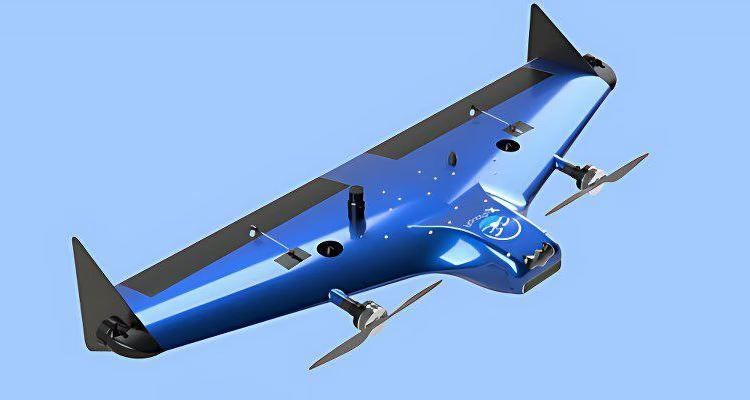
Bengaluru: In a breakthrough for India’s rapidly evolving deep-tech ecosystem, a Bengaluru-based startup has developed the country’s first amphibious drone capable of operating both in the air and underwater. Named “Avatar” (AVATAAR), the innovative drone can fly like a conventional quadcopter, dive into water to conduct underwater tasks, and then resurface to continue aerial operations.
The technology marks a significant step forward in multi-domain unmanned systems, offering a single platform that can perform surveillance and inspection tasks across both air and aquatic environments.
A Drone That Bridges Air and Water
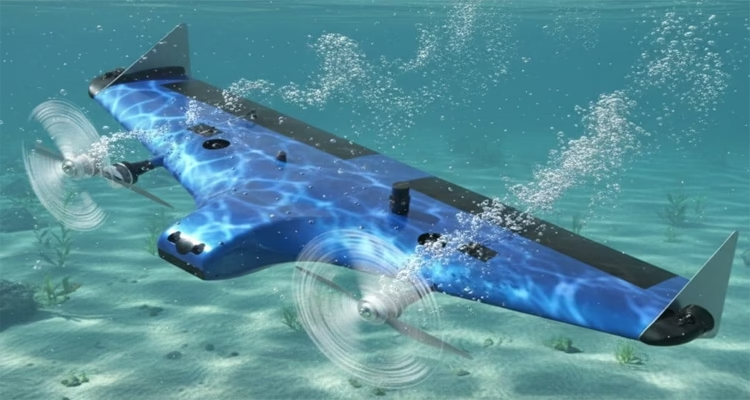
Unlike conventional drones that are limited to aerial missions, the Avatar drone is designed to seamlessly transition between flying and underwater navigation. During a mission, the drone can take off and perform aerial reconnaissance before descending onto a water surface and submerging to conduct underwater inspections or monitoring operations.
Once the underwater task is complete, the drone can emerge from the water and resume flight, allowing continuous multi-environment operations without needing separate aerial and underwater vehicles.
This hybrid capability significantly expands operational flexibility, especially in maritime environments where both surface and underwater intelligence are critical.
Advanced Engineering for Harsh Marine Conditions
The amphibious drone has been engineered to withstand the challenging conditions of marine environments. Its body uses corrosion-resistant materials and sealed electronics designed to protect sensitive systems from saltwater and debris.
To navigate underwater—where GPS signals do not function—the drone relies on advanced sensing and navigation technologies. These include sonar-based imaging systems that detect objects and obstacles, acoustic sensors for underwater mapping, and specialized navigation systems that maintain precise positioning even in low-visibility environments.
Integrated lighting and sensor modules allow the drone to carry out underwater inspections of structures, seabeds, and submerged objects.
Safety features are also built into the system. For instance, the drone will not initiate a dive if battery levels fall below safe operating thresholds, ensuring it can resurface and return safely.
Prototype Successfully Tested
The Avatar drone has already reached an advanced prototype stage, with successful demonstrations conducted in open-water environments. Engineers behind the project say the prototype has achieved a key development milestone, proving its ability to transition smoothly between aerial flight and underwater navigation.
The prototype has undergone multiple field tests to validate its propulsion system, waterproof electronics, and navigation capabilities. These trials have confirmed that the drone can perform both aerial surveillance and underwater inspection within a single mission cycle.
Following successful testing, the company is now refining the system’s performance, endurance, and sensor capabilities.
Moving Toward Production
The startup is currently working toward pre-production development, with plans to scale the technology for commercial and strategic applications. Engineers are focusing on improving battery efficiency, mission endurance, and payload capacity to support a wider range of operational requirements.
Once the next development phase is completed, the company aims to begin limited production of the amphibious drones for deployment in sectors such as maritime security, offshore infrastructure monitoring, and environmental research.
Interest in the technology is growing from both government and industry stakeholders, particularly in areas involving coastal surveillance and underwater inspections.
Wide Range of Applications
The drone’s ability to operate across two environments opens up numerous applications. In defence and security, it could support naval reconnaissance, port monitoring, and underwater threat detection. The platform can also be used to inspect offshore pipelines, underwater cables, and oil-and-gas infrastructure.
In addition, environmental agencies and research institutions could deploy the drone to study marine ecosystems, map seabeds, or monitor pollution in coastal waters.
Search-and-rescue operations following maritime accidents or disasters may also benefit from such technology, as the drone can quickly survey both surface and underwater areas.
A Milestone for India’s Deep-Tech Innovation
India’s vast coastline and growing focus on maritime security have created strong demand for advanced surveillance technologies. The development of Avatar demonstrates the growing capability of Indian startups to build sophisticated autonomous systems that combine robotics, artificial intelligence, and marine engineering.
If the project successfully enters large-scale production, the amphibious drone could become a significant addition to India’s emerging defence and maritime technology landscape, positioning the country among innovators developing next-generation multi-domain unmanned systems.
Key Points
-
India’s first amphibious drone: Bengaluru-based startup has developed ‘Avatar’ (AVATAAR), a drone capable of operating both in the air and underwater.
-
Dual-environment capability: The drone can fly like a quadcopter, land on water, dive underwater for operations, and then resurface to continue flying.
-
Advanced underwater navigation: Equipped with sonar-based sensing, acoustic navigation systems and cameras to operate even in low-visibility underwater conditions.
-
Marine-grade design: Built with corrosion-resistant materials and sealed electronics to withstand harsh saltwater environments.
-
Successful prototype testing: The drone has reached an advanced prototype stage and has already demonstrated its air-to-water transition capability in field trials.
-
Moving toward production: Developers are refining the system for improved endurance, battery efficiency and payload capacity before limited production.
-
Wide range of applications: Useful for maritime surveillance, naval security, underwater infrastructure inspection, ocean research and disaster response.
-
Boost to India’s deep-tech ecosystem: The innovation highlights the growing capability of Indian startups in robotics, autonomous systems and defence technology.