$2 Million Toll Fee / Safe Passeage Not for All—Only “Certain Ships” Face the Charge
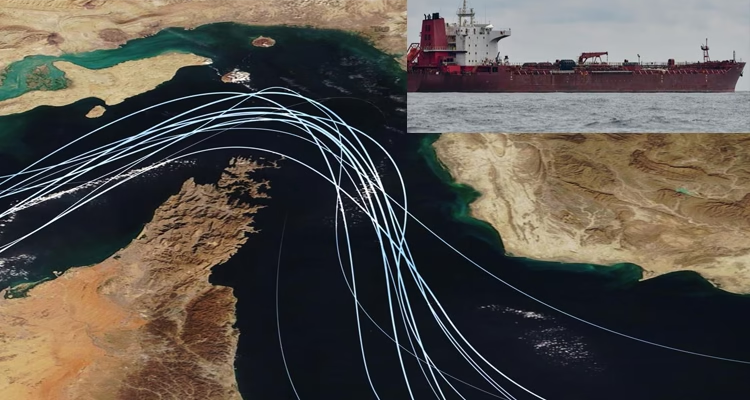
In a development that is sending ripples across global energy markets, Iran is reportedly charging select vessels up to $2 million for passage through the strategically vital Strait of Hormuz. The move, though not officially codified, signals a new phase in Tehran’s use of geopolitical leverage over one of the world’s busiest shipping corridors.
A Chokepoint Turned Pressure Point
The narrow strait, linking the Persian Gulf with global waters, carries a significant share of the world’s oil and gas shipments. Any disruption here instantly impacts global supply chains, oil prices, and maritime insurance costs.
Amid heightened tensions in the region, shipping activity has slowed, with several vessels either waiting for clearance or rerouting to avoid uncertainty.
Selective Toll, Not a Blanket Policy
Unlike a formal transit fee applied universally, the reported charges are selective and negotiated. Certain ships—especially oil tankers—are required to seek approval before entering designated routes.
An Iranian political figure was quoted as justifying the move bluntly:
“War has costs… we must take transit fees.”
Shipping insiders suggest that at least some companies have already paid hefty sums to secure safe passage, pointing to the emergence of what analysts describe as an informal toll system rather than an official tariff.
IRGC’s ‘Safe Corridor’ System
Control over this system is believed to rest with Iran’s powerful Islamic Revolutionary Guard Corps (IRGC), which is reportedly overseeing:
- Clearance and vetting of vessels
- Negotiation of passage terms
- Allocation of “safe corridors” for transit
This mechanism effectively allows Iran to decide which ships can pass—and under what conditions—turning the strait into a tightly managed gateway.
Geopolitics at Sea: Who Gets Through?
Access to the strait is increasingly being shaped by geopolitics. Ships linked to countries seen as adversarial may face stricter scrutiny or delays, while others—particularly from neutral or friendly nations—are more likely to receive clearance.
This selective approach has transformed the strait from an international passage into a strategic checkpoint influenced by diplomacy and alignment.
Global Fallout: Oil, Trade, and Tensions
The implications are far-reaching:
- Oil Markets: Even the perception of restricted access is pushing prices upward
- Shipping Costs: War-risk premiums and informal payments are increasing operational costs
- Legal Concerns: The move raises serious questions under international maritime law
- Supply Chains: Delays and rerouting threaten global trade stability
For major energy-importing nations, any prolonged disruption could translate into inflationary pressure and economic strain.
A New Maritime Reality
While the full extent of the reported $2 million “toll” remains fluid, one thing is clear: Iran is asserting unprecedented control over the Strait of Hormuz.
By combining military oversight, selective access, and negotiated transit costs, Tehran appears to be reshaping the rules of passage through one of the world’s most critical waterways—where every ship’s journey may now depend as much on politics as on navigation.