News Desk: A critical effort to ease tensions in West Asia hit a wall at the United Nations Security Council, where Russia and China vetoed a resolution calling for the reopening of the strategically vital Strait of Hormuz.
The draft, introduced by Bahrain and backed by the United States and several Western and Gulf nations, urged immediate de-escalation and restoration of maritime traffic through the Strait—through which a significant portion of the world’s oil supply passes.
Veto Exposes Global Divisions
Despite receiving 11 votes in favour in the 15-member council, the resolution failed after vetoes from Russia and China, underscoring deep fractures among global powers over how to address the crisis.
Both Moscow and Beijing argued that the resolution was “one-sided” and did not adequately reflect the broader geopolitical context, particularly the rising tensions linked to the ongoing US-Israel–Iran conflict.
Russia’s envoy Vassily Nebenzia said while Moscow supports freedom of navigation, the draft risked undermining diplomatic efforts. China’s ambassador Fu Cong echoed similar concerns, warning against selective pressure that could escalate the situation further.
US Criticises ‘Obstruction’
The United States strongly condemned the veto, with its envoy Mike Waltz calling the move “obstructionist” and a setback to global efforts aimed at stabilising energy routes and preventing further escalation.
Washington maintains that reopening the Strait is essential not just for trade, but for global economic stability and energy security.
Pakistan Maintains Neutral Stance
In a notable diplomatic signal, Pakistan chose to abstain from the vote, positioning itself between competing blocs. Its UN ambassador Asim Iftikhar Ahmad stressed the importance of keeping diplomatic channels open and avoiding steps that could shut down dialogue.
Colombia also abstained.
Diluted Draft Still Falls Short
Diplomats revealed that the resolution underwent multiple revisions in an attempt to build consensus, including removing earlier provisions that could have enabled the use of force to secure shipping lanes.
However, these changes failed to win over Russia and China, who maintained that the draft did not sufficiently address underlying regional dynamics.
High Stakes, No Consensus
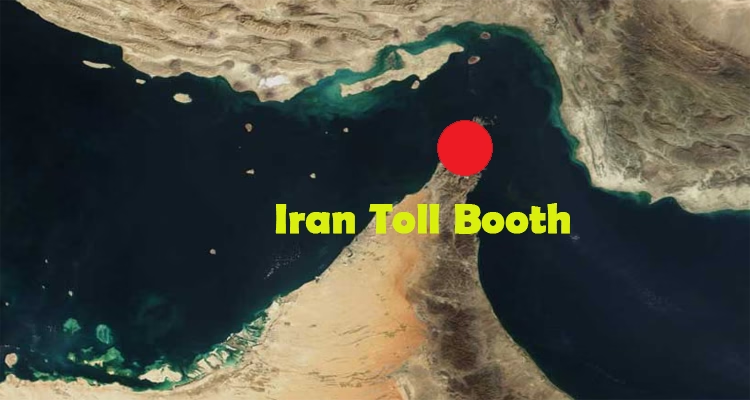
The failure of the resolution leaves the international community without a unified response as tensions in the Gulf intensify. With Iran continuing to restrict access through the Strait of Hormuz, concerns are mounting over disruptions to global oil supplies and the risk of a broader regional conflict.
The UNSC deadlock once again highlights the limitations of global diplomacy when major powers remain sharply divided.