
 by Vinod Chandrashekhar Dixit
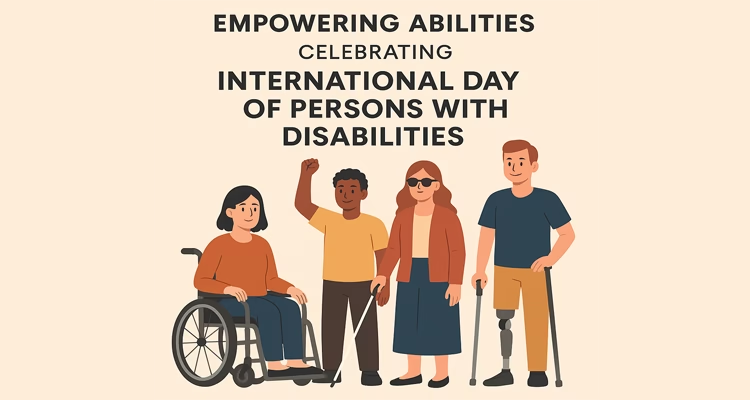
Every year on 3rd December, the world observes the International Day of Persons with Disabilities. The day seeks to deepen public understanding of disability-related issues and mobilize global support for the dignity, rights, and welfare of persons with disabilities. It also highlights the lived experiences of people with disabilities across political, social, economic, and cultural spheres.
Disability is a major concern in modern society. In 2006, the world took a significant step forward with the adoption of the UN Convention on the Rights of Persons with Disabilities (CRPD), which works toward ensuring equal opportunities for persons with disabilities and aligns strongly with the 2030 Agenda for Sustainable Development.
People with disabilities may experience physical, sensory, intellectual, or mental challenges that affect aspects of their daily lives. While they have often been treated as a minority and overlooked, they remain integral members of society. Modern governments and communities increasingly recognize the barriers they face and are working toward inclusive laws, infrastructure, and opportunities.
Yet, disability often requires emotional resilience and extraordinary determination. Different disabilities require different kinds of support and assistance, but two qualities remain crucial for empowerment: a positive attitude and strong self-confidence. With these, many individuals with disabilities have demonstrated that no obstacle is insurmountable and success is achievable.
According to the World Health Organization (WHO), more than one billion people worldwide experience disability, and this figure is expected to rise due to ageing populations and the increase in non-communicable diseases. Having a disability should never result in exclusion or isolation, yet many still experience social discrimination and marginalization. Children with disabilities, especially in developing countries, often face both physical obstacles and emotional isolation, leaving them with limited opportunities and hope.
Statistics show that the proportion of persons with disabilities globally has risen from around 10% in the 1970s to about 15% today, meaning roughly one out of every seven people in the world lives with some form of disability. Despite progress, harmful stereotypes persist. For decades, society has frequently labelled people with disabilities as “less capable” or “different,” undermining their individuality and achievements.
It must be remembered that human potential is not measured by physical ability alone. A determined individual can overcome physical, emotional, or mental challenges when driven by purpose and conviction. Disability is not an incapacity — it is a different way of interacting with the world.
As a society, we must ensure that persons with disabilities — our divyangjan — have full access to healthcare, quality education, employment opportunities, and social participation. True inclusion means not viewing disability as a limitation, but embracing the unique abilities and perspectives that every individual brings.
Let us move forward together, fostering dignity, inclusion, and empowerment for all.