
Vinod Chandrashekhar Dixit
dixitpatrakar@yahoo.in

As the world marks International Mountain Day 2025, the global spotlight turns to a theme that carries urgent ecological significance: “Glaciers matter for water, food and livelihoods in mountains and beyond.” The theme aligns with the UN’s proclamation of 2025 as the International Year of Glaciers’ Preservation, an effort that underscores the vital role glaciers play in securing water, food, clean energy and cultural identity for millions.
Since its inception in 2003, International Mountain Day has been observed every 11 December to draw attention to the indispensable role mountains play in sustaining life. These towering landscapes support 15% of the world’s population, shelter nearly half of all biodiversity hotspots, and feed some of the planet’s most important rivers. They are also cultural powerhouses — revered in mythologies, often imagined as celestial abodes of gods and goddesses, and home to temples and sacred sites that sit high above the plains.
Happening tomorrow! @UNmountains of @FAO will mark #IMD2025 by underscoring the vital role glaciers play in sustaining food, water and livelihoods in mountains and beyond.
🎥Tune into the live webcast: https://t.co/2GvyNC4QAS #MountainsMatter @SlowFoodItaly pic.twitter.com/v4zuSa9qM0
— Mountain Partnership (@UNmountains) December 10, 2025
But mountains are far more complex than their majestic silhouettes suggest. Some ranges continue to rise due to tectonic movement. The world’s tallest mountain, when measured from its true base beneath the Pacific, is Mauna Kea, not Everest. Many mountains are volcanic in origin; others carve entire continents with the freshwater they supply. These “water towers” are the source of drinking water, agriculture, hydropower and ecological balance for billions.
The Silent Crisis: Melting Glaciers
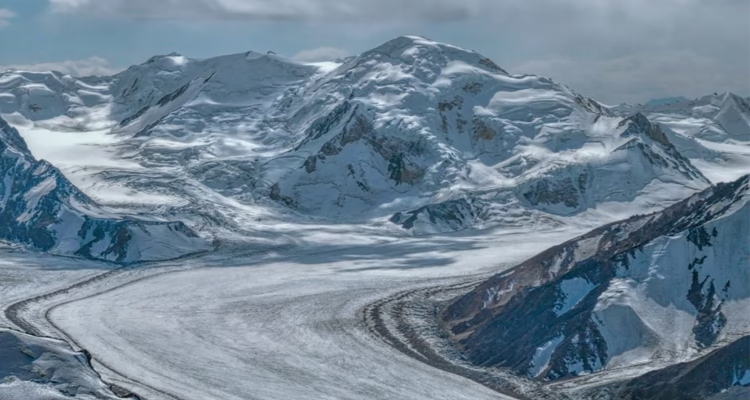
This year’s observance places glaciers at the center of global concern. Often perceived merely as frozen giants, glaciers in reality are living archives of Earth’s climate and lifelines for civilizations. They hold about 70% of the world’s freshwater, regulating river flows that sustain farms, forests, cities and wildlife.
But the crisis is accelerating. Rising global temperatures are causing glaciers to retreat at alarming rates. Their loss threatens agriculture, drinking water, clean energy generation and the fragile ecosystems downstream. Rapid melting increases the risk of floods, landslides, erosion, and the destruction of critical infrastructure. Mountain communities — already among the world’s most vulnerable — face heightened uncertainty.
Economies, too, feel the impact. Agriculture, hydropower, mountain tourism and transport sectors are under strain as water availability becomes unpredictable. For many Indigenous communities, glaciers are sacred; their disappearance is more than an environmental loss — it is a profound cultural and spiritual rupture.
A Call to Protect the Planet’s High Places
Mountains cover 27% of the Earth’s land surface yet influence nearly every aspect of human life, from weather systems to food production. As glaciers shrink and ecosystems shift, the world stands at a crossroads.
International Mountain Day 2025 is a reminder that preserving mountains is not only an environmental responsibility — it is a commitment to future generations. Safeguarding glaciers, restoring ecosystems and supporting mountain communities are essential steps toward climate resilience.
As we reflect on these mighty landscapes — their beauty, mystery and vulnerability — the message is clear: the time to act is now. Protecting mountains means protecting life itself. Let us continue to raise awareness, inspire action and work collectively to secure the world’s water towers for the decades ahead.