MI6 chief Blaise Metreweli warns of ‘dangerous grey zone’ between peace and war
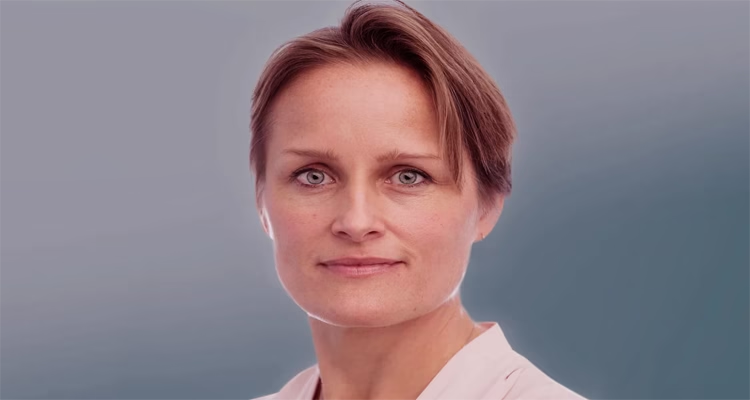
London: Britain’s foreign intelligence chief Blaise Metreweli has warned that the world is entering a perilous phase where conflicts are increasingly fought in a “grey zone” between peace and open war, marked by cyberattacks, sabotage, disinformation and covert state operations.
Metreweli is the first female chief of UK’s foreign spy service. In her first major public address as head of the Secret Intelligence Service (MI6), Metreweli said traditional ideas of warfare no longer capture the threats facing democratic nations. “We are seeing sustained hostile activity that deliberately stays below the threshold of war,” she cautioned, adding that such tactics are designed to weaken states without triggering a full military response.
What is MI6?
MI6, officially known as the Secret Intelligence Service (SIS), is the United Kingdom’s overseas intelligence agency. Its primary role is to gather human intelligence abroad, conduct covert operations, and provide classified assessments to the Prime Minister, the Foreign Secretary and senior policymakers to safeguard national security.
Unlike MI5, which handles domestic security, MI6 operates exclusively outside the UK. The agency’s chief is traditionally referred to as “C” and reports directly to the Foreign Secretary.
Warning on Russia and hostile states
Metreweli singled out Russia as a key example of a state using hybrid warfare tactics, accusing Moscow of exploiting diplomatic processes while simultaneously engaging in covert and destabilising activities across Europe. She said such actions are intended to coerce, confuse and divide adversaries rather than fight conventional wars.
Her remarks echo growing concern within Western intelligence circles over alleged sabotage attempts, cyber intrusions and influence campaigns linked to hostile states.
Technology changing espionage
A major focus of Metreweli’s warning was the rapid transformation of espionage through technology. Artificial intelligence, cyber capabilities, drones and data-driven surveillance are now central to intelligence work, she said, requiring agencies like MI6 to combine traditional spycraft with cutting-edge technical skills.
Metreweli, who previously headed MI6’s technology and innovation division, stressed that future intelligence operations will depend on mastering both human intelligence and advanced digital tools.
More proactive intelligence stance
Signalling a tougher approach, the MI6 chief said Britain must move beyond a purely reactive posture. She underlined the need for early disruption of threats through covert means and closer intelligence coordination with allies, particularly within NATO.
Why it matters
Analysts say Metreweli’s unusually candid public remarks reflect the scale of current global tensions and the growing risks posed by covert, low-intensity conflicts. As the first woman to lead MI6 since its founding in 1909, her warning is being seen as both a symbolic milestone and a clear signal that Britain’s intelligence strategy is adapting to a rapidly changing and more contested global security environment.
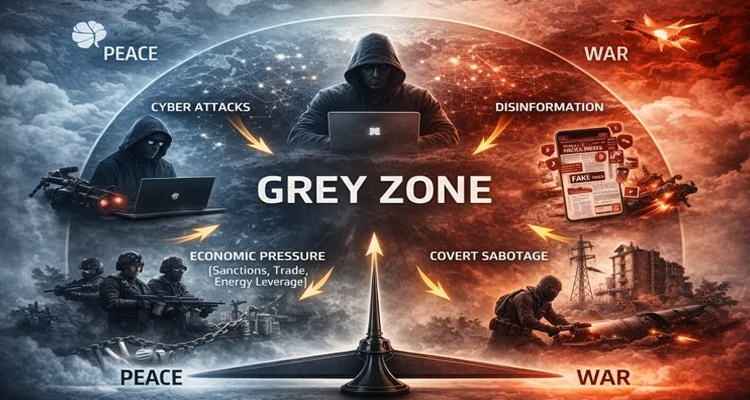
What the ‘Grey Zone’ threat means — MI6 chief’s warning explained
When MI6 chief Blaise Metreweli spoke of a growing “Grey Zone” threat, she was describing a new kind of conflict — one that sits between peace and open war.
It is not fought with tanks or missiles. There are no formal declarations of war. Instead, it is a slow, silent and continuous campaign designed to weaken a country from within.
Not peace, not war
The Grey Zone is where hostile states operate just below the threshold of war. The aim is simple: cause damage without provoking a military response.
By staying in this space, attackers make it hard for governments to prove who is responsible — and even harder to retaliate.
How Grey Zone warfare works
1. Cyber attacks without bullets
Power grids, banks, transport networks and government databases can be targeted through cyber intrusions. These attacks can disrupt daily life, steal sensitive data or create panic — all without firing a single shot.
2. Disinformation as a weapon
Social media and online platforms are used to spread fake news, half-truths and manipulated narratives. The goal is to divide societies, influence elections and erode trust in institutions.
Often, citizens themselves end up unknowingly amplifying foreign propaganda.
3. Covert sabotage
Mysterious fires, damage to undersea cables, ports or supply chains, and unexplained technical failures can all be part of Grey Zone tactics. Because these acts are covert, direct attribution becomes difficult.
4. Diplomacy on the surface, disruption underneath
One of the most dangerous aspects of Grey Zone conflict is its double face. A state may appear engaged in dialogue and diplomacy, while quietly conducting hostile operations behind the scenes.
This blurs the line between lawful behaviour and aggression.
5. Use of proxies and front organisations
Instead of acting openly, hostile actors often rely on proxies — criminal networks, fake NGOs, online groups or sympathetic influencers — to carry out operations while maintaining plausible deniability.
Why MI6 sees the Grey Zone as dangerous
According to Metreweli, Grey Zone threats are hard to counter because:
- The enemy is rarely visible
- Evidence is complex and slow to gather
- The attacks do not clearly justify military retaliation
- The real target is public trust, not territory
This form of conflict attacks a nation’s systems, institutions and social cohesion, rather than its borders.
The warning behind the words
The MI6 chief’s message is blunt: future conflicts may not begin with a bang. They will unfold quietly, day by day, across networks, screens and minds.
In the age of cyber power and information warfare, the most serious threats are often the ones that do not look like war at all.