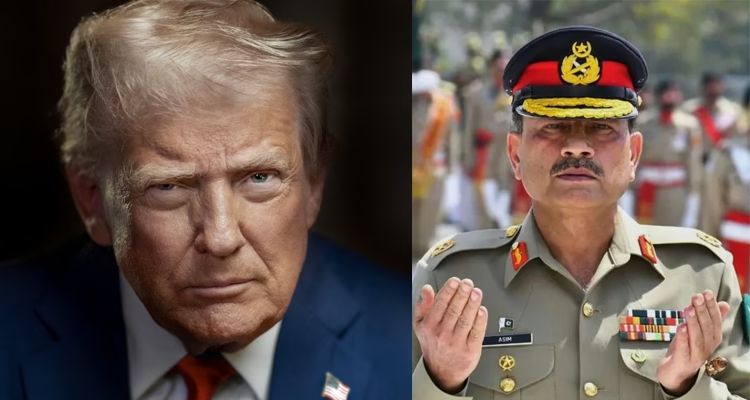
Pakistan Army chief Field Marshal Asim Munir is facing a sharp strategic test as pressure from Washington to deploy Pakistani troops in Gaza clashes with explosive public sentiment and long-held ideological positions at home.
– Trump wants Pak troops in Gaza
– Reports: U.S putting pressure on Pakistan
– ‘Pak wants to evade Gaza deployment’@SaahilSuhail shares details. pic.twitter.com/hUd3nyNaSk
— TIMES NOW (@TimesNow) December 17, 2025
The trigger is a US-backed proposal, promoted by President Donald Trump, to form an International Stabilisation Force for Gaza in the aftermath of Israel’s prolonged military campaign. Pakistan, with one of the largest standing armies in the Muslim world, has emerged as a key country Washington wants on board—placing Munir at the centre of a high-risk foreign policy moment.
Pakistan’s most powerful military chief in decades faces the toughest test of his newly amassed powers as Washington pushes Islamabad to contribute troops to the Gaza stabilization force, a move analysts say could spark domestic backlash https://t.co/su3ruIWbfb
— Reuters (@Reuters) December 17, 2025
Washington’s push, higher expectations
Munir is preparing for another visit to Washington—his third in recent months—as Trump seeks buy-in for a UN-supported Gaza framework that calls on Muslim-majority nations to shoulder security and reconstruction responsibilities.
US officials view Pakistan’s battle-hardened military and geopolitical weight as critical to lending credibility to the force. American troops, however, would stay off the ground, with command expected to rest with a US general coordinating multinational contingents.
Why Gaza is a political minefield for Islamabad
Any Pakistani military role in Gaza would cut against deeply entrenched domestic narratives. Islamabad has never recognised Israel and has long projected itself as a staunch backer of the Palestinian cause—a position hardened by the Gaza war that erupted in October 2023.
Public rhetoric in Pakistan has accused Israel of war crimes, sentiment echoed by religious leaders and Islamist groups capable of swift street mobilisation. Against this backdrop, even a limited deployment risks being portrayed as Pakistan’s army protecting Israeli interests under an American blueprint.
Munir’s shrinking room for manoeuvre
Since assuming office, Munir has carefully cultivated an image as a devout Muslim and guardian of Islamic values. Analysts say that image would come under immediate strain if Pakistani troops were sent to Gaza as part of a force widely seen as safeguarding post-war Israeli security.
The timing is particularly sensitive. Political tensions remain high, protests simmer over the jailing of former prime minister Imran Khan, and Islamist groups—despite restrictions—retain influence on the streets.
Balancing Washington without burning bridges at home
Foreign Minister Ishaq Dar has attempted to soften Pakistan’s position, suggesting Islamabad could consider peacekeeping or humanitarian roles while stressing that disarming Hamas is “not our responsibility.” The language reflects Pakistan’s effort to keep doors open in Washington without triggering backlash at home.
Analysts warn the balancing act may be unsustainable. Refusing US expectations could irritate Trump at a time when Pakistan is seeking investment, military cooperation and diplomatic support. Agreeing, however, could spark domestic unrest and strain ties with countries more sympathetic to Hamas, including Turkey and Qatar.
Power concentrated, risks magnified
Munir’s personal authority has expanded sharply. He now exercises effective command over all three armed services, has secured a long tenure extension, and enjoys legal protections that limit internal checks on his decisions. That consolidation gives him room to act—but also places full ownership of any fallout squarely on his shoulders.
A familiar Pakistan dilemma
Pakistan’s military has long walked a tightrope between external dependence and domestic legitimacy. Munir’s Gaza dilemma fits that pattern.
Sending troops could reinforce perceptions of Pakistan bending to Washington. Refusing could cool a fragile thaw with the US. Either way, the costs are high.
For Asim Munir, Gaza has become more than a distant conflict—it is a stress test of Pakistan’s military-led state, caught between Islamic symbolism at home and transactional geopolitics abroad.