
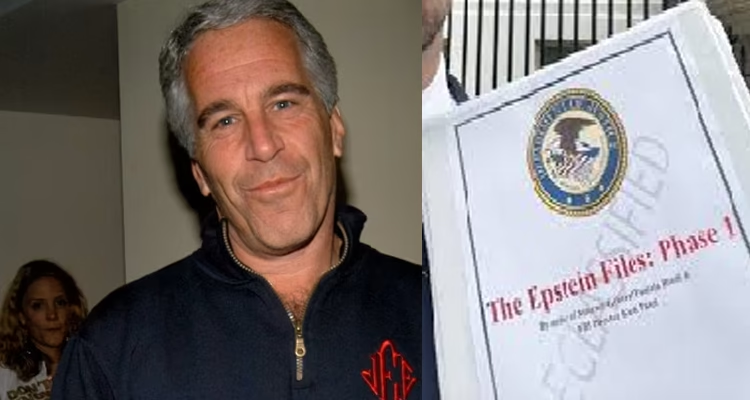
Years after disgraced financier Jeffrey Epstein died in a New York jail cell, the shadow of his crimes has returned to the centre of global attention. The long-awaited release of the so-called Epstein files — a massive cache of investigation records, court documents, flight logs and witness material — has reignited public outrage, political controversy, and a deeper reckoning over how power, privilege and silence intersected in one of the most disturbing abuse scandals of modern times.
A trove forced into daylight
The files were released after mounting public pressure and a new transparency law compelled the US Department of Justice to make public thousands of pages linked to Epstein’s investigations. These documents, collected over decades by federal agencies and courts, include early FBI complaints, travel records from Epstein’s private jets, seized photographs, contact lists and interview transcripts.
While parts of the material had surfaced earlier through civil lawsuits, this is the first time such a large body of official records has entered the public domain in one sweep.
What the documents confirm
At their core, the files reinforce what survivors and journalists have long alleged: Epstein ran a sustained system of sexual exploitation of minors, protected for years by wealth, influence and legal manoeuvring.
The records show:
-
Repeated warnings ignored: Complaints and tips dating back to the 1990s indicate law enforcement was alerted to Epstein’s conduct long before his first conviction.
-
A vast social network: Flight logs and contact books reveal Epstein’s connections to politicians, business leaders and celebrities — though officials stress that presence in records does not imply criminal wrongdoing.
-
Systematic abuse: Witness statements and corroborating evidence underline how girls were recruited, trafficked and silenced.
Epstein’s longtime associate Ghislaine Maxwell, already convicted for her role in recruiting and grooming victims, features prominently across the files, particularly in interview transcripts and correspondence.
Unredacted Trump photos from Epstein files dump reveal glamorous group of adult models: ‘He was very gentlemanly’ https://t.co/RrME3m3RI2 pic.twitter.com/juq9KBRMn9
— New York Post (@nypost) December 12, 2025
ALSO READ:- Jeffrey Epstein Explained: His Residences, Network, and the Scandal That Shook the World
What remains hidden
Despite the scale of the release, large sections of the files remain blacked out. Names are redacted, pages are withheld, and entire exhibits are missing. Authorities cite victim privacy, grand jury secrecy and ongoing legal sensitivities.
This has fuelled sharp criticism from lawmakers, civil rights groups and journalists, who argue that the public is still seeing only part of the truth. Others warn that reckless disclosure could retraumatise survivors or unfairly implicate individuals without evidence.
Politics, mistrust and conspiracy
Epstein’s 2019 death — officially ruled a suicide — continues to feed widespread suspicion. For some, the newly released files confirm a belief that powerful figures escaped scrutiny. For others, the documents expose not a grand conspiracy but a prolonged institutional failure: fragmented policing, deferential prosecutors and a justice system ill-equipped to confront elite offenders.
The partial nature of the release has only deepened mistrust, turning the Epstein files into both a legal archive and a political weapon.
Why the Epstein files matter
Beyond the headlines, the Epstein files represent something larger than one man’s crimes. They expose how:
-
Survivors were repeatedly disbelieved or sidelined
-
Legal secrecy shielded systemic failure
-
Wealth and proximity to power distorted accountability
For victims’ advocates, the disclosures are overdue validation. For institutions, they are an indictment.
The unfinished reckoning
The release of the Epstein files is not an ending — it is a checkpoint. Further court battles, investigative reporting and possible congressional scrutiny are expected. Whether new criminal cases emerge remains uncertain.
What is clear, however, is this: the Epstein scandal is no longer buried in sealed courtrooms. Its records are now public, its questions louder than ever — and its legacy a stark warning of what happens when power goes unchecked and voices go unheard.
_______________________________________________________________________________________
DOJ Releases Epstein Files on December 20, 2025
Epstein Files: What Has Been Revealed So Far
| Category | Status | Details |
|---|---|---|
| Document Volume | Partial (Incomplete) | Only a portion released so far; hundreds of thousands of pages still pending |
| Redacted Content | Very High | 1,200+ victim names protected; over 550 pages completely blacked out |
| Prominent Figures | Mentioned | References to Bill Clinton, Michael Jackson, Bill Gates, and other high-profile names |
| Evidence Photos | Newly Released | Images of hard drives, home interiors, passports, and digital storage devices |
| Next Release Schedule | Rolling Basis | New document batches expected weekly through the end of 2025 |
What This Means
The Epstein disclosures are far from complete. What has been released so far is only a fragment of a much larger archive.
With weekly releases expected, more names, documents, and connections may emerge in the months ahead, keeping the case firmly in global focus.
updated



One Comment on “Epstein Files Unsealed: What the Records Reveal — and What They Still Hide”