
Swadesh Kumar, Lucknow
Senior Journalist
The customary tea hosted by the Lok Sabha Speaker after the winter session of Parliament is usually a routine, protocol-bound affair. This time, however, it sparked an intense political conversation—largely because of the presence and positioning of Congress’s new MP, Priyanka Gandhi Vadra.
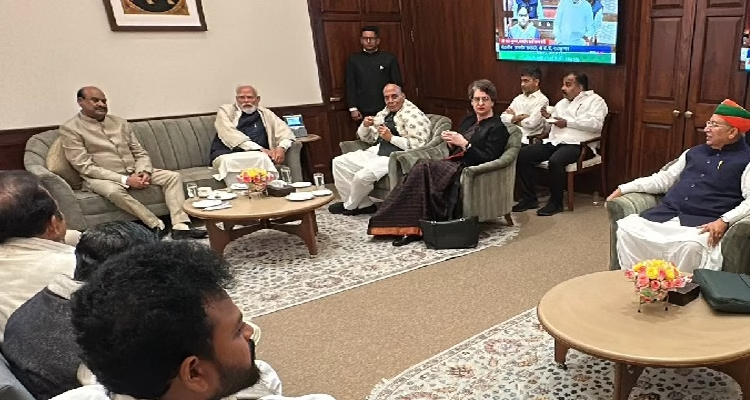
Photographs from the gathering showed Priyanka Gandhi seated prominently in the front row alongside Prime Minister Narendra Modi and Defence Minister Rajnath Singh. The images quickly became a talking point, suggesting subtle but significant shifts in Congress’s internal dynamics and a new style of opposition leadership taking shape.
In politics, visuals often speak louder than statements. This was Priyanka Gandhi’s first session in Parliament, yet her ease and confidence signalled that she does not intend to remain a low-profile newcomer. Her seating—typically reserved for top leaders and constitutional authorities—was widely read as symbolic. Equally notable was her brief, informal exchange with the Prime Minister. According to sources, the conversation touched upon issues related to Wayanad, her constituency, indicating her willingness to raise local concerns directly at the highest level.
The contrast with Rahul Gandhi was hard to miss. Rahul Gandhi, known for his sharp opposition speeches and confrontational tone inside the House, skipped the informal tea. Priyanka, instead, chose engagement. Within Congress circles, this divergence has triggered fresh comparisons between two distinct political styles—one rooted in ideological confrontation, the other in dialogue and negotiation.
Priyanka Gandhi’s approach was also visible beyond the tea meeting. During the session, she sought out Union Road Transport Minister Nitin Gadkari to discuss a national highway project linked to Wayanad. Gadkari promptly invited her for a meeting, which was described as cordial and constructive. For an opposition MP, especially a first-timer, such access reflects careful preparation and a willingness to engage across party lines.
Several Congress leaders believe this style could work to the party’s advantage. Priyanka arrives early for proceedings, closely follows parliamentary business, and maintains a visible presence both inside the House and in its corridors. Her media footprint has grown steadily, reinforcing the perception that responsibilities within the party may be gradually rebalancing.
Another notable development is the renewed visibility of experienced leaders like Manish Tewari and Shashi Tharoor. Long seen as underutilised, they are now speaking more forcefully on key issues. Within Congress, there is a growing belief that Priyanka recognises the cost of sidelining capable voices—and that her encouragement has helped project a more confident, coherent opposition.
Many in the party see echoes of Sonia Gandhi in Priyanka’s working style—emphasising consensus, calm problem-solving, and organisational unity. At a time when Congress has struggled with factionalism, her role as a listener and mediator is being welcomed. Senior leaders increasingly take their concerns and suggestions directly to her, confident of being heard.
Even within the Bharatiya Janata Party, the shift is being noticed. BJP leaders often respond sharply to Rahul Gandhi’s remarks, but their tone towards Priyanka Gandhi has been noticeably more measured. She questions the government and holds it accountable, yet does so in a way that demands engagement rather than dismissal.
Political analysts argue that the tea meeting marked more than a moment of optics—it hinted at a strategic recalibration within the Indian National Congress. The emerging view is that Rahul Gandhi may continue as the party’s ideological spearhead and mass mobiliser, while Priyanka Gandhi manages day-to-day parliamentary and organisational politics. Such conversations, once whispered, are now being openly discussed within the party.
Throughout the session, Priyanka Gandhi demonstrated a belief that opposition need not exclude dialogue. Her tea-time interaction symbolised a politics where disagreement and discussion coexist. For the public, it offered a reminder that democratic engagement is possible even amid deep differences.
Whether this moment signals the rise of two power centres or simply a pragmatic division of roles remains to be seen. But one conclusion is already evident: that cup of tea was about far more than hospitality. It offered a glimpse into Congress’s evolving political style—and affirmed that Priyanka Gandhi is ready to play an active, consequential role, not merely carry a famous surname.