 Ajay Kumar I Senior Journalist
Lucknow (U.P.)
There is no shortage in India of leaders and political parties who readily raise their voices for Muslims anywhere in the world. Whenever Israel takes military action against Hamas in Gaza, leaders of several parties and organisations here rush to protest—often loudly, sometimes violently. Congress General Secretary Priyanka Gandhi Vadra even carried a Palestine-themed bag into Parliament to register her protest.
Yet, when Hindus are persecuted—or even killed—anywhere in the world, these very voices fall silent. The same leaders who routinely attack the Bharatiya Janata Party and Hindu organisations in the name of Dalits and backward classes appear unwilling to utter a single word when atrocities are committed against Hindus in Bangladesh or Pakistan. This silence represents the peak of Muslim-appeasement politics.
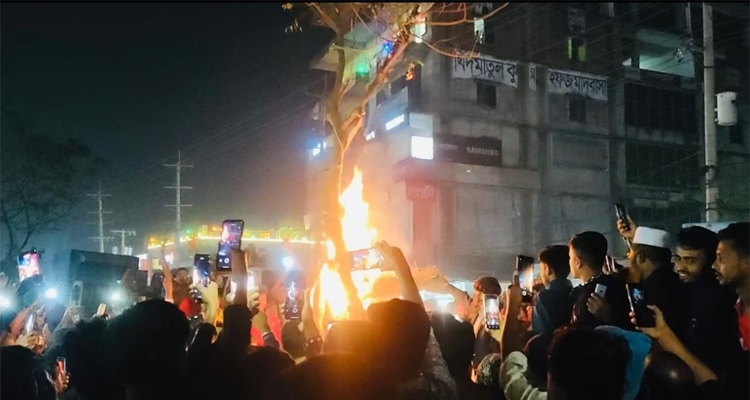
Today, protests are taking place across the country over the killing of a Hindu youth in Bangladesh. Yet, barring a few exceptions, no major Muslim organisation or Muslim vote–dependent leader has come forward. From Rahul Gandhi to Akhilesh Yadav, Chandrashekhar Azad, and Tejashwi Yadav, the silence is striking. The reason is obvious: fear of losing the Muslim vote bank. This brand of politics—riding on the backs of Dalits and backward classes while appeasing a particular community—has continued for years.
After the fall of Sheikh Hasina’s government, violence that began in August 2024 has disproportionately targeted the Hindu community in Bangladesh. Reports indicate that thousands of Hindu homes were attacked, temples vandalised, and women subjected to brutal atrocities. Backward and Dalit Hindu communities—particularly groups such as the Namasudras—have suffered the most. According to rights groups and local media, at least 200 Hindus have been killed and property worth millions destroyed.
The situation among Dalit Hindu communities is even more horrifying. Already burdened by poverty and social discrimination, these rural populations saw their villages burned and women abducted by violent mobs. Yet Dalit leaders in India remain conspicuously silent. Why? Because speaking out might upset the carefully cultivated Muslim vote bank. The hypocrisy becomes evident when these leaders invoke Dalit issues during elections but ignore the mass suffering of Dalit Hindus beyond India’s borders.
Rahul Gandhi, who projects himself as a messiah of Dalits, speaks frequently of justice. During the Bharat Jodo Yatra, he dined in Dalit homes and led a Nyay Yatra. But when Dalit Hindus are massacred in Bangladesh, there is not a word—neither in Parliament nor on social media. This silence appears strategic. In the 2024 Lok Sabha elections, Congress relied heavily on a Muslim–Dalit alliance; raising the Bangladesh issue could fracture that equation. When violence erupted in Manipur, Rahul visited promptly. Bangladesh, however, drew no such response. This is not Dalit politics—it is vote-bank politics cloaked in moral language.
The Samajwadi Party’s PDA formula (Backward, Dalit, Minority), championed since the days of Mulayam Singh Yadav and continued by Akhilesh Yadav, has centred on a Muslim–Yadav alliance. In the 2022 Uttar Pradesh Assembly elections, this strategy was reinforced. But when Dalit Hindus face brutal persecution in Bangladesh, Akhilesh Yadav’s silence is total. Nearly 40 per cent of the party’s votes come from Muslims; speaking up risks political loss. Instead, symbolic attacks on issues like the Ram Temple continue to keep a section of voters appeased.
To weaken Mayawati’s Dalit base, the Samajwadi Party promoted Chandrashekhar Azad. Yet when Dalit rights are crushed in Bangladesh, his voice is absent. Chandrashekhar, who brands himself a Bhim Army warrior, mobilised Dalit youth against the Citizenship Amendment Act, calling it anti-Dalit—even as persecuted Dalit Hindus from Bangladesh seek refuge in India. Now allied with the Samajwadi Party, he appears more focused on electoral arithmetic than on the real suffering of Hindu Dalits. His activism resonates online, but the cries of Dalits across the border neither reach his ears nor move his conscience.
In Bihar, Tejashwi Yadav continues the Muslim–Yadav formula pioneered by his father, Lalu Prasad Yadav. While attempting to woo Dalits ahead of the 2025 Assembly elections, Tejashwi has remained silent on Bangladesh—not even a single tweet. With Muslims comprising around 17 per cent of Bihar’s electorate, the silence seems calculated. He frequently attacks the Modi government over the Citizenship Amendment Act and the NRC, yet avoids speaking about Hindu refugees from Bangladesh to prevent upsetting his vote base. When Rohingya Muslims faced persecution, Lalu and Tejashwi were vocal. When Hindu Dalits are targeted, they say nothing.
This is the uncomfortable truth of backward-class politics: Dalits and backward communities are often treated merely as vote banks. In Bangladesh, the Hindu population has fallen from around 20 per cent to barely 8 per cent, with Dalit Hindus being the most vulnerable. While the Indian government has extended refuge and raised concerns, much of the opposition remains silent because a Muslim vote share of 18–20 per cent can decisively influence elections.
Political analysts point out that the upcoming 2026 West Bengal and 2027 Uttar Pradesh Assembly elections partly explain this silence. Even Dalit organisations like the Bhim Army appear trapped in alliance politics. Meanwhile, the BJP has raised the Bangladesh issue through Dalit leaders such as Ramdas Athawale. If Dalit and backward leaders abandon appeasement politics, Hindu Dalits could truly benefit.
Bangladesh must be held accountable for the safety of its minorities, and persecuted refugees should receive the benefits of the Citizenship Amendment Act. Otherwise, this cycle of selective outrage will continue. Dalits must recognise that leaders who claim to represent them often do so only for votes. When the pain of Bangladesh is raised without fear or favour, only then can a genuine revolution in politics begin.