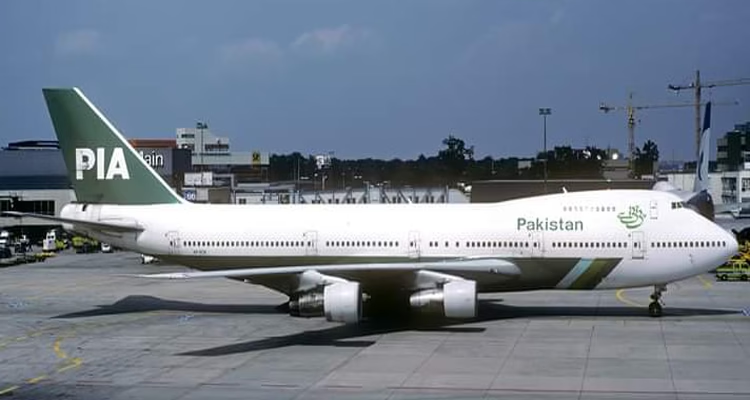
Islamabad: Pakistan’s long-troubled national carrier, Pakistan International Airlines (PIA), has finally been privatised after years of losses, bailouts and failed attempts to offload the airline. In a fiercely contested auction held in Islamabad on Tuesday, the Arif Habib consortium clinched the deal with a highest bid of Rs 135 billion, marking one of the most significant privatisation moves in Pakistan’s recent economic history.
Once a symbol of national pride and aviation excellence, PIA had slipped into chronic financial distress, becoming a major burden on the exchequer. A previous privatisation attempt last year failed to attract credible offers, but renewed interest from major business groups revived the process this time.
How the Bidding Unfolded
Ahead of the auction, three bidders were in the fray:
-
Lucky Cement, led by prominent industrialist Muhammad Ali Tabba
-
Arif Habib Group, a heavyweight in Pakistan’s financial and investment sector
-
Airblue, one of Pakistan’s leading private airlines
In the first round of bidding, Lucky Cement offered Rs 101.5 billion, Airblue Rs 26.5 billion, while the Arif Habib consortium led with Rs 115 billion. Based on the highest initial bid, the reference price was set at Rs 115 billion. Airblue exited after the first round.
According to Dawn, the second round began with bid increments of Rs 250 million. When Lucky Cement raised its offer to Rs 134 billion, the Arif Habib consortium responded with a decisive Rs 135 billion, sealing the deal.
What the Deal Involves
The sale covers 75 per cent of PIA’s shares, with the winning bidder required to acquire the remaining 25 per cent within 90 days. Reports indicate that 92.5 per cent of the proceeds will be reinvested into the airline, and the consortium will have to inject an additional Rs 80 billion over the next five years to revive operations, modernise the fleet and stabilise finances.
Arif Habib on Taking Over PIA
After emerging as the winning bidder, business leader Arif Habib described the privatisation as a boost for investor confidence.
“Privatisation will promote investment in Pakistan,” he was quoted as saying. Calling PIA a “national institution,” Habib recalled its past glory, noting that the airline was once ranked among the world’s best. He also told Geo News that he is open to bringing in foreign airline partnerships once the transaction is completed.
Government Reactions
Pakistan Prime Minister Shehbaz Sharif hailed the sale as “a historic day for Pakistan,” saying the transparent and competitive bidding process reflected renewed confidence in the country’s economy.
“The strong participation of our leading business groups is a powerful vote of confidence in Pakistan’s future,” the Prime Minister said in a post on X.
Alhamdolilah! A historic day for Pakistan 🇵🇰
It was our firm commitment to the people of Pakistan that speedy and concrete steps would be taken to privatise loss-making state-owned enterprises that have been a burden on the economy.
The successful completion of the transparent…
— Shehbaz Sharif (@CMShehbaz) December 23, 2025
Interior Minister Mohsin Naqvi echoed the sentiment, calling the outcome a national win, while Finance Minister Muhammad Aurangzeb expressed hope that the deal would attract further domestic investment.
Economist and policy expert Khaqan Najeeb termed the sale a “good start,” noting that it was the first successful privatisation of a major institution in nearly two decades.
Rise and Fall of a National Carrier
PIA was founded on October 29, 1946, in pre-Partition India by Mirza Ahmad Ispahani and Adamjee Haji Dawood. After Pakistan’s creation in 1947, it became the country’s primary carrier and a pioneer in Asian aviation, including being the second Asian airline to operate Boeing 707 jets in 1960.
However, decades of mismanagement, safety issues, flight cancellations and mounting debt led to its collapse. In 2023 alone, PIA reported losses exceeding Rs 75 billion, while its total liabilities ballooned to around Rs 825 billion.
With privatisation long seen as the only viable exit from this financial black hole, Tuesday’s auction signals a decisive — though challenging — new chapter for Pakistan’s national airline.