 Ajay Kumar
Senior Journalist
Lucknow (U.P.)
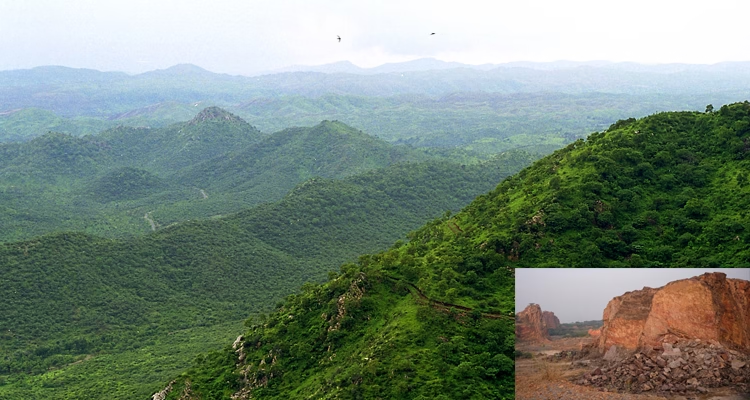
The Aravalli Range has long served as a vital environmental shield for Delhi‑NCR and its surrounding regions. Acting as a natural barrier against desertification, it supports groundwater recharge, conserves air and water quality, and prevents soil erosion. Over decades, however, this ancient mountain system has faced sustained pressure from real-estate interests, mining lobbies, and shifting political priorities. Time and again, environmentalists, planners, and the judiciary have stepped in to prevent irreversible damage.
A landscape repeatedly under threat
Large stretches of the Aravalli lie in Faridabad and Gurugram. Successive state governments attempted to remove these lands from the definition of forest areas to facilitate construction and mining. A decisive moment came in December 2017, when the NCR Planning Board rejected a proposal to de-notify nearly 17,000 acres in Faridabad. The Board clarified that the Aravalli would be recognised as a protected ecological system across the entire NCR—not just within Haryana and Rajasthan—thereby blocking a major avenue for encroachment.
The DRDO land controversy
The sensitivity of the Aravalli ecosystem was underscored by the controversial sale of land by the Faridabad Municipal Corporation to the Defence Research and Development Organisation (DRDO). About 407 acres falling under Sections 4 and 5 of the Punjab Land Preservation Act (PLPA)—which prohibits non-forest activity—were sold to the Ministry of Defence, subject to environmental clearance.
Clearances never came. The Central Empowered Committee and the Ministry of Environment, Forest and Climate Change declined permission, and the Comptroller and Auditor General of India criticised the transaction as imprudent. Earlier attempts by DRDO to divert forest land were halted after officials confirmed the area’s forest status, which—under orders of the Supreme Court of India—requires central approval for any non-forest use.
Projects stalled, forests saved
Other high-profile projects met similar resistance. The proposed European Technology Park near Manesar, cleared on 500 acres during the Hooda government’s tenure, was stopped by the environment ministry. In 2012, the draft Manesar Development Plan-2031—seeking to include more than 10,000 hectares from 23 villages—was refused approval by the NCR Planning Board to protect forest land.
In February 2019, the Haryana Legislative Assembly passed an amendment to the PLPA that could have opened around 60,000 acres of Aravalli forest for development. The Supreme Court intervened, staying the law and reiterating that lands covered under the PLPA must be treated as forest and cannot be casually diverted.
A new definition, new anxieties
Recent judicial observations redefining the Aravalli as areas rising 100 metres or more have sparked fresh concern. Environmental experts warn that excluding smaller slopes would weaken ecological protection, even though such terrain is crucial for groundwater recharge, air purification, and soil stability. Any dilution, they argue, could worsen air pollution, water scarcity, and dust storms across Delhi-NCR.
Public resistance gathers pace
In response, citizens and environmental groups in Haryana and Rajasthan have intensified protests. Student organisations like the National Students’ Union of India (NSUI) and civil society networks have organised campaigns such as the Save Aravalli March. Their message is clear: the Aravalli is not merely a chain of hills but a lifeline for biodiversity, water, and clean air.
A test for policy and justice
Today, the fate of the Aravalli stands at the intersection of politics, policy, and judicial oversight. Governments maintain that no new mining leases will be issued and that land management will proceed under Supreme Court supervision. Environmentalists counter that even subtle definitional changes could erode hard-won safeguards.
The struggle to save the Aravalli has become a decisive national test. It is about far more than land or wildlife—it concerns environmental security, public health, and the rights of future generations. If this green shield is compromised, Delhi-NCR and neighbouring states risk severe air pollution, water crises, and biodiversity loss. That is why the eyes of the nation remain fixed on the Aravalli Range, a symbol of both ecological resilience and the enduring fight to protect it.