
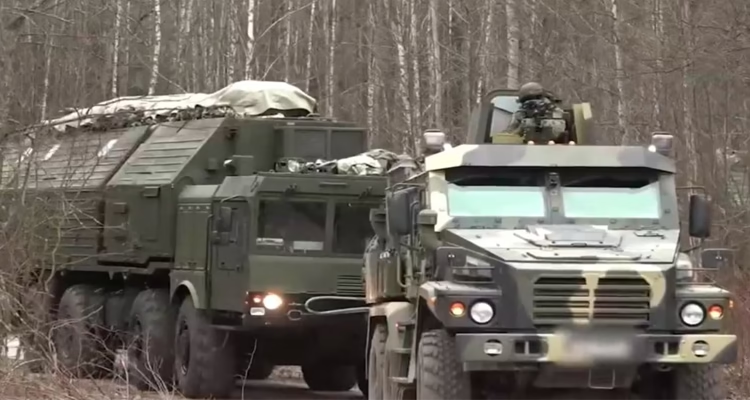
Moscow/Minsk: Russia on Tuesday confirmed that its nuclear-capable Oreshnik missile systems have entered active combat duty in Belarus, a close ally that borders NATO members Poland, Lithuania and Latvia—raising fresh alarm across Europe over Moscow’s expanding nuclear posture.
According to official statements cited by international media, the missile units are now operational at undisclosed locations inside Belarus. Footage released by the Russian and Belarusian defence ministries showed the systems being moved into forested areas and concealed under camouflage nets, underscoring efforts to keep deployment sites hidden.
Minsk Is Locked & Loaded: ‘Oreshnik’ Missile System Assumes Combat Duty In Belarus pic.twitter.com/efcXKXOk0p
— RT_India (@RT_India_news) December 30, 2025
Russian President Vladimir Putin has described the Oreshnik as “impossible to intercept,” claiming it travels at speeds exceeding ten times the speed of sound. Military analysts say stationing such systems in Belarus could significantly reduce warning times for potential strikes on European targets.
The intermediate-range missile is believed to have a reach of roughly 5,500 km, allowing it to hit targets across Europe and, if launched from Russian territory, potentially even the US west coast. Belarus’s defence ministry said the Oreshnik missile division has begun carrying out “combat duty tasks” in designated areas of the country.
Western security experts argue that the move reflects the Kremlin’s increasing reliance on nuclear signaling to deter NATO countries from supplying Ukraine with long-range weapons capable of striking deep into Russian territory.
‼️🇧🇾🇷🇺 BREAKING: Belarus Deploys Russian Oreshnik Missile System
Satellite images reveal the former airfield just 4 km from the Russian border now hosts launch areas and support infrastructure. Analysts see this as Minsk boosting regional strike capabilities and deepening… pic.twitter.com/dpUVplBRiV
— WAR (@warsurveillance) December 28, 2025
US researchers, citing analysis of satellite imagery, told Reuters that Russia is likely positioning the missiles and their mobile launchers at a former air base in eastern Belarus.
The deployment follows a sharp escalation in nuclear rhetoric since November 2024, when Moscow formally lowered its threshold for nuclear weapons use—a shift widely seen as a warning to the West. Shortly afterward, Russia used the newly introduced Oreshnik, fitted with a conventional warhead, in a strike on Dnipro in Ukraine, marking its first battlefield use.
Defense analysts say the appearance of the nuclear-capable Oreshnik represents a serious challenge to Europe’s existing missile defence systems. The missile’s name, derived from the Russian word for hazel shrub, has quickly become associated with a new phase of strategic intimidation.
Adding to global concern, Putin earlier announced the testing of the nuclear-powered Burevestnik cruise missile, reinforcing signs that Russia is accelerating the development and deployment of next-generation strategic weapons amid its prolonged confrontation with the West.