India’s Data Shows AI Is Creating More Jobs Than It Replaces
 by Ashis Sinha
Even as fears persist that Artificial Intelligence (AI) could replace human jobs, emerging evidence from India suggests a more nuanced reality—one where AI is reshaping work, not erasing it, and creating new opportunities across sectors.
According to a 2024 report by NASSCOM titled Advancing India’s AI Skills, India’s AI talent pool is projected to more than double by 2027. The number of AI professionals is expected to rise from about 6–6.5 lakh to over 12.5 lakh, growing at a compound annual rate of 15 percent. Demand is accelerating in areas such as data science, data curation, AI engineering and advanced analytics.
Government data shows that by August 2025, nearly 8.65 lakh candidates had enrolled or received training in emerging technology courses, including over 3.20 lakh in AI and Big Data Analytics, underscoring the growing appetite for future-ready skills.
Artificial Intelligence is not just a technological shift, it’s a workforce revolution.
As continues to augment roles and create new opportunities, it is expected to transform 38 million jobs transform by 2030!Read India Skills Report for more: https://t.co/99iz1niJdC#AI… pic.twitter.com/3Nw9pIvQzx
— CII Western Region (WR) (@CII4WR) December 31, 2025
Reskilling Push to Prepare Workforce
To equip professionals for this shift, the Ministry of Electronics and Information Technology (MeitY) has rolled out FutureSkills PRIME, a national reskilling and upskilling programme covering 10 emerging technologies, including AI. As of August 2025, more than 18.56 lakh candidates had registered on the platform, with over 3.37 lakh successfully completing their courses.
Officials say the programme reflects a broader strategy to ensure that AI augments human capability rather than displacing it.
AI in Governance and Justice Delivery
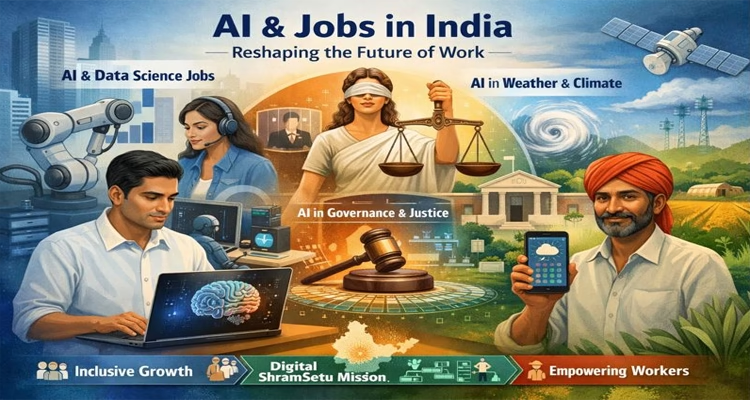
AI is also transforming governance and public services. The Supreme Court of India has highlighted the integration of advanced technologies under the e-Courts Project Phase III to improve efficiency and accessibility in the justice system. Tools based on Machine Learning, Optical Character Recognition and Natural Language Processing are being deployed for translation, intelligent scheduling, automated filing and chatbot-based communication.
AI Translation Committees in High Courts are overseeing the conversion of Supreme Court and High Court judgments into regional languages. Platforms such as e-HCR and e-ILR now allow citizens to access judgments online in multiple vernacular languages, making justice delivery more transparent and inclusive.
Weather Forecasting and Climate Services
In climate and disaster management, AI is strengthening India’s forecasting capabilities. The India Meteorological Department uses AI-driven models to predict rainfall, fog, lightning and forest fires. Tools such as the Advanced Dvorak Technique help estimate cyclone intensity, while MausamGPT, an upcoming AI chatbot, is expected to provide real-time weather and climate advisories to farmers and disaster response agencies.
AI for Inclusive Growth
A forward-looking roadmap for inclusive AI adoption has been outlined in NITI Aayog’s report AI for Inclusive Societal Development (October 2025). The report focuses on how frontier technologies can empower India’s vast informal workforce—estimated at nearly 490 million people—rather than marginalise it.
Drawing on real-life accounts of workers ranging from home healthcare aides and carpenters to farmers, the report argues that technology must amplify human skills, not replace them. It highlights the potential of AI, Internet of Things, blockchain, robotics and immersive learning to remove systemic barriers such as language, literacy and access to timely payments.
The vision includes voice-first AI interfaces to bridge literacy gaps, smart contracts for transparent payments, and micro-credentials that allow workers to upskill at their own pace.
Digital ShramSetu Mission
Central to this strategy is the proposed Digital ShramSetu Mission, a national initiative aimed at deploying frontier technologies at scale for the informal sector. The mission emphasises sector-led prioritisation, state-driven implementation, regulatory support and partnerships with industry and civil society to ensure affordability and widespread adoption.
The report cautions that realising this inclusive digital leap will require sustained investment in research and development, targeted skilling programmes and a strong innovation ecosystem. It points to India’s experience with digital public infrastructure—such as Aadhaar, UPI and Jan Dhan—as proof that large-scale, inclusive platforms can succeed.
Far from triggering mass unemployment, AI in India is increasingly being positioned as a catalyst for new jobs, better governance and more inclusive growth—provided policy, skills and technology move forward together.