by Ashis Sinha
Editor’s Note
“From Oslo to the Oval” is not a metaphor—it is an accusation.
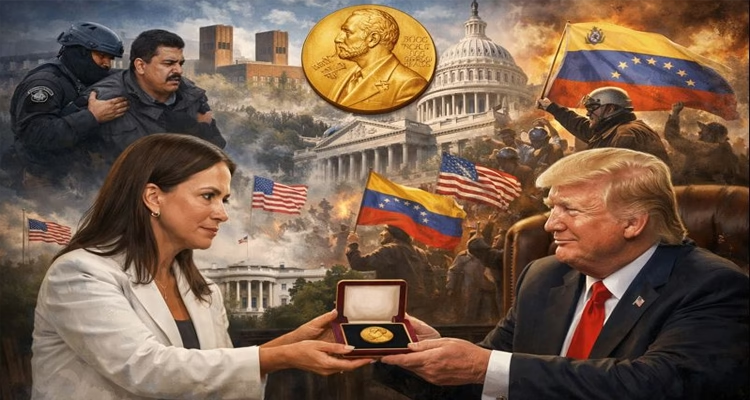
This editorial traces how Venezuela’s moral struggle, crowned in Oslo with a Nobel Peace Prize awarded to María Corina Machado, later crossed the Atlantic and entered the Oval Office, where Machado reportedly handed her Nobel medal to U.S. President Donald Trump. The gesture came after Nicolás Maduro had already been removed from power—not through ballots or a popular uprising, but by force backed from abroad.
This piece poses an uncomfortable question: did Venezuela’s democracy truly prevail, or was its outcome retrospectively sanctified when a peace prize became a political prop in the world’s most powerful office?
History often turns on symbols. Sometimes they illuminate truth; sometimes they distract from it.
The claim that Venezuela’s opposition leader María Corina Machado handed over her Nobel Peace Prize medal to Donald Trump—reportedly weeks after U.S. forces arrested Nicolás Maduro and his wife—has become one such symbol, provoking applause, outrage, and deep unease in equal measure.
At first glance, the recent chain of events in Venezuela appears dramatic but disjointed: a Nobel Peace Prize changing hands, the sudden arrest of a long-entrenched president, jubilant opposition reactions, and the hurried emergence of a caretaker government. Yet when viewed together, these episodes form a coherent geopolitical arc rather than isolated headlines.

The question is unavoidable: are these developments organically linked—or carefully sequenced?
A Timeline That Refuses to Be Coincidental
Consider the order of events.
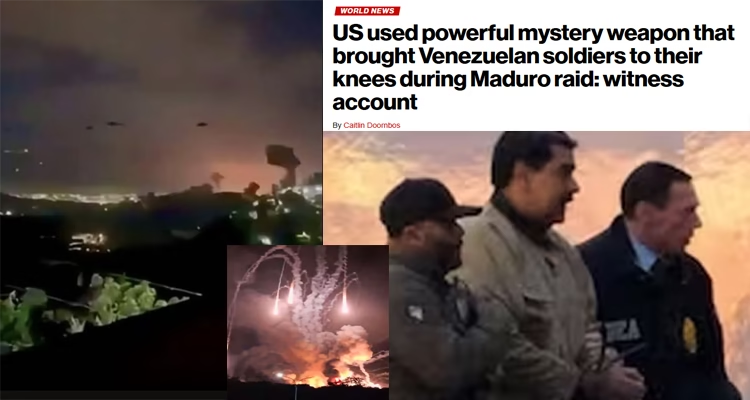
Venezuela, already crippled by years of economic collapse, sanctions, and political repression, reached a breaking point. Soon after, Nicolás Maduro and his wife were captured, abruptly ending a regime that had survived global pressure for more than a decade. Almost immediately, a caretaker arrangement was announced, complete with international backing.
Then came the most symbolically charged act of all: María Corina Machado handing her Nobel Peace Prize medal to Donald Trump—barely a fortnight after Maduro’s arrest.
In geopolitics, timing is rarely accidental.
The Nobel Gesture: Gratitude or Signal?
Machado’s decision to present her Nobel medal to Trump was not a gesture of ceremonial politeness. It functioned as political signalling—an acknowledgement of decisive external intervention rather than an internal democratic victory.
Trump, who has openly coveted a Nobel Prize since 2017 and frequently derided Barack Obama’s award, received the medal at a moment when his administration was being credited—by supporters—for ending Maduro’s rule. The act effectively linked Venezuela’s regime change to American power, not merely Venezuelan resistance.
This is where the dots begin to connect.
Was the Opposition Merely a Moral Cover?
The Venezuelan opposition publicly celebrated Maduro’s arrest. The jubilation was understandable—the fall of a ruler often feels like liberation. But celebration does not equal control.
There is no public evidence that Machado or her movement planned or executed Maduro’s capture. What is evident is that the opposition’s long moral struggle created the legitimising narrative for external action.
Put simply:
-
The opposition provided the cause.
-
External power delivered the coup de grâce.
-
Global optics framed it as a victory for democracy.
Yet when the dust settled, the opposition was not handed power outright.
Caretaker Government: Transition or Strategic Pause?
The rapid formation of a caretaker government points to pre-planning. Power vacuums rarely fill themselves overnight. Such arrangements typically emerge when international stakeholders prioritise stability over ideological purity.
This raises an uncomfortable possibility: that Venezuela’s transition is being managed, not liberated.
If that is the case, Machado’s Nobel Prize—and her subsequent gifting of it—becomes less a symbol of people’s power and more a currency of moral endorsement in a larger geopolitical transaction.
So, Are These Events Connected?
Yes—not as a conspiracy, but as a continuum.
-
Venezuela’s collapse weakened the state.
-
The opposition’s legitimacy weakened the regime.
-
External intervention removed Maduro.
-
A caretaker government preserved order.
-
The Nobel handover sanctified the outcome.
Each step reinforced the next.
What appears spontaneous is better understood as interlocking political momentum—where ideals, power, and symbolism converged.
The Unsettling Takeaway
The most sobering lesson is this: moral authority does not guarantee political authority.
Machado’s Nobel Peace Prize crowned her struggle—but it did not crown her leader of Venezuela. Instead, it became a global prop in the theatre of power, handed to the very man whose force reshaped the outcome.
Venezuela may be free of Maduro.
Whether it is free to choose its own destiny—without external scripts—remains the unanswered question.
Venezuela’s trajectory should serve as a warning to every nation—including India, where a united opposition is actively seeking regime change—that moral agitation and international applause can invite forces that ultimately decide outcomes beyond the people’s control.