Sanjay Saxena, Lucknow
Senior Journalist

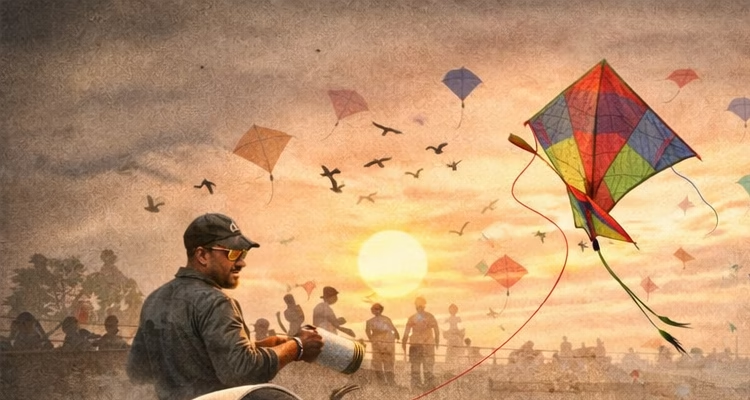
In the cold weather of Lucknow, with the sunrise, the rustling of kites in the sky and the shouts of kite flyers on rooftops and in open grounds are a common sight. The sky fills with colourful kites. Yet amid this excitement, danger lurks. From Bareilly to Lucknow, no one knows when kite flyers using Chinese manjha and sharp metal wires may turn deadly for a passerby — or even for someone sitting in the courtyard of their home. When a kite is cut loose, its manjha can entangle the neck of a two-wheeler rider on a road or bridge, sometimes with fatal consequences. Chinese manjha may look shiny, but its sharpness can be lethal. The Yogi government is now planning to classify deaths caused by riders getting trapped in Chinese manjha under the category of murder. The question, however, remains: how will it be stopped?
The death of Shoaib (28), a young resident of the city, stands as grim testimony to this danger. In Lucknow’s Haiderganj area, the medical representative died after his throat was slit by Chinese manjha. Earlier, on January 11, constable Shah Rukh in Shahjahanpur also succumbed to injuries sustained in a similar incident. Shoaib was crossing a bridge on his two-wheeler when the manjha caught around his neck; within moments, his throat was cut and he died. This was not an isolated case. In Lucknow, Chinese manjha has repeatedly caused deaths and serious injuries. The most tragic aspect is that those flying such kites are often not small children but youths and even people aged 40–45, fully aware of the risks. Calling such kite flyers reckless — if not culpable — would not be entirely misplaced.
After Shoaib’s death, doctors stated that the manjha contained glass particles capable of severing arteries. Such incidents are reported in many districts of Uttar Pradesh. This manjha is manufactured on a large scale in factories in Bareilly, using raw material that includes glass powder mixed with synthetic compounds. Sold cheaply in Lucknow markets, it is preferred by kite flyers eager to win bets. They fly kites from high rooftops or open grounds. Police need a network of informers to identify risk-prone areas so raids can be conducted and illegal manjha seized. While strict action by the Yogi government has shut some shops, factories continue to operate. The government should mandate that the manufacturer’s name and address be printed on every spool.
It is worth noting that on July 12, 2017, the National Green Tribunal (NGT) ordered a complete ban on the sale of Chinese manjha. A bench headed by Justice Swatanter Kumar prohibited all synthetic and nylon manjha across the country following a petition filed by PETA in August 2016. Enforcement was entrusted to state governments. Yet the continued availability of such manjha shows that monitoring mechanisms were inadequate. NGT orders are legally binding like court directives, and non-compliance can lead to imprisonment of up to three years, a fine, or both. The question remains — who is responsible for stopping its sale? The district administration says the Trade Tax Department monitors banned products, and instructions have been issued. Police action is ongoing. At the same time, since kite flying is a cherished tradition in Lucknow, citizens are urged to celebrate festivals enthusiastically — but without using Chinese manjha.
In older parts of the city, betting on kite flying — much like cricket betting — is common. In areas such as Chowk, Bazaar Wala, Sahadatganj, Thakurganj, and around Faizullaganj, teams fly kites on rooftops and open grounds, wagering between ₹5,000 and ₹25,000. Winnings are distributed afterward, and under this guise, betting worth lakhs of rupees takes place — sometimes at the cost of innocent lives. The manjha is so sharp that even flyers’ fingers are often cut. Sandeep Kashyap of Kundri Rakabganj notes that traditional kites — Manwar, Lachedar, Taukia, Do Panni Charkhaniya, Aadi, Majholi, Sawateen, Pauna, and Gendar — are now flown using Chinese manjha, tarnishing centuries-old traditions. Earlier, such incidents were rare; now accidents occur almost daily.
Not only Chinese manjha but kites tied with thin iron wires are equally dangerous. When these wires touch electric lines, current passes through them. One such incident in Nawabganj left a young man severely burned after his kite got entangled in a wire; he survived narrowly after hospitalisation. These wires are easily available in markets. Though considered strong by kite flyers, they too carry deadly risks.
The government must show stronger resolve. During kite-flying seasons, surveillance through drones, a network of informers, school awareness programmes on safe manjha, and strict market vigilance are essential. Only then can the joy of kite flying remain alive without turning the skies into a corridor of death.