
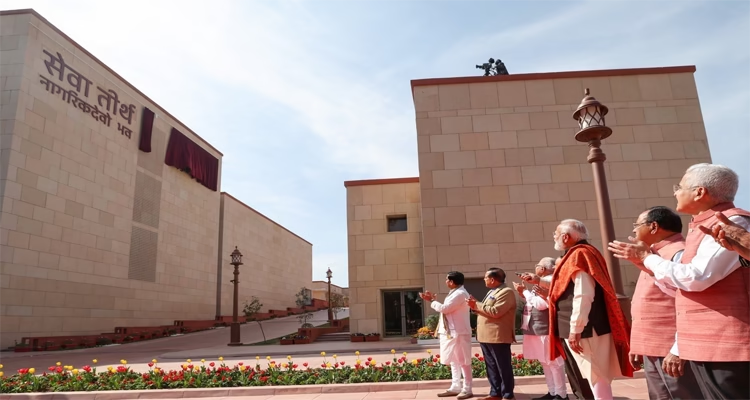
New PMO Complex Inaugurated: Seva Teerth Marks Administrative Shift
New Delhi: Prime Minister Narendra Modi on Friday inaugurated the newly built Seva Teerth complex in the national capital, marking a significant step in the overhaul of India’s administrative infrastructure under the Central Vista redevelopment initiative. He also dedicated Kartavya Bhavan-1 and Kartavya Bhavan-2 to the nation, bringing several key government offices and ministries into modern integrated workspaces.
The inauguration marks what officials describe as a transformative milestone in India’s governance architecture and reflects the Prime Minister’s emphasis on building a modern, efficient, accessible and citizen-centric administrative ecosystem. Addressing the occasion, Modi said the transition symbolises a shift in governance culture — from the legacy of power-centric structures to a spirit of public service.
देशवासियों की सेवा के अटूट संकल्प और ‘नागरिक देवो भव’ की पावन भावना को साथ लेकर, आज ‘सेवा तीर्थ’ को राष्ट्र को समर्पित करने का सौभाग्य मिला।
‘सेवा तीर्थ’ कर्तव्य, करुणा और ‘राष्ट्र प्रथम’ के लिए हमारी प्रतिबद्धता का सशक्त प्रतीक है।
मेरी कामना है कि यह आने वाली पीढ़ियों को… pic.twitter.com/YWYUuSHtsD
— Narendra Modi (@narendramodi) February 13, 2026
For decades, several key government offices and ministries functioned from fragmented and ageing infrastructure spread across multiple locations in the Central Vista area. This dispersion led to operational inefficiencies, coordination challenges, rising maintenance costs and sub-optimal working environments. The new complexes aim to resolve these issues by consolidating administrative functions within future-ready facilities.
Seva Teerth houses the Prime Minister’s Office, the National Security Council Secretariat and the Cabinet Secretariat — all of which were earlier located in separate premises. The consolidation is expected to streamline coordination and decision-making at the highest levels of governance.
One Nation. One Coordinated Governance Framework.
Did You Know?
Over 50 government offices in Delhi functioned from scattered buildings, costing more than ₹1,500 crore annually in rent alone. That’s public money spent on fragmentation instead of efficiency.
With the… pic.twitter.com/O2KDOPbu8x— Abhijit Kalita (@Akalitabjp) February 13, 2026
Kartavya Bhavan-1 and 2 accommodate several major ministries including Finance, Defence, Health, Education, Agriculture and Information & Broadcasting. The clustering of ministries within a shared infrastructure is intended to improve inter-departmental collaboration and reduce logistical challenges associated with scattered offices.
Both building complexes feature digitally integrated offices, structured public interface zones and centralised reception facilities designed to improve internal workflow and citizen access. They incorporate renewable energy systems, water conservation measures, waste-management solutions and high-performance building envelopes as part of sustainability-focused construction standards.
Officials said the consolidation of offices is also expected to generate long-term economic benefits by cutting rental expenditure, reducing travel time between departments and improving administrative efficiency. Security and accessibility features — including advanced access control and surveillance systems — have been integrated to ensure safe and seamless functioning.
The inauguration of Seva Teerth and Kartavya Bhavan-1 and 2 signals the operational beginning of a new administrative phase in the national capital, combining technological modernisation, sustainability and institutional consolidation. The new complexes are positioned as landmark additions to India’s governance infrastructure aimed at strengthening coordination and enhancing service delivery to citizens.