After BNP’s decisive victory in Bangladesh’s 2026 elections, Prime Minister Tarique Rahman signals balanced ties with India. Can Dhaka-New Delhi relations improve amid regional security concerns?

Following Bangladesh’s formation of a new government under the leadership of the Bangladesh Nationalist Party (BNP) after a largely fair and peaceful national election on February 12, 2026, people in eastern India — a region that almost encircles the poverty-stricken nation except for narrow borders with Myanmar and the Bay of Bengal — are hopeful of a progressive and politically stable regime in Dhaka. They expect the new leadership to focus on economic development for the country’s over 170 million citizens.
However, the Muslim-majority nation continues to remain a concern for India’s northeastern states, particularly Assam, for at least two reasons: the unabated influx of migrants and persistent regional security challenges affecting millions of indigenous families.
Concerns over land connectivity between India’s northeast and the rest of the country are often amplified by certain motivated elements in Bangladesh, who highlight vulnerabilities surrounding the Siliguri Corridor, popularly known as the “Chicken’s Neck.” Some fringe voices even fantasize about incorporating large parts of eastern India into a so-called “Greater Banglasthan,” arguing that a prosperous nation should possess coastal access, fertile river valleys, and mountain ranges — even extending such claims toward parts of Bhutan and Tibet. Others promote the idea that Bangladesh, already unified linguistically by Bengali identity, should evolve toward a mono-religious character.
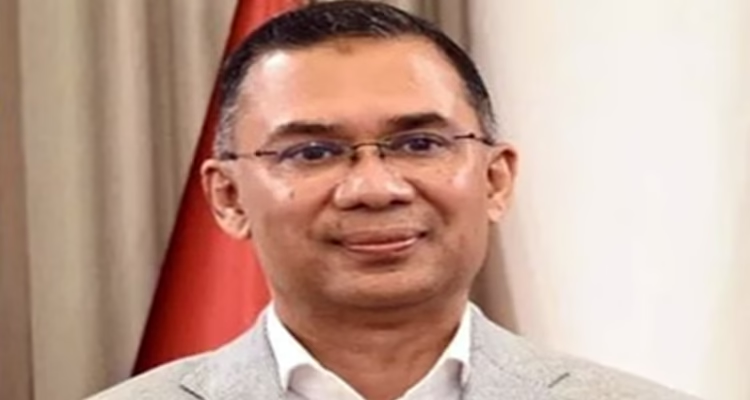
The election, held in an unusually festive atmosphere, recorded around 60 percent voter turnout and delivered a sweeping mandate to the BNP, which secured 212 seats in the 300-member Parliament (with another 50 reserved seats for women to be added to the Jatiya Sangsad). Sixty-year-old Tarique Rahman — son of former Prime Minister Khaleda Zia and former President Ziaur Rahman — led the party’s campaign without resorting to the customary anti-India rhetoric often used to gain quick popularity in Bangladesh. Even after taking oath as Prime Minister, Rahman maintained a measured tone and emphasized balanced relations with neighboring countries, including India.
Anti-India rhetoric in Bangladesh had intensified after ousted Prime Minister Sheikh Hasina took refuge in New Delhi, where she and thousands of Awami League leaders have sought political asylum since her sudden departure on August 5, 2024. The interim government led by Nobel laureate Dr. Muhammad Yunus repeatedly sought Hasina’s extradition, citing a death sentence handed down by a Bangladeshi tribunal, but India did not respond positively. Notably, Prime Minister Rahman refrained from aggressive remarks against Hasina, who has dismissed the 13th Jatiya Sangsad as a “farce,” and instead stated that any repatriation issue should proceed strictly through legal channels.
Amid international concern over reported atrocities against religious minorities in recent years, four non-Muslim candidates — including two Hindus, Goyeshwar Chandra Roy and Nitai Roy Chowdhury — won in the latest election. Both BNP nominees defeated candidates from Jamaat-e-Islami. Two other minority winners, Saching Pru and Dipen Dewan, were also fielded by the BNP, with Roy Chowdhury and Dewan later inducted into Rahman’s ministry. Hindus currently number about 13 million in Bangladesh (around 8 percent of the population), down sharply from over 22 percent at the time of Partition.
Prime Minister Narendra Modi promptly congratulated the BNP leadership on its decisive victory, becoming the first global leader to speak with Tarique Rahman and expressing India’s willingness to work closely with Dhaka for mutual benefit. The BNP leadership welcomed the gesture, stating that Bangladesh looks forward to constructive engagement with New Delhi based on mutual respect, sensitivity to each other’s concerns, and a shared commitment to regional peace and prosperity.
Although Modi could not attend Rahman’s swearing-in ceremony on February 17, he deputed Lok Sabha Speaker Om Birla to represent India at the event held in the southern courtyard of the Jatiya Sangsad Bhaban in Dhaka.
Earlier, in his final televised address as chief adviser of the caretaker government, Dr. Yunus described the election as “not merely a transfer of power but the beginning of a new journey for Bangladesh’s democracy.” The globally acclaimed microcredit pioneer noted that the interim regime had started from “minus, not even zero,” alleging that the previous administration had left the country in disarray. He emphasized Bangladesh’s enormous opportunities for regional cooperation with Nepal, Bhutan, and India’s northeastern states, and urged citizens and political leaders to sustain momentum for peace, progress, and reform with unity.
Nevertheless, concerns persist in India — particularly in Assam — as Bangladesh Jamaat-e-Islami, which historically opposed the 1971 liberation movement, has emerged as the principal opposition party in the Jatiya Sangsad for the first time. The party led an 11-member alliance that won 77 seats, with the Shafiqur Rahman-led Jamaat itself securing 68 constituencies, many along the West Bengal border.
Meanwhile, the newly formed National Citizen Party — created by student leaders of the July–August 2024 uprising that toppled Hasina — contested the polls in alliance with Jamaat and won six seats. Political observers believe that a potential strategic challenge may be emerging for India’s landlocked northeastern region, one that New Delhi will need to address through careful recalibration of bilateral ties with its troubled neighbor.