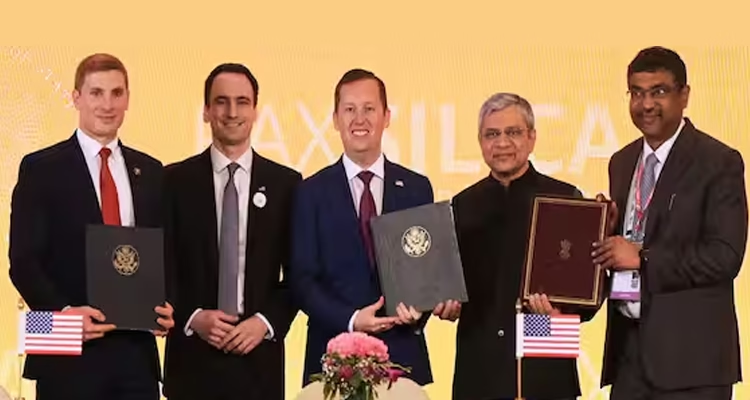
New Delhi: India and the United States on Friday signed the Pax Silica Declaration at the India AI Impact Summit in the national capital, signalling a major push to deepen cooperation in critical minerals, semiconductors and artificial intelligence (AI).
Union Minister for Electronics and IT Ashwini Vaishnaw, who presided over the ceremony, said India is positioning itself to take a leadership role in the global semiconductor and electronics ecosystem. Highlighting the country’s growing capabilities, he noted that Indian engineers are already designing advanced two-nanometre chips and that the industry’s requirement of over 10 lakh skilled professionals will be met domestically. He added that students from more than 300 universities and colleges are currently engaged in chip design work.
US Ambassador to India Sergio Gor described the India-US technology partnership as having “limitless” potential. He said the emerging coalition aims to secure the full silicon value chain — from critical minerals and chip fabrication to AI deployment — and replace coercive dependencies with trusted industrial partnerships that support open markets.
India formally joined the Pax Silica coalition, marking a significant milestone in the strengthening of strategic technology and supply chain cooperation between India and the United States.
The signing ceremony brought together senior government leaders from both nations,… pic.twitter.com/cL35qmLyN9
— Ministry of Information and Broadcasting (@MIB_India) February 20, 2026
Google and Alphabet CEO Sundar Pichai, speaking at the summit, said the company is proud to act as a bridge between India and the United States. He emphasised that the bilateral partnership will play a decisive role in shaping an inclusive and transformative AI future. Pichai stressed the importance of building secure supply chains and said Google is supporting the momentum with end-to-end investments in products, infrastructure and scaling.
What is Pax Silica?
Pax Silica is a US-led initiative designed to secure the global silicon ecosystem, spanning critical minerals, semiconductor manufacturing, AI infrastructure and related technologies. The initiative seeks to bring together trusted partner nations to build a resilient and innovation-driven technology network while safeguarding sensitive technologies from undue external control.
The grouping was originally launched in December 2025 with founding signatories including Japan, South Korea, Singapore, Australia and Israel. India’s entry into the framework is being viewed as strategically significant.
Why India’s Entry Matters
India’s participation comes at a time when Western economies are trying to reduce dependence on China for rare earth elements, chips and AI infrastructure. China’s dominant position in key mineral supply chains and past export curbs have heightened global concerns.
By joining Pax Silica, India is expected to attract fresh investments, strengthen its semiconductor mission and secure a larger role in the shifting global manufacturing landscape. The move could also accelerate the country’s ambitions in artificial intelligence and advanced electronics.
The pact underscores a broader India-US push to build trusted technology partnerships and shape the economic and technological architecture of the 21st century.