Chandrapura Crisis: DVC Issues Power Cut Notices, Enforces 60x Penalty on Residents
by Ashis Sinha / Arvind Sharma
The Damodar Valley Corporation (DVC) has intensified eviction and demolition activities in Chandrapura as it moves ahead with plans to establish a 1600 MW super-critical thermal power plant, a joint venture with Coal India.
Fresh documentary evidence, including official notices and policy guidelines, reveals a tightening administrative push on both serving and retired employees to vacate quarters, deepening anxiety across the township.
Official Notice Warns of Power Disconnection
A recent notice issued by the Estate Section of DVC’s Chandrapura Thermal Power Station directs pensioners to immediately submit their quarter allotment papers within three days, failing which electricity supply to their quarters will be disconnected.
The notice, dated April 8, 2026, underscores urgency and warns that non-compliance will invite immediate action without further communication. This adds another layer of pressure on residents already facing eviction and demolition drives.
New Policy: 60 Times Penalty, Forced Eviction
The latest DVC office memorandum dated March 24, 2026, lays down stringent rules for retired employees occupying company quarters.
Key provisions include:
- Retired employees can retain quarters for only four months after superannuation.
- After the permitted period, allotment stands automatically cancelled without further notice.
- Continued occupation invites penal rent at 60 times the normal license fee.
- DVC can recover dues directly from pension or retirement benefits.
- Eviction proceedings may be initiated under the Public Premises (Eviction of Unauthorised Occupants) Act, 1971.
- The revised rules came into effect from April 1, 2026.
The memorandum also states that retirement benefits such as travel allowance and leave encashment may be withheld until quarters are vacated.
Demolition of 3,200 Quarters Underway
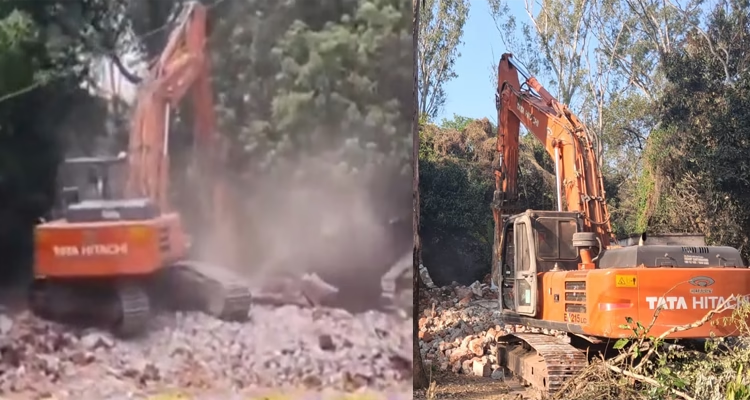
To make way for the proposed plant, DVC has begun razing residential quarters across the Chandrapura colony. Around 3,200 units, housing employees from officers to Class IV staff, are being cleared using bulldozers.
The plant is expected to come up in the ‘D-Type’ sector of the Officers’ Colony, with a detailed project report currently under preparation.
Environmental Clearance Process in Motion
The project site includes nearly 3,200 trees, and the process for their removal has begun. However, tree felling will only proceed after formal approval from the Forest Department.
Officials from the Bokaro Forest Division have already conducted site inspections, reviewing both the thermal plant premises and adjoining residential areas.
Residents Face Uncertainty and Fear
The aggressive eviction timeline and demolition drive have left residents distressed. Families who have lived in the colony for decades are now being forced to vacate within short deadlines.
An atmosphere of confusion prevails, with many unsure about relocation options or rehabilitation measures. Vacated quarters have also reportedly led to a rise in petty theft and security concerns in the area.
Strategic Expansion, Human Cost
While DVC positions the project as a step toward boosting power generation through efficient super-critical technology, the human and social cost is becoming increasingly visible.
With stricter enforcement measures now backed by formal notices and revised policies, Chandrapura stands at the centre of a growing conflict between infrastructure expansion and community displacement.
Voices of Protest Grow Louder
Criticism of the eviction drive and revised penalty policy is mounting, with trade union leaders and activists accusing the Damodar Valley Corporation of unfair treatment toward retired employees.
Umesh Sharma, Central Treasurer of the DVC INTUC and Secretary of the Chandrapura Pensioners’ Society, termed the 60-fold increase in license fee as “deeply unjust and exploitative.” He argued that pensioners who had spent decades—often their entire working lives—in DVC quarters were now being burdened with an abrupt and steep financial demand. “Those who earlier paid a nominal rent of around ₹370 for Type-3 quarters are now being asked to pay nearly ₹25,000 for the same accommodation. This is not just excessive, it violates basic principles of fairness,” he said.
Echoing similar concerns, Praveen Kumar Singh, State Convener of the Damodar Bachao Andolan, alleged that the policy reflects a disregard for humanitarian considerations. He stated that instead of adopting a straightforward and respectful approach to vacating quarters, the management has imposed measures that place undue financial and emotional strain on pensioners. “This move appears less about regulation and more about coercion,” he added.
DVC Defends Policy as Necessary Measure
Responding to the criticism, Ram Kumar Anubhavi, Head of Project (HOP) at Damodar Valley Corporation Chandrapura, defended the Corporation’s stance, stating that the penalty provisions are enforced out of administrative necessity rather than intent to harass.
He explained that the 60-fold license fee comes into effect only when pensioners fail to vacate quarters within the stipulated retention period. “The rule is meant to ensure timely vacation of residential units. In several cases, delays in vacating quarters create operational constraints,” he said.
Anubhavi further noted that prolonged occupation of quarters beyond the permitted period places an undue burden on the Corporation. “There have been instances where the system is effectively misused, with quarters not being vacated on time after retirement. The penalty is a deterrent to prevent such situations,” he added.