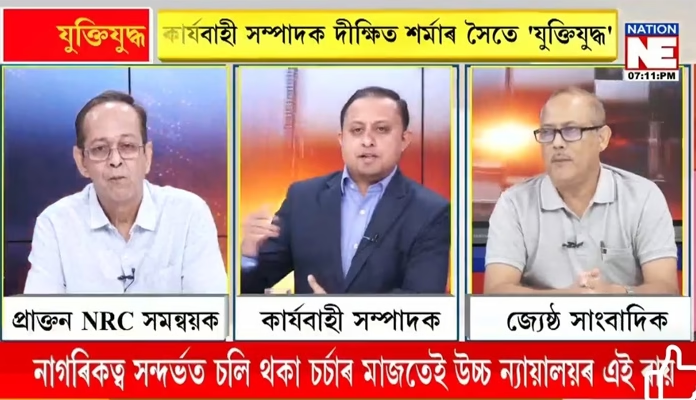
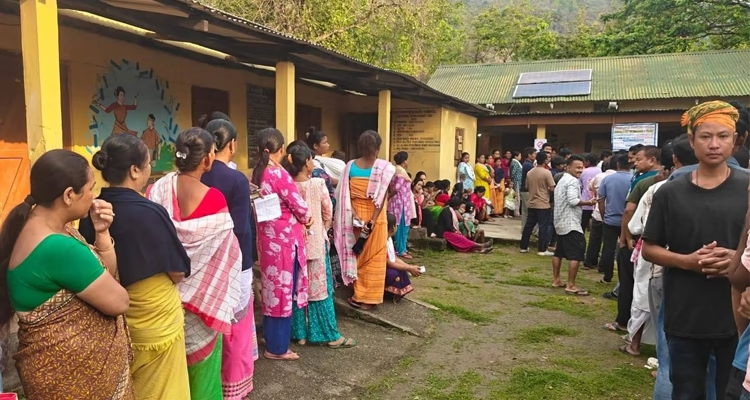
Assam records an impressive 85.96% voter turnout in the 2026 assembly elections, signaling strong democratic participation. Experts debate whether the surge favors the BJP-led NDA or the Congress alliance.

After the completion of assembly elections in Assam, Kerala, and the Union Territory of Puducherry, the next phase of State legislative polls is set to unfold in Tamil Nadu and West Bengal in the second half of April 2026. Meanwhile, millions of voters have demonstrated remarkable commitment to the democratic process by participating in largely peaceful single-phase polling held on April 9, recording an impressive turnout across regions.
Assam registered a voter turnout of 85.96% across its 126 assembly constituencies. Puducherry led with over 90% participation in its 30 seats, followed by Kerala (140 constituencies) with nearly 80% polling.
Assam’s electorate of around 2.5 crore voters—including 1.25 crore women and approximately 6.4 lakh first-time voters—has sealed the fate of 722 candidates representing various political parties and independent groups. Voting was conducted using electronic voting machines across 31,490 polling stations in 35 districts.
Looking ahead, Tamil Nadu will go to polls in a single phase on April 23, while West Bengal will conduct elections in two phases on April 23 and 29. The results of all assembly elections, along with bypolls in Karnataka’s Bagalkot and Davanagere South, Nagaland’s Koridang, and Tripura’s Dharmanagar, will be declared on May 4.
According to the Election Commission of India, several constituencies in Assam—including Parbatjhora, Golakganj, Gauripur, Dhubri, Bilasipara, Mankachar, Jaleshwar, Goalpara West, Abhayapuri, Nalbari, Dalgaon, Dhing, Rupahihat, and Samaguri—recorded over 90% polling. However, urban areas in Kamrup and Kamrup (Metropolitan) districts reported relatively lower turnout, hovering around 80% in constituencies such as Dispur, Guwahati Central, and Jalukbari.
Assam had earlier witnessed strong voter participation in 2016, recording 84.72%, which led to the defeat of the Congress government and the rise of a new alliance led by the Bharatiya Janata Party.
With such high voter participation, political observers have offered sharply divided predictions. One group anticipates the return of the BJP-led government, while another sees momentum building for the opposition alliance led by the Indian National Congress.
Supporters of the ruling alliance cite improved law and order, sustained development, and inclusive welfare schemes as key factors influencing voters. An aggressive campaign led by Chief Minister Himanta Biswa Sarma—supported by Prime Minister Narendra Modi and Union Home Minister Amit Shah—is believed to have energized voter turnout.
Key issues such as anti-infiltration measures, implementation of peace accords, infrastructure development, and welfare initiatives have resonated with large sections of the population. The state government’s flagship Direct Benefit Transfer scheme, Orunodoi, provides ₹1,250 per month to eligible women and currently benefits nearly 40 lakh individuals. Ahead of the elections, beneficiaries also received a lump sum of ₹9,000, covering four months of payments along with a Bohag (Rongali Bihu) cash incentive.
A section of analysts interprets the high turnout as indicative of a pro-incumbency wave. They note that traditionally, mainstream Assamese voters have shown relative reluctance in electoral participation, but this time came out in large numbers, signaling heightened political engagement and concern for the future.
Additionally, a revision of electoral rolls—removing deceased or relocated voters—along with increased voter awareness, contributed to the surge in turnout. Notably, women voters outpaced male participation. While women lagged behind in the 2011 elections, they achieved parity in 2016 and have surpassed male turnout in the last two elections, including 2026.
However, opposition leaders present a contrasting narrative, attributing the high turnout to anti-incumbency sentiments. Assam Congress chief Gaurav Gogoi described the turnout as a mandate for change. Allegations of corruption and misgovernance have also been raised against the Chief Minister.
Senior Congress leader Pawan Khera recently made controversial allegations concerning the Chief Minister’s family, triggering political tension and legal responses. Gogoi further alleged that the Chief Minister reacted with aggressive rhetoric following these developments.
Leaders from allied parties such as Asom Jatiya Parishad and Raijor Dal echoed similar concerns. Meanwhile, the All India United Democratic Front (AIUDF), once aligned with Congress, contested the elections independently.
On the other hand, Assam BJP president Dilip Saikia expressed confidence that the BJP-led National Democratic Alliance (NDA) would improve upon its 2021 tally of 75 seats. Asom Gana Parishad president Atul Bora predicted that the NDA could cross 90 seats.
The Jorhat constituency drew particular media attention, where BJP legislator Hitendra Nath Goswami and Congress MP Gaurav Gogoi maintained a restrained campaign without personal attacks.
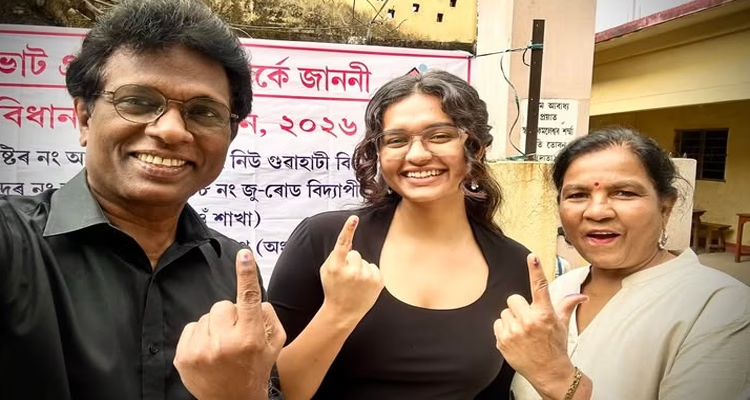
Chief Minister Sarma, however, criticized the Congress for politicizing the death of noted singer Zubeen Garg, whose demise in Singapore last year became a campaign issue. The Congress promised justice within 100 days if voted to power. Garg’s widow, Garima Saikia Garg, reiterated her appeal to political parties not to exploit the tragedy for electoral gain while casting her vote in Guwahati.