Dr. Vinod Chandrashekhar Dixit
Explore how Digital India is transforming governance, economy, and inclusion through UPI, 5G, Aadhaar, and digital public infrastructure.

Launched on 1 July 2015 by Prime Minister Narendra Modi, the Digital India initiative was envisioned as a flagship programme to transform India into a digitally empowered society and a knowledge-based economy. What began as a government mission has, over the past decade, evolved into a nationwide people’s movement.
Built on three key pillars—digital infrastructure as a utility for every citizen, governance and services on demand, and digital empowerment of citizens—the initiative has fundamentally reshaped how India lives, works, learns, and governs. Today, Digital India stands as a global model of inclusive digital transformation, positioning India among the world’s leading digital economies.
The backbone of this transformation is unprecedented digital infrastructure. India has laid over 42 lakh kilometres of optical fibre under the BharatNet programme, connecting more than 2.18 lakh Gram Panchayats with high-speed broadband and bringing internet access to remote villages. Mobile connectivity has expanded deep into rural India, with over 6.15 lakh villages now covered by 4G networks.
The rollout of 5G has been equally remarkable. With over 4.8 lakh base stations deployed, India achieved 99.6% district coverage in under 22 months, making it one of the fastest 5G rollouts globally. This massive infrastructure has democratized access to information and services, ensuring that a farmer in Vidarbha and a startup founder in Bengaluru operate on the same digital highway.
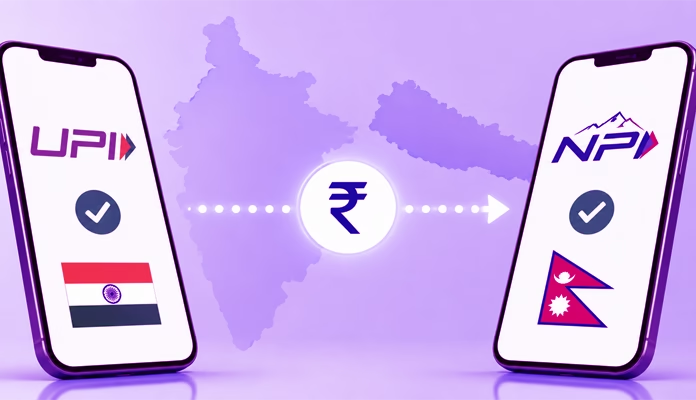
One of Digital India’s most visible successes is in financial inclusion and transparency. India is now a global leader in real-time digital payments. The Unified Payments Interface (UPI) processes transactions worth over ₹1 crore every second, enabling seamless payments from street vendors to large enterprises.
The Direct Benefit Transfer (DBT) system has revolutionized welfare delivery by transferring over ₹34 lakh crore directly into beneficiaries’ bank accounts, eliminating middlemen and saving the exchequer approximately ₹3.48 lakh crore. The JAM trinity—Jan Dhan accounts, Aadhaar, and mobile connectivity—has brought more than 50 crore previously unbanked citizens into the formal financial system, providing access to credit, insurance, and pensions.
This ecosystem is powered by a suite of indigenous Digital Public Infrastructure. Aadhaar provides unique 12-digit biometric identification to over 1.3 billion residents, enabling authentication at scale. DigiLocker offers secure cloud storage for documents, reducing paperwork for millions. BHIM and eSign enable instant payments and paperless signatures.
Platforms like UMANG integrate hundreds of government services into a single application, while MyGov promotes citizen participation in policymaking. The Government e-Marketplace (GeM) has brought transparency to public procurement, allowing MSMEs to sell directly to government buyers.
During the pandemic, CoWIN demonstrated India’s capacity to manage the world’s largest digital vaccination drive. Meanwhile, the Ayushman Bharat Digital Mission is creating digital health IDs to unify health records across the country.
The economic and social impact of Digital India has been profound. Digital platforms have unlocked new business models and markets. Through Open Network for Digital Commerce and GeM, small traders, weavers, and rural artisans can now access national and global markets without intermediaries.
India’s startup ecosystem, nurtured by open digital infrastructure and affordable data, has produced over 100 unicorns, with thousands of ventures emerging from Tier-2 and Tier-3 cities. Digital skilling initiatives like PMGDISHA have trained crores of rural citizens, creating a digitally literate workforce prepared for the new economy.
In education, platforms such as DIKSHA and SWAYAM have democratized learning by delivering quality content in multiple Indian languages. In healthcare, eSanjeevani has facilitated over 25 crore tele-consultations, bringing specialist healthcare to underserved regions.
Beyond convenience, Digital India has redefined governance. Services that once required multiple visits to government offices—such as certificates, licences, land records, and pensions—are now accessible via mobile phones. Real-time dashboards, online RTI filing, and digital grievance redressal systems have made governance more transparent and accountable.
Citizens are no longer passive beneficiaries; they are active participants in governance through feedback, consultations, and policy co-creation on MyGov. As Prime Minister Narendra Modi has emphasized, Digital India is central to building an Aatmanirbhar Bharat and positioning India as a trusted global partner in digital innovation.
However, challenges remain. The digital divide, though narrowing, still exists between urban and rural populations and across age groups. Cybersecurity threats, digital fraud, data privacy concerns, and misinformation have grown alongside digital adoption. There is a pressing need for stronger digital literacy, safer digital ecosystems, and content in Indian languages to ensure inclusivity.
Bridging the skill gap and building trust in digital systems will define the next phase of Digital India.
In conclusion, Digital India has ushered in a new era of empowerment. It has made governance transparent, services accessible, markets inclusive, and opportunities universal. By transforming technology into a tool for social and economic justice, it has impacted millions of lives and ignited aspirations across the nation.
More than just a programme, Digital India has become a national movement—one that is shaping a self-reliant future and positioning India not merely as a consumer of technology, but as a global creator of digital solutions.