
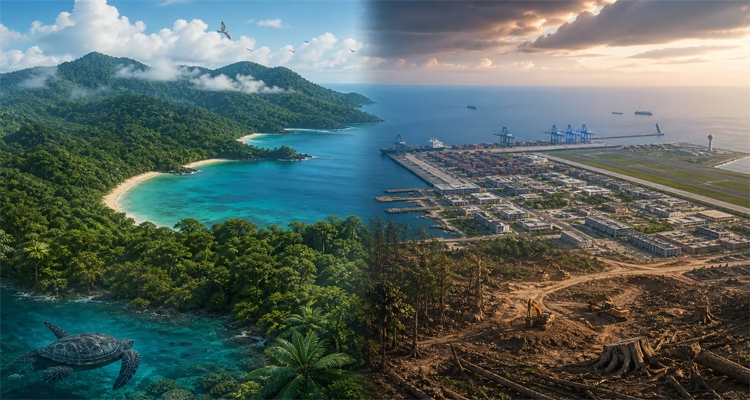
Great Nicobar Project Row: Development Imperative or Ecological Gamble? Why It Matters—and Why Congress Is Opposing It
Is India’s ₹80,000 crore Great Nicobar project a strategic breakthrough or an ecological risk? Here’s what you need to know.

India’s ₹80,000-crore Great Nicobar Island Development Project has emerged as one of the most consequential—and controversial—policy debates in recent years. Touted by the government as a strategic and economic game-changer, the project is being sharply questioned by the Indian National Congress and environmental experts as a potential ecological and humanitarian risk.
At its core, the debate goes beyond infrastructure. It reflects a deeper national dilemma:
Can India pursue large-scale development without compromising its ecological balance and indigenous heritage?
The Vision: Transforming a Remote Island into a Global Hub
- A mega transshipment port at Galathea Bay
- A greenfield international airport
- A planned township and industrial ecosystem
- Hybrid energy infrastructure (gas and renewable)
Strategically located near the Strait of Malacca, one of the busiest maritime trade routes in the world, the island offers India a rare geopolitical advantage.
Why the Project Is Considered Essential
1. Strategic and Geopolitical Importance
- Enhances India’s ability to monitor key Indo-Pacific sea lanes
- Strengthens naval presence amid China’s expanding footprint
- Seen as a potential “unsinkable aircraft carrier” in the Indian Ocean
In an increasingly contested Indo-Pacific, the project is viewed as a strategic necessity rather than a choice.
2. Economic Transformation
India currently depends on foreign ports like Singapore and Colombo for cargo transshipment.
- Potential to retain a large share of Indian cargo domestically
- Reduce logistics costs and boost exports
- Create a major industrial and trade hub
This aligns with India’s ambition to become a global economic powerhouse.
3. Regional Development
The Andaman & Nicobar Islands have long remained underdeveloped.
- Promises infrastructure, employment, and connectivity
- Boost to tourism and local economies
- Integration with Southeast Asian markets
The Opposition: Why Congress Is Raising Alarm
Despite its promise, the project faces strong opposition from the Indian National Congress.
1. Environmental Concerns
- Large-scale diversion of pristine rainforest
- Felling of hundreds of thousands of trees
- Threat to endangered species such as the leatherback sea turtle
- Damage to fragile coral reef systems
2. Impact on Indigenous Communities
Congress argues:
- Tribal reserves could be disrupted
- Increased external contact may lead to disease and displacement
- Risk of cultural erosion or extinction
3. Transparency and Environmental Clearance Issues
The opposition alleges:
- Environmental approvals were fast-tracked
- Impact assessments were inadequate
- Limited public consultation
4. Seismic and Disaster Risks
- The island lies in a seismically active zone
- Severe impact during the 2004 tsunami
- Concerns over long-term safety of large infrastructure
5. Economic Viability Concerns
- High investment with uncertain returns
- Competition with established global ports
- Risk of becoming a “white elephant” project
Government’s Position
The Centre maintains that:
- The project is a strategic national imperative
- Environmental safeguards and mitigation measures are in place
- Tribal interests will be protected
- Development will be phased and regulated
Global Lessons: What the World Tells Us
- Jurong Island (Singapore):
Built by merging smaller islands into a petrochemical hub
👉 Result: Economic and strategic success with strict planning - Palm Jumeirah (UAE):
Artificial islands developed for tourism and real estate
👉 Result: Economic boom but significant marine ecological damage
Key Lessons for India
- Success requires strong governance and phased planning
- Environmental neglect can lead to irreversible damage
- Island ecosystems are inherently fragile and high-risk
The Core Debate: Development vs Sustainability
| Development Argument | Environmental Concern |
|---|---|
| Strategic Indo-Pacific presence | Irreversible ecological loss |
| Economic growth and trade control | Biodiversity destruction |
| Infrastructure and jobs | Threat to indigenous communities |
| Maritime dominance | Climate and disaster vulnerability |
Conclusion: A Defining Test for India
The Great Nicobar project is more than an infrastructure initiative—it is a test of India’s development philosophy.
- If executed responsibly, it could position India as a global maritime and economic power
- If mismanaged, it risks becoming a case of ecological degradation and cultural loss
The fundamental question remains:
Can India balance ambition with sustainability?
As the debate intensifies, Great Nicobar may well define how India navigates the complex intersection of growth, ecology, and geopolitics in the 21st century.