
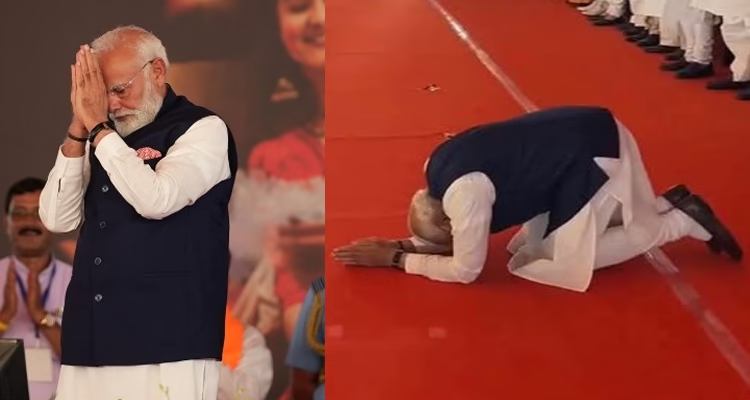
News Desk: Prime Minister Narendra Modi and the BJP may have gained a decisive political advantage ahead of the 2029 Lok Sabha elections after the party’s sweeping victory in West Bengal, according to a fresh analysis by Bloomberg.
The report said the BJP’s dramatic rise in Bengal, along with setbacks for ruling parties in Tamil Nadu and Kerala, has reinforced Modi’s position as India’s dominant political leader and strengthened the party’s long-term national expansion strategy.
Prime Minister Narendra Modi is poised to hold power in India into the next decade, a Bloomberg analysis of voting trends shows. https://t.co/SDXcIendAo
📷️: Dibyangshu Sarkar/AFP pic.twitter.com/2sYxwyopqL
— Bloomberg (@business) May 11, 2026
Political observers quoted in the analysis believe the BJP now enters the next electoral cycle as the strongest force in Indian politics, with Modi remaining the central figure around whom the party’s national campaign is likely to revolve.
If the BJP regains a full majority on its own in the 2029 general elections, Modi could surpass Jawaharlal Nehru as India’s longest-serving Prime Minister.
Bengal Victory Changes BJP’s Political Geography
The BJP’s victory in West Bengal is being viewed as one of the most significant breakthroughs in the party’s electoral history.
Winning 207 seats in the 294-member Assembly, the saffron party ended Mamata Banerjee’s 15-year rule and formed its first government in the state.
The result is politically important because it signals the BJP’s growing ability to penetrate regions once considered resistant to its brand of politics. Analysts say the Bengal mandate has expanded the BJP’s footprint far beyond its traditional Hindi heartland base.
South Asia analyst Michael Kugelman told Bloomberg that the BJP is now the clear favourite heading into the 2029 Lok Sabha battle and appears better positioned than the opposition alliance.
Hindu Consolidation Continues to Benefit BJP
The analysis noted that the BJP’s electoral success still rests heavily on its ability to mobilise a broad Hindu voter base cutting across caste, class and regional divisions.
Even though the party lost its standalone majority in the 2024 Lok Sabha elections and relied on NDA allies to form the government, recent Assembly victories indicate that its larger political strategy remains intact.
The BJP has consistently focused its campaigns on nationalism, welfare delivery, religious identity and strong leadership, while attacking rivals over corruption, minority politics and governance issues.
Bengal Voting Patterns Favoured BJP Expansion
Citing constituency-level voting data and research by Raphael Cohen-Almagor Susewind of the London School of Economics and Political Science, the report said the BJP registered stronger gains in constituencies with larger Hindu populations.
At the same time, opposition votes in several Muslim-dominated seats remained divided among multiple parties, limiting the emergence of a united anti-BJP challenge.
The report clarified that the findings were based on constituency trends rather than individual voter data.
Opposition Faces Tough Road Ahead
The Bengal outcome has added to the BJP’s growing momentum after victories in Maharashtra, Haryana and Delhi following the 2024 parliamentary polls.
During the Bengal campaign, Modi aggressively targeted the Trinamool Congress government on issues ranging from corruption and law and order to illegal migration and political violence.
The defeat has weakened one of the opposition bloc’s most influential regional leaders and once again exposed the lack of unity among anti-BJP parties.
CPI(M) leader Hannan Mollah told Bloomberg that opposition parties have still not been able to create a credible nationwide alternative to Modi and the BJP.
Reform Agenda May Accelerate
The stronger political position could also give the Modi government greater confidence to push difficult economic reforms over the next year and a half.
According to the analysis, the Centre may now move more aggressively on manufacturing expansion, land reforms and policies aimed at attracting global investment into India.
Global companies including Apple Inc. have steadily expanded manufacturing operations in India as businesses diversify supply chains away from China.
Economist Sonal Varma told Bloomberg that the coming months may provide the best political window for the government to implement major reforms before electoral calculations begin dominating policy decisions again.
BJP May Push Core Ideological Goals
The report also suggested that the BJP could revive key ideological priorities, including simultaneous national and state elections and the implementation of a Uniform Civil Code.
However, the party still lacks the numbers required in the Rajya Sabha to independently pass major constitutional amendments.
Political scientist Sandeep Shastri observed that, in the long run, the BJP’s biggest challenge may eventually come from internal factional competition within a dominant political organisation rather than from external rivals.
Despite the BJP’s growing momentum, the analysis said upcoming elections in states such as Uttar Pradesh, Gujarat, Punjab and Goa could still offer opposition parties opportunities to regain political ground before 2029.