
Maguni Charan Behera, Ph.D.
Retd. Professor of Tribal Studies
mcbehera1959@gmail.com

An analytical article by Maguni Charan Behera examining the language debate in tribal education in India, highlighting issues of educational inequality, multilingual learning, teacher quality, cultural preservation, and employment opportunities.
Education is widely regarded as the most powerful instrument of social transformation. In India, however, the educational system often reproduces inequality rather than eliminating it. Different categories of schools—private institutions, government schools, missionary schools, NGO-run schools, and elite international schools—create unequal standards of learning, exposure, confidence, and opportunity. The result is not merely educational disparity but also social division, economic inequality, and political marginalisation.
In discussions concerning tribal education, language has emerged as a major issue. It is frequently argued that non-tribal teachers cannot communicate effectively with tribal children in nursery and primary classes because they do not know the tribal language. Consequently, some believe that only tribal teachers should be appointed in tribal areas. At first glance, this argument appears logical and sympathetic to tribal concerns. However, a pragmatic examination reveals that the issue is far more complex.
The real challenge before India is not merely language, but the quality of education, equality of opportunity, commitment of teachers, and preparation of students for modern society and employment. Reducing the entire problem to a tribal versus non-tribal debate oversimplifies the issue and diverts attention from deeper structural inequalities.
Does Education Ensure Equality?
India today operates multiple educational systems simultaneously. Wealthy families send their children to expensive private schools, convent institutions, English-medium schools, coaching centres, and even foreign universities. Poor families, including most tribal communities, depend largely on government schools. Naturally, the quality of infrastructure, teaching, technology, language exposure, and career preparation differs widely.
This unequal educational structure creates unequal human resources. One child studies in a digital classroom with trained teachers, spoken-English programmes, coding classes, and international exposure. Another studies in a poorly equipped rural school lacking teachers, electricity, or internet access. Later, both compete for the same jobs and examinations. The outcome is predictable: the privileged child succeeds more often.
Ironically, many educated and affluent people publicly advocate mother-tongue education while privately ensuring that their own children study in English-medium institutions. Their children become globally competitive, while poorer sections remain confined to weaker educational systems in the name of cultural preservation or local identity.
Thus, the issue is not simply language, but unequal access to quality education.
Does Reservation Ensure Equality?
Reservation was introduced to promote social justice and representation. It has undoubtedly benefited many disadvantaged communities. Yet reservation alone cannot establish equality if educational quality remains unequal from the beginning.
The first beneficiaries of reservation often become economically stable and educationally advanced. Their children inherit better opportunities, coaching, urban exposure, and social networks. Meanwhile, many poor families within the same communities continue to struggle. As a result, inequality persists even within reserved categories.
This creates frustration among unemployed youth. Political groups then exploit unemployment and social resentment for electoral gains. Hatred and instability grow, while the real issue—quality education and skill development—remains neglected.
Degrees alone do not guarantee employment. Modern economies demand competence, communication skills, technological literacy, discipline, and adaptability. Unfortunately, much of the present educational system fails to provide these capacities.
Issue of Tribal Language in Early Schooling
In the education of tribal children, language has become a sensitive issue. It is often alleged that non-tribal teachers fail to communicate with tribal children in early classes because they do not understand the local tribal language. Consequently, demands arise that only tribal teachers from the same tribe should teach tribal children.
However, this argument raises several practical questions.
Can a teacher belonging to one tribe effectively teach children belonging to another tribe with a different language? India has hundreds of tribal communities with distinct dialects and cultural practices. If language alone becomes the criterion, even tribal teachers may face communication difficulties in areas inhabited by multiple tribes.
Moreover, there are situations where communities demand the appointment of teachers from their own tribe but simultaneously resist the posting of their own educated youth in remote village schools. In some cases, communities even prefer non-tribal teachers who are more regular and willing to stay. This itself reveals that the issue cannot be understood merely through a tribal versus non-tribal framework.
Is Communication the Real Issue?
Children in Anganwadi centres often interact with local workers who know the tribal language. This early exposure helps prepare them for formal schooling. Furthermore, children naturally learn languages quickly through interaction, play, observation, and social exposure.
In many tribal schools, non-tribal students and students from different tribes study together. If one tribal language becomes the sole medium of instruction, children belonging to other linguistic groups may themselves face exclusion.
Similarly, tribal children living in urban areas often study successfully in regional-language or English-medium schools because the surrounding social environment encourages adaptation. Television, markets, peer groups, transport systems, and digital media continuously expose them to dominant languages.
This suggests that environment, teacher commitment, and educational support matter more than rigid linguistic categorisation.
Language Issue and Cultural Preservation
No sensible person would deny the importance of preserving tribal languages and cultures. Language carries memories, folklore, songs, customs, and collective identity. Tribal languages should absolutely be documented, developed, promoted, and respected.
However, preserving a language does not necessarily require making it the sole medium of instruction in formal education. Languages survive through family use, community interaction, literature, songs, theatre, storytelling, and cultural practices. Home and society remain the natural spaces for language preservation.
At the same time, educational policy must prepare children for higher education, employment, technological advancement, and participation in the wider world.
Focusing exclusively on one’s own language can sometimes restrict intellectual exposure and limit engagement with wider cultures and systems of knowledge. Students educated only within a narrowly confined linguistic environment may receive much of global knowledge indirectly through translation. Yet translation alone cannot fully communicate the cultural context, emotional depth, idiomatic richness, and intellectual spirit embedded in a language. Consequently, even if such students later learn a dominant regional or global language, their understanding may remain largely academic and mechanical rather than natural, intuitive, and socially rooted.
This is one reason why many parents, including those from tribal and economically weaker communities, increasingly prefer schools that provide exposure to broader languages such as Hindi or English. Their aspiration is not the rejection of their own culture, but access to wider opportunities, higher education, employment, technology, and participation in the modern world.
Language of Small Tribes: Practical vs Ideal Concerns
India has several very small tribes with populations below five hundred. In some areas, the number of school-going children may itself be extremely small. Is it practically possible to prepare textbooks, train teachers, and create a complete educational system separately for every small tribal language?
Even if such systems are created administratively, how will those children later compete in colleges, universities, administration, science, medicine, engineering, technology, and the modern job market?
The issue becomes even more complicated when missionary schools, NGO-run schools, and private institutions operating in tribal regions themselves promote Hindi- or English-medium education because parents demand it.
Teachers Have a Crucial Role
The assumption that non-tribal teachers cannot communicate with tribal children is partly exaggerated. A teacher living in a tribal village naturally learns commonly used local words and expressions through daily interaction in markets, public spaces, and community life.
Young children themselves communicate through gestures, observation, repetition, songs, and activities. Communication at lower levels does not always require linguistic perfection.
What matters most is dedication, patience, and respect for children.
Unfortunately, some teachers—tribal and non-tribal alike—lack commitment. Some carry prejudices and underestimate the capabilities of tribal children. Such teachers fail not because of language, but because of attitude.
On the other hand, many sincere teachers develop close emotional bonds with tribal students despite linguistic differences. Children respond positively when teachers are caring, patient, and encouraging. This can be observed in many tribal areas across India.
Thus, the real issue is teacher quality, training, motivation, and accountability—not merely ethnic identity.
Language and the Job Market
Modern employment increasingly demands competence in dominant languages, digital literacy, and communication skills. Whether one likes it or not, regional languages, Hindi, and English have become essential for higher education and employment opportunities.
If children remain educationally isolated in the name of linguistic purity, they may later struggle in competitive examinations and professional environments.
The goal of education should be empowerment, not isolation.
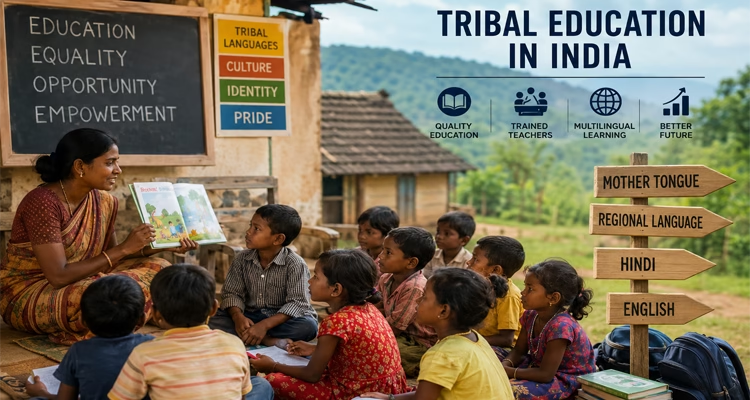
This does not mean rejecting tribal languages. Rather, it means adopting multilingual approaches where tribal children receive emotional and cultural support while gradually acquiring broader communication skills necessary for modern life.
Technology as a Solution
Instead of intensifying tribal–non-tribal divisions, India should use technology and innovative pedagogy to solve communication problems.
Digital tools today can translate lessons into local languages. Audio-visual learning materials, bilingual content, interactive applications, community recordings, and AI-assisted translation can help children understand concepts without isolating them from mainstream education.
Teachers can receive orientation programmes about tribal culture and communication methods. Local youth can assist as language facilitators. Community participation can strengthen schools.
The future solution lies not in rigid identity politics, but in pragmatic educational reform.
Conclusion
The language issue in tribal education is real, but it is often exaggerated beyond proportion. The problem cannot be solved simply by replacing non-tribal teachers with tribal teachers. Reality is far more complex. Tribes themselves are linguistically diverse. Parents desire quality education, dignity, and employment opportunities for their children. Modern economies require broader communication skills and technological competence.
The real crisis in Indian education is unequal educational quality, poor infrastructure, lack of technological access, inadequate teacher training, and weak institutional accountability.
Preserving tribal languages and cultures is essential, but preservation should not become a barrier to educational advancement and social mobility. A balanced approach is needed—one that respects cultural identity while simultaneously preparing children for the modern world.
India must therefore move beyond narrow tribal–non-tribal binaries and focus instead on quality education, multilingual competence, technological innovation, equal opportunity, and teacher dedication. Only then can education truly become an instrument of empowerment rather than marginalisation.



A deep and grassrooted thought on preservation with adoption of modern day tools