Lawyer Seeks Action Against ‘Cockroach Janta Party’, Demands CBI Probe Into Fake Advocates
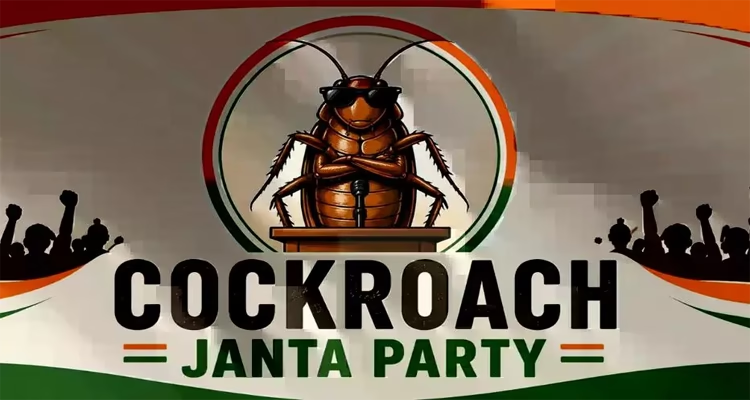
News Desk: A public interest litigation (PIL) has been filed in the Supreme Court seeking action against the controversial satirical collective known as the “Cockroach Janta Party” (CJP), accusing the group of exploiting judicial remarks for branding, publicity, and commercial gain.
The petition, moved by advocate Raja Choudhary, alleges that the group transformed oral observations made during Supreme Court proceedings into a large-scale online campaign aimed at monetising public attention and social media engagement.
Court Remarks Allegedly Turned Into ‘Brand’
According to the plea, the Cockroach Janta Party used comments made during court hearings as the foundation for a digital identity, eventually turning the phrase into a viral political-satirical brand.
The PIL claims that the group’s activities went beyond satire and entered the domain of commercial exploitation, pointing to alleged trademark attempts, merchandising, and aggressive social media promotion linked to the CJP label.
The petition argues that such actions amount to the misuse of judicial discourse for private gain and risk undermining the sanctity of courtroom proceedings.
[BREAKING] Plea filed in Supreme Court seeking probe into fake advocates, ‘Cockroach Janta Party’ activitieshttps://t.co/XXewPFAbNY
— Bar and Bench (@barandbench) May 24, 2026
Origins Linked to Supreme Court Observation
The controversy reportedly traces back to remarks made by Chief Justice of India Surya Kant during a hearing, where certain unemployed activists and social media influencers with questionable credentials were allegedly described as “cockroaches” and “parasites.”
Following the comments, the term quickly gained traction online, eventually evolving into the so-called “Cockroach Janta Party,” which reportedly amassed nearly 20 million followers across multiple digital platforms.
The petitioner has argued that the rapid rise of the parody movement reflects a growing trend where courtroom expressions are being converted into tools for mass publicity, political messaging, and monetised digital influence.
#BREAKIGN Plea In Supreme Court Seeks CBI Investigation Against ‘Cockroach Janta Party’ Activities & Fake Advocates |@AmishaShriv #SupremeCourt #CockroachJanataParty https://t.co/aMZTHQddbE
— Live Law (@LiveLawIndia) May 24, 2026
Concerns Over ‘Commodification’ of Judiciary
The PIL warns that the growing commercialisation of judicial commentary could set a dangerous precedent for public discourse around constitutional institutions.
It contends that legal proceedings are increasingly being repackaged as entertainment and online content, blurring the line between satire, activism, and commercial enterprise.
The plea further states that courtroom observations, which are often contextual and informal, should not be weaponised or monetised in ways that compromise the dignity of the judiciary.
Demand for CBI Probe Into Fake Lawyers
Apart from targeting the Cockroach Janta Party, the petition has also sought a Central Bureau of Investigation (CBI) inquiry into individuals allegedly posing as advocates using fake law degrees and forged qualifications.
The petitioner expressed concern over the alleged rise of fraudulent legal practitioners operating under fabricated credentials, calling it a serious threat to the integrity of the judicial system.
The PIL urges authorities to investigate networks that may be enabling unqualified individuals to falsely represent themselves as lawyers and participate in legal proceedings.
Legal, Digital, and Political Debate Intensifies
The case has triggered fresh debate around the intersection of satire, free speech, digital influence, and judicial dignity in India’s rapidly evolving online ecosystem.
As the matter comes up for consideration, the Supreme Court is expected to examine whether the alleged branding and monetisation linked to courtroom remarks crossed legal and ethical boundaries.
The controversy is also likely to reignite wider discussions on the role of social media-driven parody movements and the limits of commercialising public institutions in the digital age.