Can the Cockroach Janta Party transform viral social media outrage into real political change? An analysis of digital activism, youth anger, unemployment, and the challenges of grassroots politics in India.

Delhi’s Constitution Club has traditionally been a venue for serious political debates, press conferences, and gatherings of conventional politicians in white attire. However, what transpired there last Wednesday hinted at the emergence of a new and unconventional chapter in Indian politics. Three educated young individuals sat on the stage and loudly demanded the resignation of the country’s Education Minister.
This demand did not come from any established opposition party, but from an organisation calling itself the “Cockroach Janta Party.” What until recently existed as satire, digital humour, and a source of biting memes on social media is now preparing to take to the streets of the national capital. This movement is a direct by-product of the deep frustration and anger brewing among the country’s youth over recurring paper leaks in examinations such as NEET-UG and CBSE.
Yet the larger question remains: Can the reality of grassroots politics be altered merely by going viral or by taking jibes in the digital space? Is this an authentic expression of youthful restlessness in Indian democracy, or just another short-lived spectacle born in the glittering world of social media?
The three faces regarded as the backbone of this movement—Sourav Das, Vijeta Dahiya, and Ashutosh Ranka—have interesting backgrounds. None of them is an established politician. One is a journalist and social activist who has consistently exposed flaws in government machinery through RTI investigations. Another has been associated with research and scriptwriting for major platforms such as Dhruv Rathee’s. The third is a public policy expert educated at institutions like IIT Kanpur and the London School of Economics.
These are young people who speak fluent English, understand the dynamics of the internet, and possess the sophistication to present their ideas in a modern manner. On June 6, when the party’s founder returns to Delhi from the United States and permission is sought for a protest at Jantar Mantar, this digital anger will face its first real test on the ground.
The issue of paper leaks is undoubtedly serious and deeply connected to the future of millions of students and their families. The resentment among the youth is entirely justified. However, relying on a symbol like the “cockroach” and using satire as the primary vehicle for expressing that anger raises questions about the movement’s seriousness and long-term credibility.
History shows that outrage alone, amplified by social media algorithms, rarely produces lasting change. Trending hashtags and millions of likes cannot be the benchmark of a revolution. The Cockroach Party has successfully highlighted the pain of unemployment and the frustrations simmering among young Indians, but when it comes to presenting a concrete and practical agenda, the organisation appears uncertain.
A democratic nation cannot be run solely on jokes, memes, and performances. Sooner or later, both the public and the passage of time begin asking difficult questions. How will jobs be created? What is the plan for reviving the economy? What is the party’s position on taxation, police reforms, agriculture, healthcare, or foreign policy?
At present, the Cockroach Party offers no clear answers to these fundamental policy questions. Such ambiguity does provide one advantage: it allows people from diverse ideological backgrounds to remain connected under a broad umbrella of discontent. But the moment an organisation takes a definitive stand on serious issues, internal contradictions and disagreements inevitably emerge.
A more dangerous aspect of this narrative is that it may gradually push young people toward cynicism and complete despair regarding the system itself. Criticising the establishment and asking difficult questions is the essence of democracy. However, a healthy democracy also requires citizens who believe that reform within the system is possible.
When every constitutional and social institution—the judiciary, media, elections, and universities—becomes merely an object of ridicule, people eventually lose faith in them and stop attempting to improve them. At that stage, it ceases to be a rebellion against the system and begins to resemble surrender.
Moreover, the movement’s claim that it represents every struggling young Indian appears somewhat exaggerated. A closer look at its leading faces and support base suggests that it is largely an urban, English-speaking, digitally connected phenomenon. The youth living in remote villages, the children of farmers working in the fields, migrant labourers, and millions of young people without access to smartphones or high-speed internet remain largely absent from this narrative.
Winning popularity online and building support on the dusty roads of India are entirely different challenges.
Another practical problem is that the movement appears heavily dependent on a single charismatic figure. History shows that when organisations revolve around one individual, the entire structure risks collapsing the moment that individual falters. Indian politics offers several examples of movements that began with great momentum but gradually became absorbed into the conventional realities of governance.
Running a genuine political organisation requires a strong organisational framework, a trained cadre, and a clearly defined ideology. The architecture of social media, meanwhile, is designed to reward outrage, agitation, and sensationalism. Without clear principles and organisational discipline, such movements can quickly become vulnerable to chaos, misinformation, and opportunistic elements.
There is also an uncomfortable truth that existing political establishments often find this kind of meme-based opposition relatively convenient. Viral posts and witty sarcasm may attract attention, but they can also dissipate the energy that might otherwise evolve into a serious electoral challenge.
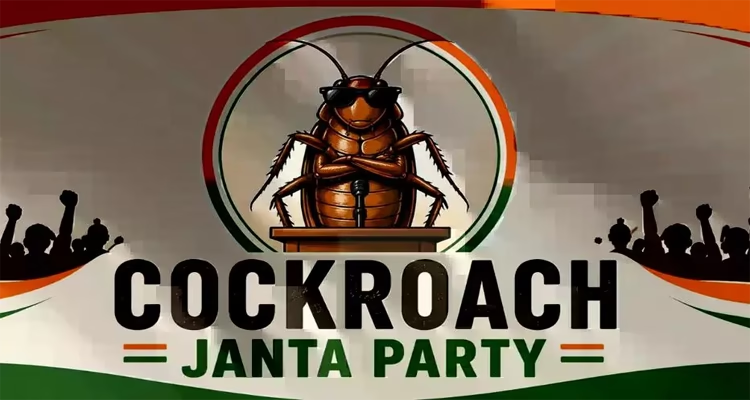
For any powerful government, organised and disciplined opposition at the grassroots level is a far greater threat than online mockery. Even the party’s chosen election symbol—the cockroach—is a double-edged sword. While the creature is admired for its remarkable ability to survive under adverse conditions, it is also associated in the public imagination with dirt, disease, and disgust. Political symbols inevitably acquire meanings that extend far beyond their intended message.
Ultimately, social media popularity and real political power are two very different things. The digital world can create the illusion of a massive movement overnight, but online enthusiasm often disappears as quickly as it emerges. The moment a new viral issue captures public attention, yesterday’s debate is forgotten.
Real and lasting change demands patience, years of hard work, and the painstaking process of building institutions and organisations—perhaps the most difficult task in the internet age.
India’s youth are genuinely troubled by unemployment, inflation, and an often insensitive system. Their anger is real and justified. The credit for bringing this frustration into the national conversation certainly belongs, at least in part, to this digital campaign. However, highlighting a problem and providing a practical solution are two entirely different challenges.
Unless these jokes, jibes, and memes eventually evolve into a coherent political vision and a credible policy framework, this movement risks being remembered like many other internet sensations that once appeared revolutionary but ultimately failed to bring meaningful change to the system they sought to challenge.