by Prof. (Dr.) Manmohan Prakash
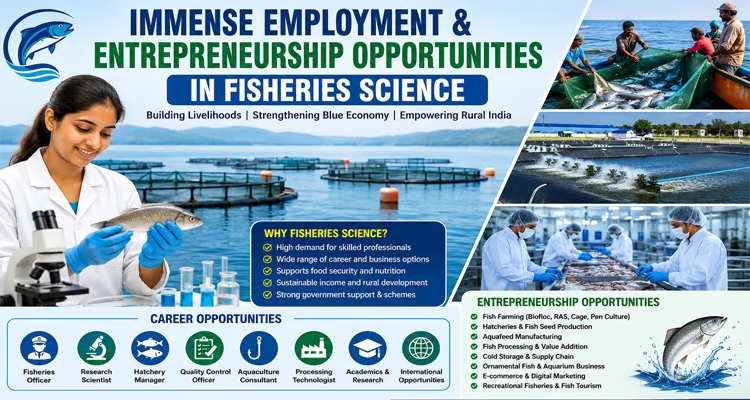
India’s fisheries sector is creating immense opportunities for employment and entrepreneurship. Explore careers in Fisheries Science, aquaculture, fish farming, Blue Economy, PMMSY, and emerging technologies driving rural development and economic growth.

India, endowed with an extensive coastline of nearly 7,500 kilometres and an expansive network of rivers, reservoirs, lakes, wetlands, and ponds, possesses immense potential for fisheries and aquaculture. Consequently, the fisheries sector has emerged as one of the most dynamic contributors to the country’s economy. Over the past decade, India has witnessed remarkable growth in fish production, aquaculture, processing, value addition, and seafood exports. Today, India ranks among the world’s leading fish-producing nations and is one of the largest producers of aquaculture products. After agriculture, the fisheries sector has become one of the most important sources of livelihood in rural India. In this rapidly evolving scenario, Fisheries Science offers immense opportunities for employment, self-employment, innovation, and entrepreneurship.
Fisheries Science is far more than the study of fish farming. It is a multidisciplinary field that integrates aquatic biology, ecology, environmental science, nutrition, biotechnology, engineering, and modern production technologies. The discipline encompasses water and soil quality assessment, fish seed production, breeding and culture of finfish, shrimp, and other aquatic organisms, fish nutrition, aquatic animal health and disease management, fisheries genetics, biodiversity conservation, reservoir management, sustainable fishing technologies, fishing gear and vessel design, fish processing, quality assurance, cold-chain management, packaging, value-added seafood production, marketing, and international trade. As the fisheries value chain continues to expand, the demand for professionally trained fisheries graduates is increasing steadily.
Graduates in Fisheries Science enjoy diverse career opportunities in both the public and private sectors. Employment avenues include State Fisheries Departments, institutions under the Indian Council of Agricultural Research (ICAR), fisheries and agricultural universities and colleges, research laboratories, fisheries development corporations, seafood processing industries, export companies, multinational organizations, and environmental consulting firms. Career options include Fisheries Development Officer, Fisheries Inspector, Scientist, Research Officer, Hatchery Manager, Quality Control Officer, Aquaculture Consultant, Fish Health Specialist, Processing Technologist, Project Manager, and faculty positions in universities and colleges. Opportunities also exist in research projects, competitive examinations, and international organizations working in fisheries, aquaculture, food security, and sustainable resource management.
The scope for self-employment and entrepreneurship in Fisheries Science has expanded significantly with advances in aquaculture technologies. Scientific innovations have made profitable fish farming possible even on limited land and with restricted water resources. Technologies such as Biofloc systems, Recirculating Aquaculture Systems (RAS), cage culture, pen culture, shrimp farming, integrated fish farming, ornamental fish culture, and rice-fish farming have transformed aquaculture into a highly profitable enterprise. By integrating fisheries with conventional agriculture, rural youth can substantially enhance their income while promoting sustainable farming practices.
The fisheries sector has also given rise to numerous allied industries that offer attractive entrepreneurial opportunities. These include fish seed production, hatchery management, aquafeed manufacturing, fishing nets and equipment production, aquarium design and maintenance, aquatic animal healthcare products, seafood processing, cold storage and refrigerated transportation, e-commerce and digital seafood marketing, value-added fish products such as fish pickles, fish cutlets, fish powder, fish oil, fish meal, and organic fertilizers prepared from fish waste, as well as recreational fisheries and fish-based tourism. Women’s Self-Help Groups (SHGs) are also playing an increasingly important role in fish processing, packaging, and marketing, thereby contributing to rural livelihoods and women’s economic empowerment.
Recognizing the strategic importance of the sector, the Government of India has identified fisheries as a key pillar of the country’s Blue Economy. Through the Pradhan Mantri Matsya Sampada Yojana (PMMSY), financial assistance, technical support, skill development, institutional credit, and infrastructure development are being provided for hatcheries, Biofloc units, aquaculture farms, fish processing facilities, cold-chain networks, transportation, and marketing. Complementary initiatives such as fisheries insurance, institutional financing, digital marketing platforms, and the promotion of Fisheries Producer Organizations (FPOs) are further strengthening the sector. These interventions aim not only to enhance fish production but also to generate employment, promote entrepreneurship, and improve rural incomes.
Academically, Fisheries Science has evolved into a vibrant professional discipline. Students with a background in Biology or Zoology can pursue undergraduate (B.F.Sc.), postgraduate (M.F.Sc.), doctoral (Ph.D.), and advanced research programmes. Numerous fisheries colleges, agricultural universities, and premier research institutions across India offer quality education, advanced research facilities, industry exposure, and excellent placement opportunities.
Although Madhya Pradesh is a landlocked state, it has emerged as one of India’s leading inland fisheries producers. Its extensive network of rivers, reservoirs, dams, and village ponds provides enormous potential for scientific fish farming and inland aquaculture. With the wider adoption of modern technologies, quality fish seed, scientific management practices, efficient processing, and improved marketing infrastructure, the state can significantly increase fish production while creating thousands of employment and entrepreneurship opportunities for rural youth.
In the context of Atmanirbhar Bharat, sustainable rural development, nutritional security, and the expanding Blue Economy, Fisheries Science is no longer merely an academic discipline; it is a gateway to economic growth, innovation, and livelihood generation. The need of the hour is to encourage more young people to acquire professional training in fisheries, take advantage of government support programmes, establish successful enterprises, and contribute to employment generation. With its vast natural resources, expanding domestic and global markets, and strong policy support, the fisheries sector is poised to become one of the strongest engines of India’s rural prosperity and sustainable economic development in the decades ahead.