
Forced Conversion: Stricter Punishment for Women, Minors and SC/ST Persons
by Ashis Sinha
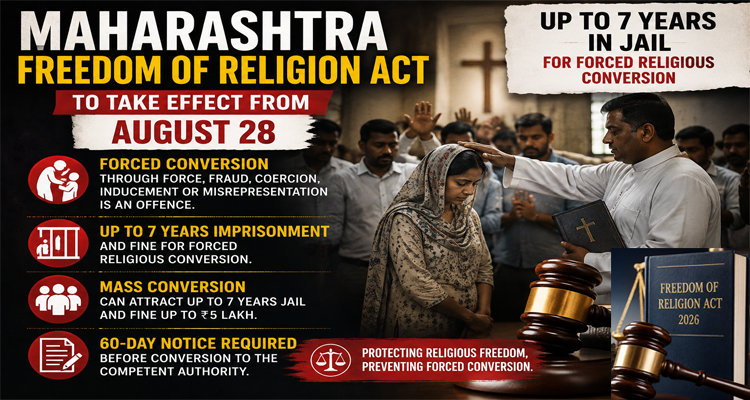
Mumbai: Maharashtra is set to bring its much-debated Maharashtra Freedom of Religion Act, 2026 into force from August 28, introducing stringent legal action against religious conversions allegedly carried out through force, fraud, coercion, inducement, misrepresentation, undue influence or marriage-related deception (Forced Conversion).
The state government has notified August 28 as the commencement date through the Official Gazette, giving effect to legislation passed by the Maharashtra legislature earlier this year.
The law provides for up to seven years of imprisonment in several categories of unlawful conversion cases, along with financial penalties. The punishment can become more severe in cases involving vulnerable persons or repeat offences.
What the New Law Prohibits
The Act targets religious conversions allegedly secured through force, fraud, coercion, misrepresentation, undue influence, inducement or deceit.
It also covers conversions linked to marriage where coercion, deception or inducement is involved. The legislation specifically treats offers such as money, gifts, employment, free education, promises of marriage, a better lifestyle or claims of divine healing as potential forms of “allurement” when used to induce conversion.
The government has maintained that the objective is not to prevent voluntary changes of faith but to curb unlawful conversions and protect individuals who may be vulnerable to coercion or deception.
Up to 7 Years in Jail
Under the Act, unlawful conversion can attract imprisonment of up to seven years and a fine. The punishment is more stringent when the alleged victim is a woman, minor, person of unsound mind, or belongs to the Scheduled Caste or Scheduled Tribe communities.
Mass conversions can also attract a seven-year jail term and a fine of up to ₹5 lakh. Repeat offenders face an even tougher provision, with imprisonment that can extend to 10 years.
Thus, while the seven-year punishment is a major feature of the law, 10 years is the maximum imprisonment applicable in certain repeat-offence situations.
Maharashtra’s new Freedom of Religion Act, 2026 will come into force on 28 August 2026.
The law prohibits religious conversion through force, fraud, coercion, allurement, undue influence or deceit.
It also provides for:
• 60 days’ prior notice for voluntary conversion
•… pic.twitter.com/tdnYANbLKk— Mumbai Heritage (@mumbaiheritage) August 18, 2026
60-Day Notice Before Conversion
One of the most significant provisions is the mandatory notice mechanism.
A person intending to change religion, as well as the individual or organisation conducting the conversion ceremony, is required to submit a notice at least 60 days in advance to the competent authority, generally the District Magistrate or an authorised officer.
The proposed conversion details can then be publicly displayed, allowing objections to be raised. Following conversion, declarations are also required within the prescribed period.
Family Members Can Lodge Complaints
The legislation also widens the scope for complaints. Parents, siblings and certain relatives of the person allegedly subjected to unlawful conversion can approach the police.
Offences under the Act are treated as cognisable and non-bailable, with investigations to be conducted by a police officer of the prescribed rank. The law also places the burden of establishing that a conversion was lawful on the person accused of causing, assisting or facilitating the conversion.
Controversy Already Surrounds the Law
The Act has triggered a political and legal debate even before its full implementation.
Critics, including civil-society groups and Christian organisations, have raised concerns that the broad definitions and complaint provisions could be misused against consensual interfaith relationships and voluntary religious choices. Supporters, meanwhile, argue that the legislation is necessary to prevent coercive and fraudulent conversion practices and protect vulnerable people.
The debate is likely to intensify as the law moves from legislation to enforcement.
Interestingly, Pune police had registered two cases citing provisions of the new Act earlier this month, but subsequently dropped those provisions because the law had not yet formally come into force. The development underlines the importance of August 28 as the date from which the statute will become operational across Maharashtra.
Maharashtra Joins States With Anti-Conversion Laws
With the new legislation, Maharashtra joins a growing group of Indian states that have enacted laws regulating religious conversions. The Maharashtra law broadly follows the approach adopted by several states, while introducing its own procedural requirements concerning prior notice, objections, declarations and complaints.
The government says the Act seeks to balance the constitutional freedom of religion with safeguards against forced or fraudulent conversion. Critics, however, are expected to scrutinise its implementation closely, particularly its impact on individual choice, interfaith marriages and religious freedom.
From August 28, Maharashtra will therefore enter a new legal phase on religious conversion—with a seven-year prison threat hanging over several categories of alleged unlawful conversion and even tougher consequences for repeat offenders.